Honda Super Cub C100: transport that fits a day
A small engine made sense within a design that changed several everyday tasks.
A short trip can ask more of a machine than its maximum speed suggests. A rider may stop repeatedly, have to get on and off in ordinary clothes, and still need somewhere they can ask for service. The Super Cub C100 makes those small demands visible. Honda launched the model in Japan in 1958. The Science Museum Group preserves a basic C100 made in 1965, a later example of the same model line. [1][2]
Look low between the seat and front shield. That open route for a leg, together with the shield and a clutch that did not need a hand lever, is a better introduction to the small motorcycle than the number stamped into its model name. [1]
← Explore Motorcycles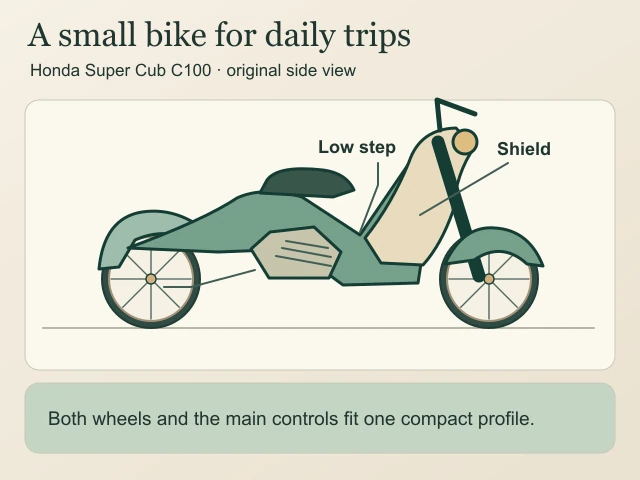
Original side profile illustrating C100 design features, not a photograph, exact paint scheme or reconstruction of the museum’s 1965 specimen.
Original Manthoryn educational illustration · CC BY 4.0. CC BY 4.0 ↗ · Image source ↗
A few details change the picture.
Start with getting aboard
The low section of the frame lets a person step through instead of swinging a leg high across the seat. The broad shields put material between the rider’s legs and some spray from the road. Neither feature adds engine power. Both affect whether the machine fits an ordinary repeated trip. The side profile shows these parts together and keeps both wheels visible. [1][2]
One less control, with gears still present
A clutch connects the engine to the drive. In the C100, a centrifugal mechanism can engage the drive as engine speed rises, handling the engagement without a manual clutch lever. That does not make it a gearless machine. Honda describes a three-speed transmission. Put those details together and you can see a deliberate change in the coordination the rider has to perform, not a claim that balance or judgment no longer matters. [1][3]
A daily vehicle includes service
Honda’s own account describes efforts to recruit local sellers who could help after a sale, including people who had not previously sold motorcycles. That is the manufacturer’s recollection, not a claim that every owner could obtain convenient repairs. It does explain what the company considered part of making the vehicle useful: a machine’s work does not stop when it leaves the factory. [1]
Distinguish an example from the whole family
A 1965 C100 is not an August 1958 specimen. Later Super Cubs could have different engines or details. Keep model, year and use separate when comparing photographs. The original drawing highlights the open step, shield and small engine of the C100 type. It does not identify an individual serial number or an exact paint finish. [2][3]
Keep a little curiosity.
Enjoying a discovery is enough. These optional questions may become a deeper investigation.
Which transport designs remove a repeated task without removing the rider’s choices?
This is a design comparison across ordinary journeys, not a riding lesson or model recommendation.
A complete CEL answer is not published yet.
Plant a Seed for this question →Sources & image notes.
Facts are tied to the references below. This is a source-checked editorial discovery, rather than an assessment or a claim of independent expert review.
- Quality Products Have No International Boundaries ↗
Honda Global Heritage. C100 original August 1958 launch, low frame, leg shields, three speeds and automatic centrifugal clutch. Honda dealer history is attributed to the manufacturer.
Checked 2026-11-17. - Honda C100 motorcycle, 1965 ↗
Science Museum Group. Identifies this exact 1965 collection object as a basic C100, part of the line launched in Japan in 1958 and introduced to the UK in 1962.
Checked 2026-11-17. - The Invention of the Super Cub ↗
Honda 75 Years of History. Early C100 wheel and engine choices; distinguishes later C65 and C50 developments.
Checked 2026-11-17.
Image provenance and modifications
Some collection cards show a labelled detail crop. The full image above retains its source framing.
Illustration
Original side profile illustrating C100 design features, not a photograph, exact paint scheme or reconstruction of the museum’s 1965 specimen.
Original Manthoryn educational illustration · CC BY 4.0.
Creator/publisher: Original Manthoryn educational illustration / Manthoryn.
Source record · Original image · Original Manthoryn educational illustration, CC BY 4.0 International. No third-party photo or illustration was reproduced.
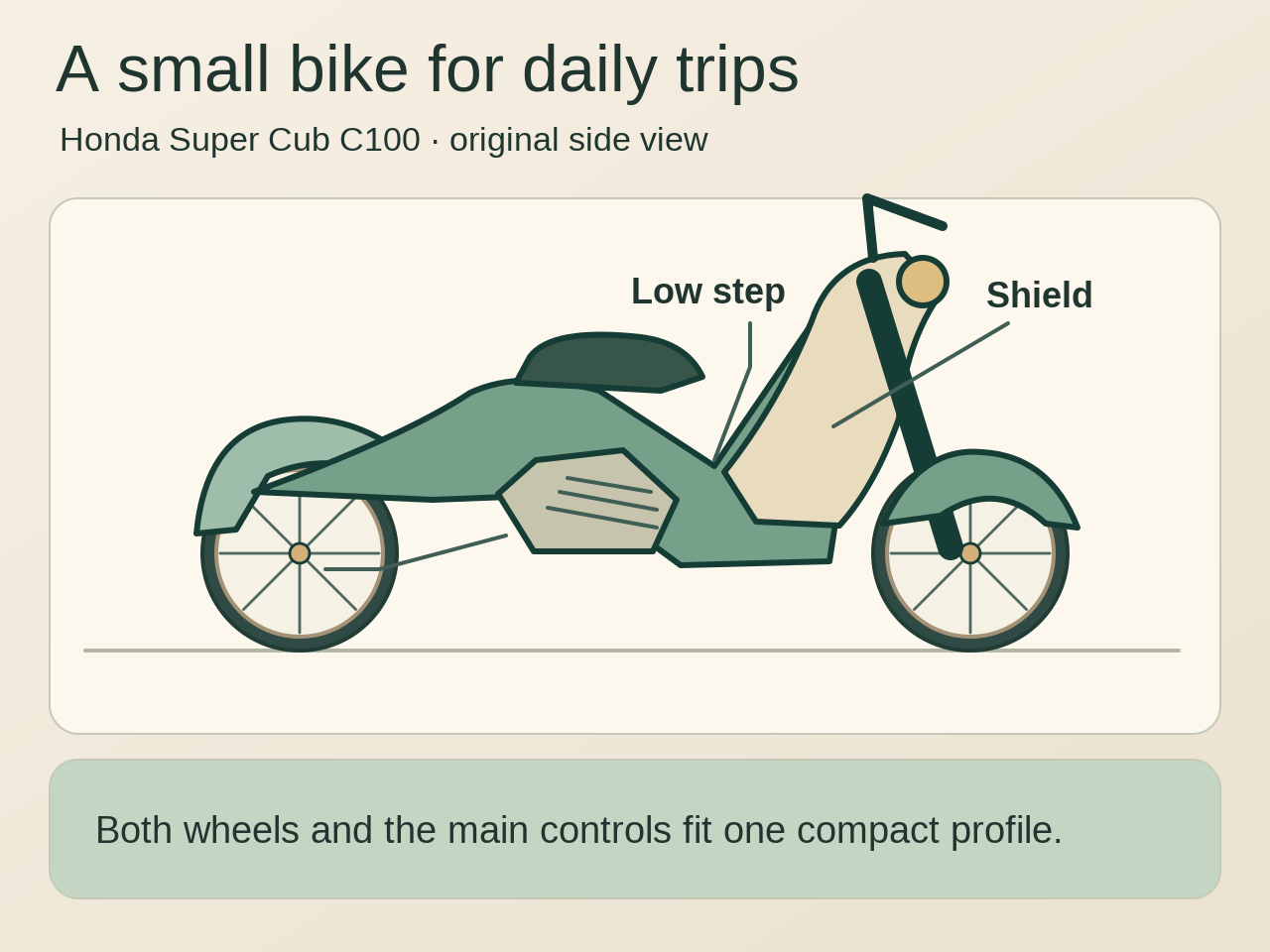
Changes: Created as an original SVG, then proportionally rasterized to WebP at two widths without cropping.
Rights/source metadata checked 2026-11-17. Images identify the object or work; factual claims rely on the editorial references.
Discovery entry.ce3-machines-honda-super-cub-c100 · revision 1.0.0. Raise a content or image concern →. This prepares a local note; no report is delivered.