A documented animation layout sheet
One sheet gives different production teams a shared frame of reference.
Studio Ghibli’s official illustrated guide to layout, credited GORO, shows paper with a printed frame and examples of extended layouts for moving views. A layout can carry how a shot is framed, where the subject and setting belong, and how the camera may move. It gives the background and animation teams a shared picture before their drawings are assembled. [1][2]
The Academy Museum lists original layouts separately from storyboards, backgrounds and cels in its exhibition on Hayao Miyazaki. The differences matter. One kind of record can show how successive shots tell a story, another how several contributions to a particular shot fit together. [3][1]
← Explore Anime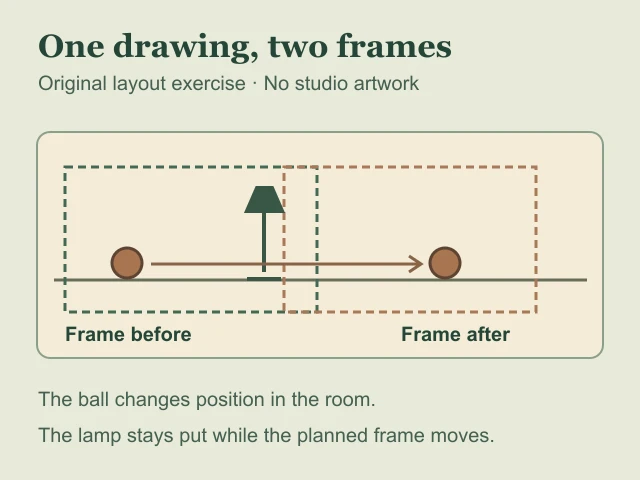
Original layout exercise using a ball and a lamp. It illustrates the concepts discussed in the official guide without reproducing its art.
Original Manthoryn educational illustration · CC BY 4.0. CC BY 4.0 ↗ · Image source ↗
A few details change the picture.
Locate the boundaries of the planned shot
The guide depicts a frame on layout paper. That frame tells a team what the camera is expected to include at one point. In a fictional layout of a ball rolling past a lamp, separate marks can show the lamp’s position, the ball’s start and end, and the common boundary. Two sets of drawings can then share where the floor and screen edge are. [1]
Distinguish moving elements and a moving view
Imagine the lamp stays in one place in the depicted room. If the frame follows the ball, the lamp can still move across the screen. Sections 5 and 6 of the guide discuss the position of characters and backgrounds and show why a frame movement may require a wider or taller drawing. A spatial change can enter from several places in production. [1][2]
Identify which team will use the marks
An animator may need the path of the ball. A background artist needs the stable locations of nearby objects. The guide’s production sequence places layout after the larger sequence has been planned. Later work resolves details the layout leaves open. Different productions can use different tools and practices; this is one documented workflow. [1][3]
Try a different path without changing the room
In the invented lamp example, draw a fixed frame and a moving one. Place the ball at the same two positions in the room in both versions. Describe how each would look to a viewer and which production instructions would differ. This exercise is built from geometric shapes and does not copy an exhibit piece or a named character. [1]
Keep a little curiosity.
Enjoying a discovery is enough. These optional questions may become a deeper investigation.
What does the background artist need to know if the character stays centered while the camera follows them?
Use the original geometric example. The exact workflow can vary with the production.
A complete CEL answer is not published yet.
Plant a Seed for this question →Sources & image notes.
Facts are tied to the references below. This is a source-checked editorial discovery, rather than an assessment or a claim of independent expert review.
- What Is an Animation Layout? (Japanese teaching sheet) ↗
GORO, Studio Ghibli layout exhibition. Primary studio guide, steps 2 and 5–8, layout paper, frame and movement examples. Japanese technical wording reviewed and paraphrased.
Checked 2026-11-17. - Studio Ghibli Layout Exhibition ↗
Studio Ghibli. Official exhibition context describes layout as a plan for movement, background and camera for a shot.
Checked 2026-11-17. - Hayao Miyazaki exhibition ↗
Academy Museum of Motion Pictures. Archive objects loaned by Studio Ghibli, including the distinct class of production layouts.
Checked 2026-11-17.
Image provenance and modifications
Some collection cards show a labelled detail crop. The full image above retains its source framing.
Illustration
Original layout exercise using a ball and a lamp. It illustrates the concepts discussed in the official guide without reproducing its art.
Original Manthoryn educational illustration · CC BY 4.0.
Creator/publisher: Original Manthoryn educational illustration / Manthoryn.
Source record · Original image · Original Manthoryn illustration, CC BY 4.0. No third-party art or recorded media reproduced.
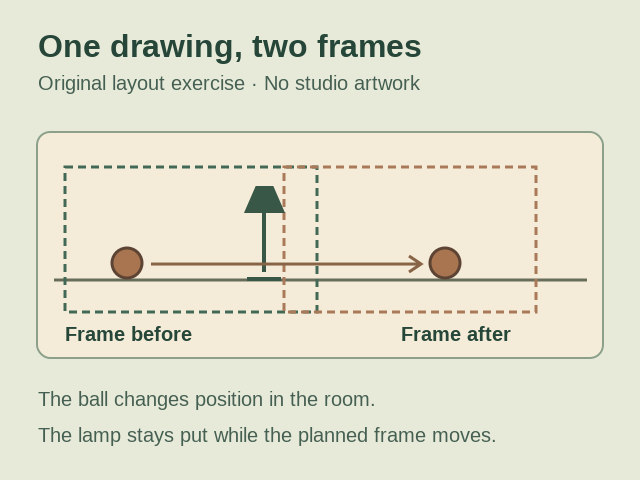
Changes: Rasterized to two full-frame WebP widths.
Rights/source metadata checked 2026-11-17. Images identify the object or work; factual claims rely on the editorial references.
Discovery entry.ce3-movies-animation-layout · revision 1.0.0. Raise a content or image concern →. This prepares a local note; no report is delivered.