Pepper’s Ghost
Transmitted scenery and a reflected image meet in the same view.
In the stage illusion called Pepper’s Ghost, an audience can see a room and a figure that appears to occupy the same space. The scenery is seen through a sheet of transparent material. A second light path reflects an illuminated source so its image seems to be inside the visible scene. [1][3]
The University of London’s record connects Henry Dircks and John Henry Pepper to the technique. Pepper’s own historical account documents a stage use and the role of reflection. A modern optical model explains what an observer sees without treating the reflected figure as a projected solid object. [1][2][3]
← Explore Special Effects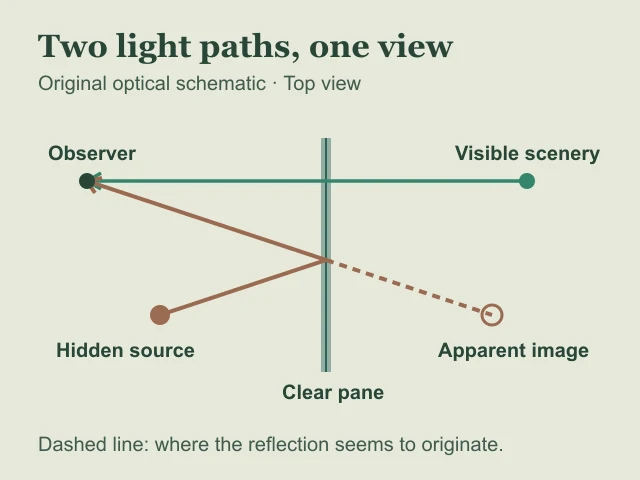
Original ray sketch. The dashed line marks apparent origin. It gives no practical stage-installation or equipment guidance.
Original Manthoryn educational illustration · CC BY 4.0. CC BY 4.0 ↗ · Image source ↗
A few details change the picture.
Follow light from the stage and light from the hidden source
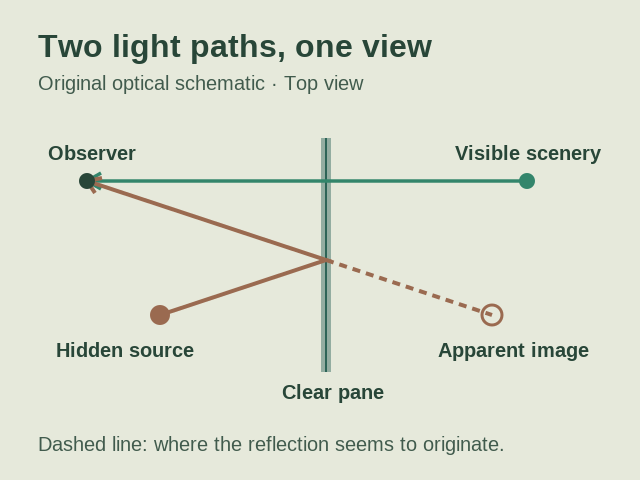
Light from visible scenery can pass through the transparent surface toward the audience. Light from a source outside the direct view can reflect toward that same audience. When both contributions are visible, their images can appear to share a scene. The two light paths are different even when they arrive together. [1][3]
Extend the reflected ray back in the direction it seems to come from
In the plane-reflection model, rays spread toward the viewer as if they came from a location behind the reflecting surface. The real rays did not pass through that apparent location. An original diagram distinguishes observed rays from an extended dashed construction line. The extension helps locate a virtual image. [3]
Ask why the figure can appear and fade
If the reflected contribution is faint compared with the scenery, the viewer may see little of the figure. Changing that contribution can make the figure more or less apparent without a new physical person entering the visible scene. Viewing position and multiple reflections complicate what an actual audience member sees. [1][2][3]
Distinguish the theatrical effect from a technology label
A scene can place the reflected figure in relation to a doorway or a person to create the impression of an encounter. The optical account is an explanation of reflection and transmission, separate from holography. The qualitative diagram leaves out the hardware, stage geometry, alignment and safety decisions of a real installation. [2][3]
Keep a little curiosity.
Enjoying a discovery is enough. These optional questions may become a deeper investigation.
How would a diagram distinguish the place a reflected figure seems to be from the place its light actually came from?
Trace the different lines for observed and virtual paths in the drawing. No live experiment or build is required.
A complete CEL answer is not published yet.
Plant a Seed for this question →Sources & image notes.
Facts are tied to the references below. This is a source-checked editorial discovery, rather than an assessment or a claim of independent expert review.
- The True History of the Ghost; and all about Metempsychosis ↗
University of London, Digital Galleries. Historical catalogue, attribution to Dircks alongside Pepper, and stage reflection through glass.
Checked 2026-11-17. - The True History of the Ghost ↗
John Henry Pepper, 1890; Wellcome Collection. Historical apparatus and presentation account. No dimensions or construction method reproduced.
Checked 2026-11-17. - Images Formed by Plane Mirrors ↗
OpenStax, University Physics Volume 3. Qualitative ray extension and formation of a virtual image. The stage adds transmission as described by historical sources.
Checked 2026-11-17.
Image provenance and modifications
Some collection cards show a labelled detail crop. The full image above retains its source framing.
Illustration
Original ray sketch. The dashed line marks apparent origin. It gives no practical stage-installation or equipment guidance.
Original Manthoryn educational illustration · CC BY 4.0.
Creator/publisher: Original Manthoryn educational illustration / Manthoryn.
Source record · Original image · Original Manthoryn illustration, CC BY 4.0. No third-party art or recorded media reproduced.
Changes: Rasterized to two full-frame WebP widths.
Rights/source metadata checked 2026-11-17. Images identify the object or work; factual claims rely on the editorial references.
Discovery entry.ce3-movies-peppers-ghost · revision 1.0.0. Raise a content or image concern →. This prepares a local note; no report is delivered.