Vera Molnár: a rule leaves room to choose
A machine can repeat an instruction. The artist decides what repetition and change are worth seeing.
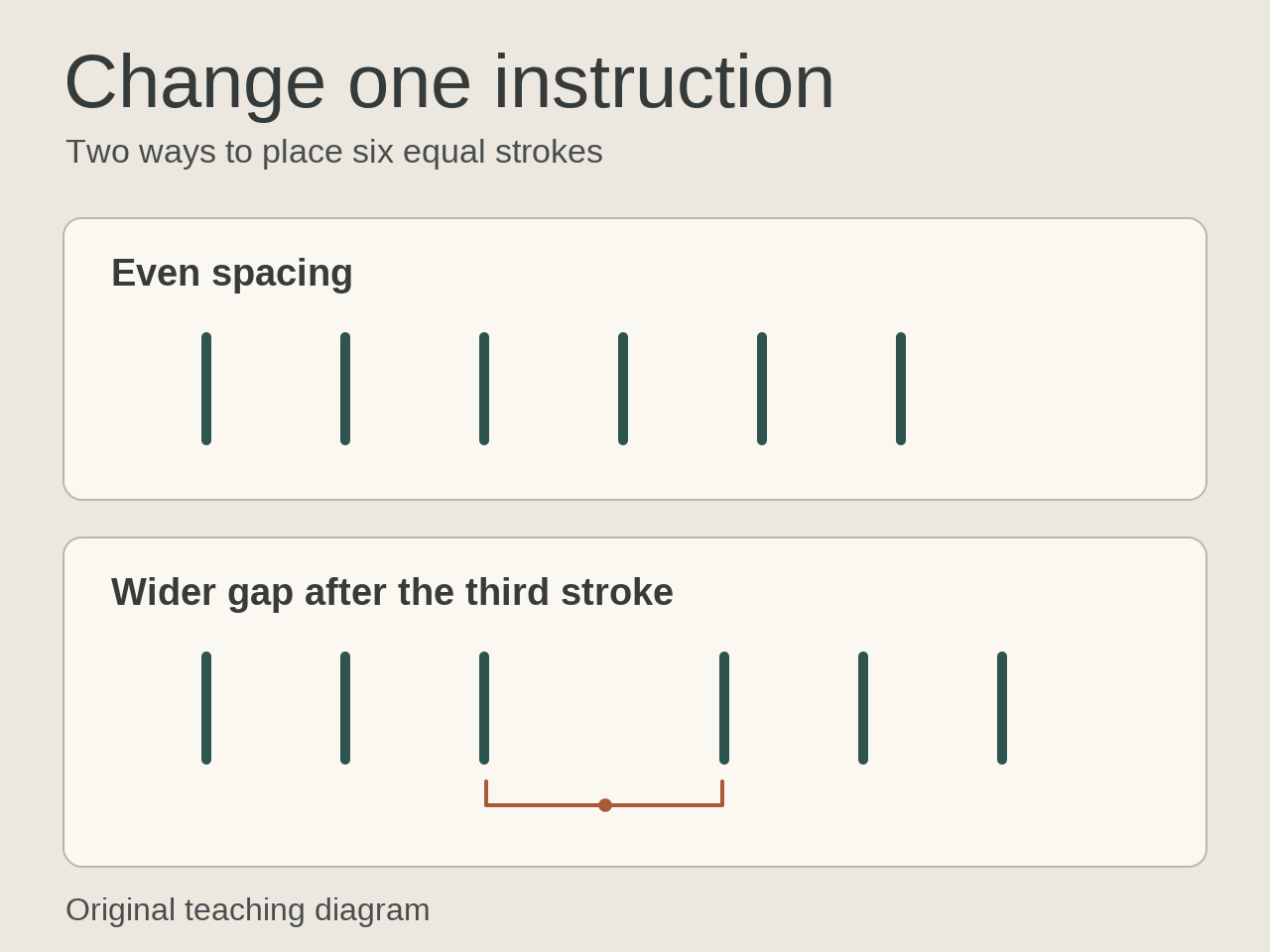
Suppose you ask a pen to draw six strokes of the same height. Now change one instruction: put a wider gap after the third stroke. You can follow the new rule and still choose whether the result feels divided, balanced or unfinished. The rule gives you something you can deliberately vary. It does not decide what to keep. [1][3]
Vera Molnár treated systematic choice as an artistic tool. The V&A holds Interruptions, a plotter drawing from 1969. Its historical machine is a context for the idea, rather than a model for the six strokes in our original teaching illustration. [1][2]
← Explore Creative Technology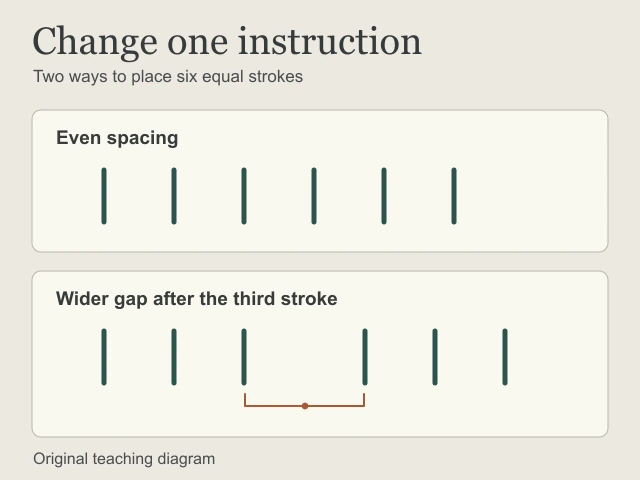
Original six-stroke comparison, not a Molnár work or a copy of her visual language. The changed spacing makes the choice visible.
Original Manthoryn educational illustration · CC BY 4.0. CC BY 4.0 ↗ · Image source ↗
A few details change the picture.
A rule can begin without a computer
The V&A describes Molnár’s imaginary machine as a way to think through instructions before she could give them to a real one. Put that beside the small example. You can draw six equal strokes by hand and compare two spacings. The conceptual commitment is to use a procedure you can repeat and vary. It is not a claim that human hands were absent. [1][3]
A program meets a material
A plotter turns movement data into physical ink lines. The paper and pen contribute qualities that a list of coordinates alone does not show. When a maker moves a rule from drawing by hand to a machine, the effects of the tool become part of what can be chosen or evaluated. This connects the historical object to the procedure without claiming that every mark followed a universal recipe. [1][2]
One large gap changes the relation
The first little pattern here has evenly spaced marks. In the second the two groups have a larger separation while their strokes retain the same lengths. Several choices remain: how many marks, where the gap goes, and whether this version is more interesting. Breaking a pattern is legible when enough of it remains for the viewer to recognize what changed. [3][1]
Keep the artist in view
In the interview, Molnár discusses the work of selecting, altering and evaluating outcomes over time. That makes a rule an instrument rather than a verdict. The old plotter is one moment in that practice, and computational art has many other histories. The six-stroke teaching example reproduces neither her visual language nor the geometry of Interruptions. [3][1][2]
Keep a little curiosity.
Enjoying a discovery is enough. These optional questions may become a deeper investigation.
If a rule gives you ten possible drawings, what criteria might help decide which ones to keep?
A rule can produce related choices. This question asks what the maker and viewers might find valuable in their differences.
A complete CEL answer is not published yet.
Plant a Seed for this question →Sources & image notes.
Facts are tied to the references below. This is a source-checked editorial discovery, rather than an assessment or a claim of independent expert review.
- Digital art ↗
Victoria and Albert Museum. Identifies Molnár’s Interruptions as a 1969 plotter drawing, E.269-2011, and describes her pre-computer protocols and access to computing.
Checked 2026-11-17. - Early pioneers ↗
V&A Research Journal, issue 6. Museum research on Interruptions, physical plotter, machine context and Molnár’s earlier systematic method.
Checked 2026-11-17. - An Interview with Vera Molnar ↗
Vera Molnár in conversation with Zsofi Valyi-Nagy. Artist’s retrospective account of imaginary machine, intentional variation and creative evaluation. No modern AI comparison attributed to the artist.
Checked 2026-11-17.
Image provenance and modifications
Some collection cards show a labelled detail crop. The full image above retains its source framing.
Illustration
Original six-stroke comparison, not a Molnár work or a copy of her visual language. The changed spacing makes the choice visible.
Original Manthoryn educational illustration · CC BY 4.0.
Creator/publisher: Original Manthoryn educational illustration / Manthoryn.
Source record · Original image · Original Manthoryn illustration, CC BY 4.0. No museum image, historic figure or third-party illustration was reproduced.
Changes: Original subject-specific SVG rasterized to two WebP widths without cropping.
Rights/source metadata checked 2026-11-17. Images identify the object or work; factual claims rely on the editorial references.
Discovery entry.ce3-music-arts-molnar-plotter · revision 1.0.0. Raise a content or image concern →. This prepares a local note; no report is delivered.