A Meiji summer robe: a design revealed in motion
A thin fabric, an overlap and a band of color meet on one dated garment.
Spread out, the summer robe shows a mostly quiet field of gray silk with warmer decoration near the edges. Fold it around a person and one front panel covers part of the other. The viewer no longer sees everything at once. That is a central feature of this particular Japanese hito-e, dated by the Met to around the 1870s or 1880s. [1]
It helps to read the robe as both a textile and a garment. The fine silk and gradual colors describe decisions made at the material surface. The overlap explains how those decisions could look different each time the wearer moved. [1][2]
← Explore Fashion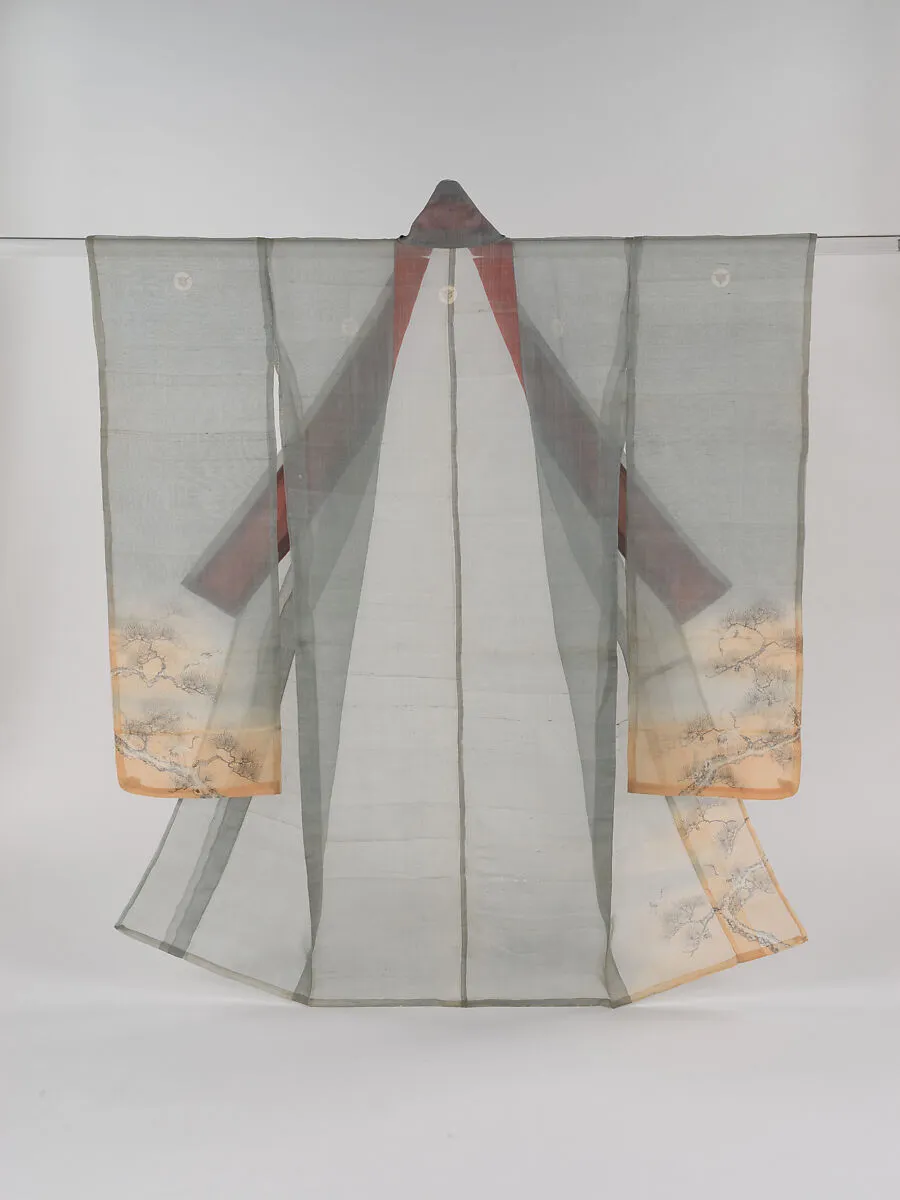
Summer robe (hito-e) with cranes and pines, Japan, ca. 1870–80s. Plain-weave silk with paste-resist dyeing. The Metropolitan Museum of Art, 2023.325a, b. Public Domain.
The Metropolitan Museum of Art, Purchase, Friends of Asian Art Gifts, 2023. Japan, 2023.325a, b. Public Domain (CC0). Public domain / CC0 ↗ · Image source ↗
A few details change the picture.
Look at the weight of the material
The photograph lets you see through parts of the robe where there is less fabric behind them. An unlined garment made of thin silk is a seasonal answer, not a material that represents all kimono. The Met identifies an accompanying white undergarment that would protect the silk in wear. Flat display and dressed appearance tell different parts of the story. [1][2]
Follow the shift in color
Warm patches around the lower sleeves and hem stand out against a much quieter gray field. The museum identifies a controlled gradation produced with paste-resist dyeing, and hand-painted cranes and pines. This is a particular combination of textile skill and picture-making. There is no need to turn the whole object into a single dye technique or claim the print can tell us the dyer’s exact method. [1]
Ask what the overlap changes
The garment wraps with the left panel over the right in ordinary dress. Some richly worked areas could be covered, then briefly revealed while walking. A museum photo with the robe spread out makes the decoration easy to study, while changing the conditions under which it was typically seen. Neither view alone is the complete garment in use. [1][2]
Keep meaning tied to a place and time
The Met associates this pair of motifs with longevity and sees the decoration scheme as carrying ideas from the late Edo period into an early Meiji summer garment. That is narrower than giving every kimono one meaning. The V&A’s broader history follows changing occasions, fabrics and forms. One robe makes those historical differences more visible, because it is a dated object with its own decisions. [1][2][3]
Keep a little curiosity.
Enjoying a discovery is enough. These optional questions may become a deeper investigation.
What changes in your interpretation when you see a garment on a body instead of laid out flat?
This follows a material and display question from one accession, not a universal meaning or dressing instruction.
A complete CEL answer is not published yet.
Plant a Seed for this question →Sources & image notes.
Facts are tied to the references below. This is a source-checked editorial discovery, rather than an assessment or a claim of independent expert review.
- Summer robe (hito-e) with cranes and pines ↗
The Metropolitan Museum of Art, Department of Asian Art. Exact hito-e accession 2023.325a, b, c. 1870–80s, plain-weave silk, paste-resist dyeing, painted pattern, overlap and undergarment. Public Domain image designation.
Checked 2026-11-17. - Kimono ↗
Victoria and Albert Museum. Historical diversity, wrap arrangement, seasonal materials and the crane motif in particular textile contexts.
Checked 2026-11-17. - Kimono: Kyoto to Catwalk ↗
Victoria and Albert Museum. Exhibition’s historical frame of evolving fabric, design and social contexts across a wide range of garments. Not an interpretation of the exact Met accession.
Checked 2026-11-17.
Image provenance and modifications
Some collection cards show a labelled detail crop. The full image above retains its source framing.
Artwork reproduction
Summer robe (hito-e) with cranes and pines, Japan, ca. 1870–80s. Plain-weave silk with paste-resist dyeing. The Metropolitan Museum of Art, 2023.325a, b. Public Domain.
The Metropolitan Museum of Art, Purchase, Friends of Asian Art Gifts, 2023. Japan, 2023.325a, b. Public Domain (CC0).
Creator/publisher: Unidentified Japanese maker; photograph from The Metropolitan Museum of Art / The Metropolitan Museum of Art.
Source record · Original image · The linked exact artwork record marks this museum image Public Domain. The Metropolitan Museum of Art makes its designated public-domain artwork images available under CC0.
Changes: Institutional JPEG retained in the source archive. Full image converted to WebP at two widths without cropping, rotation or recoloring.
Rights/source metadata checked 2026-11-17. Images identify the object or work; factual claims rely on the editorial references.
Discovery entry.ce3-music-arts-meiji-summer-robe · revision 1.0.0. Raise a content or image concern →. This prepares a local note; no report is delivered.