St Paul’s Whispering Gallery: sound near the wall
A whisper can follow a route that an open room would not offer.
Walk around a curved passage and the wall keeps turning back toward you. In the Whispering Gallery of St Paul’s Cathedral, part of a sound launched near the wall can keep following that curve. A listener can therefore hear a small sound at a point that feels surprisingly far away. The effect is an explanation of how sound is distributed, not of how the building makes a voice louder at its source. [1][2]
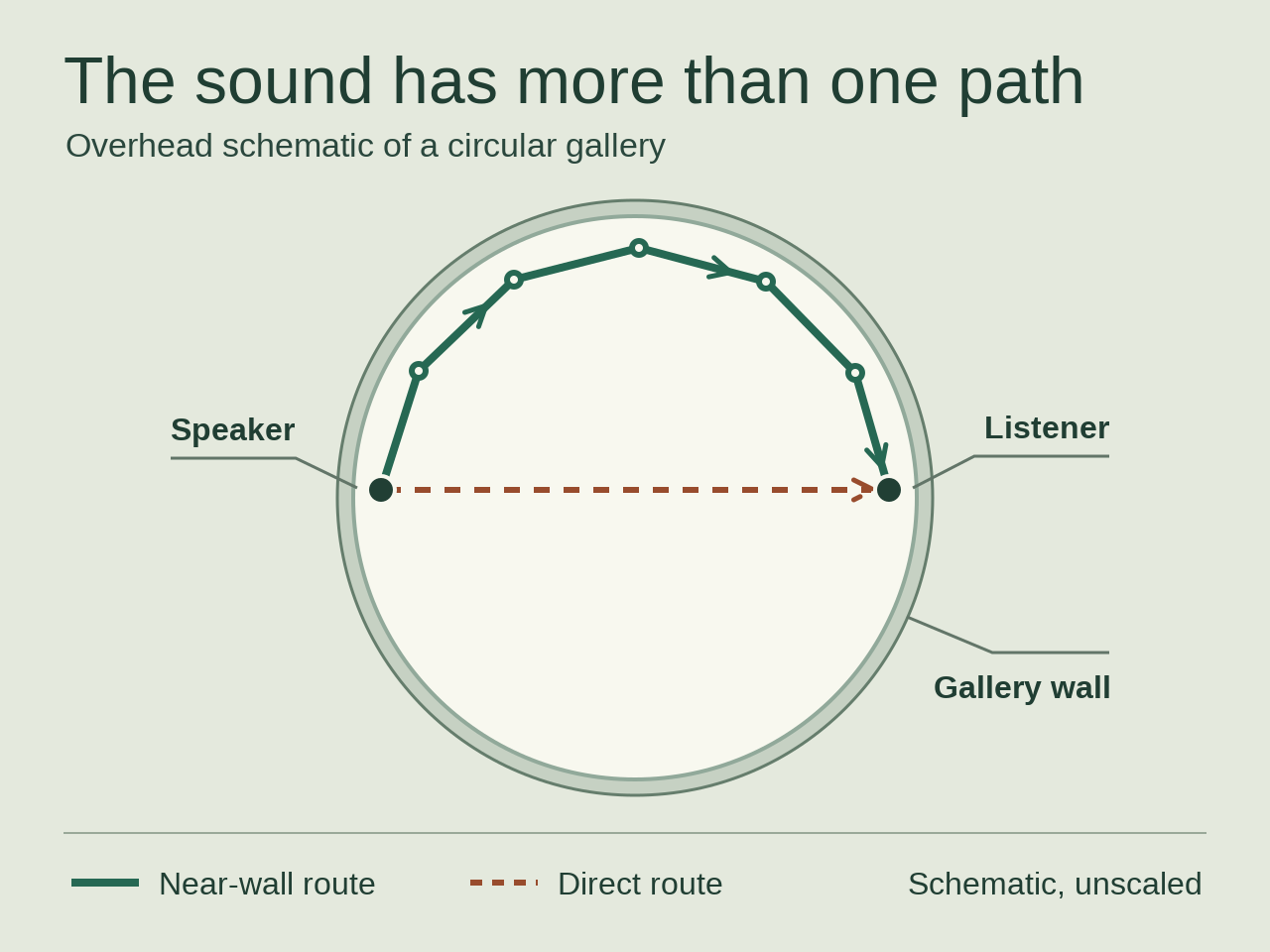
Look down on the gallery in the diagram. One trace represents a route across open space. The other follows the wall around the circle. A source and listener can be connected by several such routes. Their signals can arrive at different times and with different strengths. [1]
← Explore Sound & Acoustics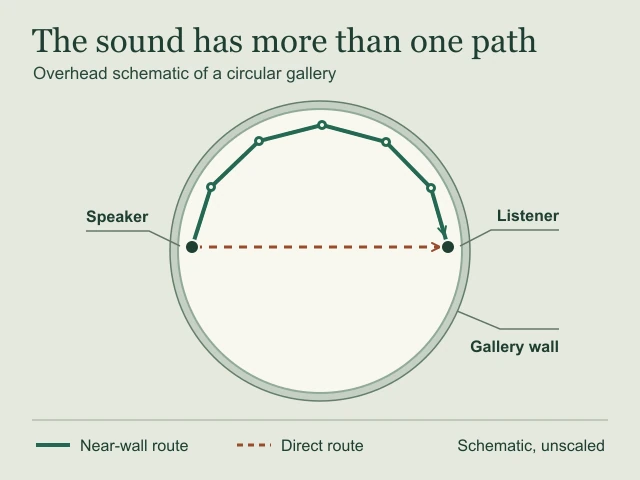
Original sound-path illustration inspired by the St Paul’s measurements. Neither path is measured or drawn to scale.
Original Manthoryn educational illustration · CC BY 4.0. CC BY 4.0 ↗ · Image source ↗
A few details change the picture.
Start with two possible paths
A direct wave leaves the source and spreads into the space. Another portion meets the hard wall at a shallow angle. The reflection can carry that portion toward a neighboring stretch of wall, where the process repeats. A top-down drawing of short segments helps you picture the guided route. Real sound is a wave. The segments are not actual beams you could see in the gallery. [1][2]
Turn the source and compare
The recent study compared source orientations near the curved wall. It found a different balance of later arrivals when the source favored the wall path. That comparison matters because it tests a specific mechanism. If a quiet source always produced the same effect wherever it pointed, it would be harder to explain the measured differences by near-wall guidance. [1]
Not one perfect reflection
Some waves travel around the gallery in different directions. Some take a more direct route. Because their distances differ, sounds can arrive together or separately and portions of waves can reinforce or weaken one another. A place where one listener hears clearly need not tell you what a listener a pace away will hear. The study separates measured arrivals from its explanation of the paths. [1][2]
The real gallery matters
A curved floor plan alone cannot tell you the result. Surface, geometry, sound frequency, background noise and where the sound begins all matter. A resonant room may emphasize certain frequencies, but that is a different question from how sound reaches an ear near the wall. This gallery illustrates both why a sound path can matter and why exact behavior needs evidence from the actual place. [1]
Keep a little curiosity.
Enjoying a discovery is enough. These optional questions may become a deeper investigation.
What does an echo’s timing tell us that its volume alone cannot?
Different paths may contribute to the same measurement. This diagram doesn’t predict audibility at specific locations.
A complete CEL answer is not published yet.
Plant a Seed for this question →Sources & image notes.
Facts are tied to the references below. This is a source-checked editorial discovery, rather than an assessment or a claim of independent expert review.
- Revisiting the Acoustics of St Paul’s Cathedral, London ↗
Acoustics, 2025 field study. Measurement setup, site history, direction-dependent audio impulse responses and interpretation of repeated sound around the gallery.
Checked 2026-11-17. - Whispering-Gallery Phenomena at St. Paul’s Cathedral ↗
Nature, C. V. Raman and G. A. Sutherland, 1921. Historic experiment and the near-wall propagation interpretation originally attributed to Rayleigh.
Checked 2026-11-17.
Image provenance and modifications
Some collection cards show a labelled detail crop. The full image above retains its source framing.
Illustration
Original sound-path illustration inspired by the St Paul’s measurements. Neither path is measured or drawn to scale.
Original Manthoryn educational illustration · CC BY 4.0.
Creator/publisher: Original Manthoryn educational illustration / Manthoryn.
Source record · Original image · Original Manthoryn illustration, CC BY 4.0. No museum image, historic figure or third-party illustration was reproduced.
Changes: Original subject-specific SVG rasterized to two WebP widths without cropping.
Rights/source metadata checked 2026-11-17. Images identify the object or work; factual claims rely on the editorial references.
Discovery entry.ce3-music-arts-whispering-gallery · revision 1.0.0. Raise a content or image concern →. This prepares a local note; no report is delivered.