How a rufous hummingbird holds its place in the air
A bird can stay at the same height while its wings and the surrounding air keep moving.
A rufous hummingbird pauses in front of a flower. From a distance its body seems almost still. Air continues to move past and below it, and the wings have to sustain the bird through each beat. In one experiment, scientists looked at the patterns the wings left behind in the air to see how much of the work happened in each half of a stroke. [1]
← Explore Animals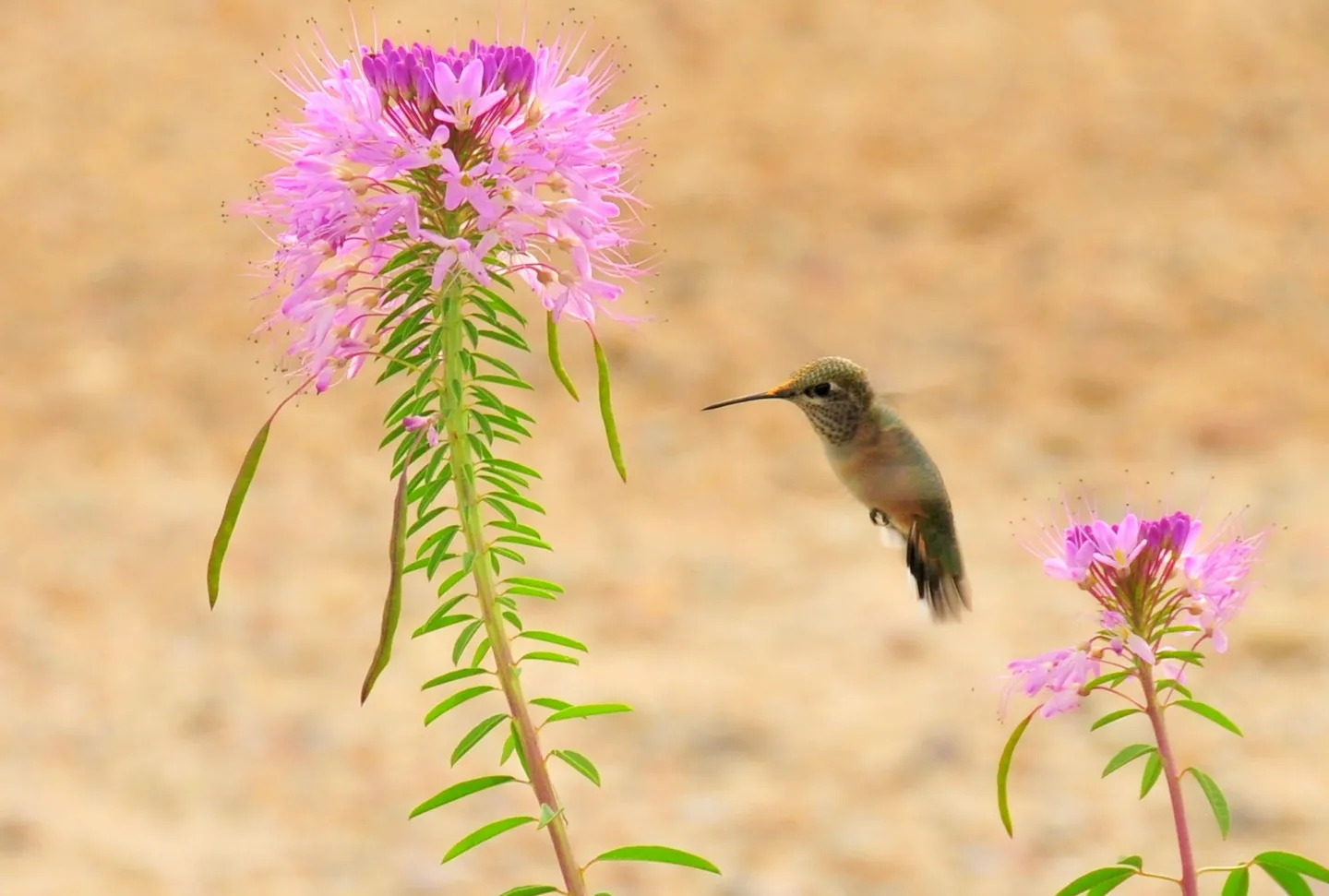
Rufous hummingbird feeding at a Rocky Mountain beeplant, Seedskadee National Wildlife Refuge. This wild observation is separate from the laboratory flight study.
Tom Koerner / USFWS Mountain-Prairie. Original release CC BY 2.0. CC BY 2.0 ↗ · Image source ↗
A few details change the picture.
Hovering takes an average upward force
Hold a hand above a table and notice that the hand itself can be still while your muscles keep working. A hovering bird also keeps its body at roughly the same height while producing an upward force. Across complete wingbeats that average force has to balance weight. Within each beat, the force can vary. The bird sends momentum down into the surrounding air as it creates lift. [1]
Read what the wing leaves behind
The researchers used visible tracer particles to estimate the movement of air in the wake. With the timings of the wing strokes, those measurements let them ask when the bird generated weight support. They found meaningful contributions on both halves of the stroke, with the larger share on the downstroke. Someone watching only the body could easily miss that distinction. [1]
Two strokes can share the work unequally
The wing reverses its sweep and changes orientation as it returns. Its ability to help support the bird on the upstroke is part of what makes the repeated motion distinctive. The experiment compared the way the bird uses its wings to familiar models of insect hovering. Similar visible outcomes need not imply that both halves of each stroke work in the same way. [1]
Keep the result attached to the test
The fraction is an estimate for these birds under these test conditions. It is a division of weight support, separate from how long each stroke lasted or how much energy the muscles used. A different flight direction or species may change the balance. To learn what changes during a sideways maneuver, we would need measurements of that maneuver. [1]
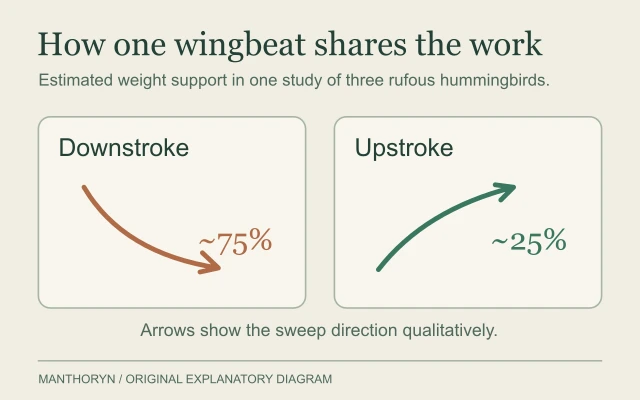
Original diagram of the reported contribution in one hovering study. Stroke arcs are qualitative and are not a trace of an individual bird.
Original Manthoryn educational illustration · CC BY 4.0. Image rights ↗ · Image source ↗
Keep a little curiosity.
Enjoying a discovery is enough. These optional questions may become a deeper investigation.
How could you tell whether both wings contribute equally when the bird hovers in a crosswind?
A new measurement would be needed to connect this particular hovering observation to crosswind responses.
A complete CEL answer is not published yet.
Plant a Seed for this question →Sources & image notes.
Facts are tied to the references below. This is a source-checked editorial discovery, rather than an assessment or a claim of independent expert review.
- Aerodynamics of the hovering hummingbird ↗
Douglas Warrick, Bret Tobalske and Donald Powers, Nature. Exact species, sample size, digital particle image velocimetry, observed asymmetry and comparison with insect hovering.
Checked 2026-11-17.
Image provenance and modifications
Some collection cards show a labelled detail crop. The full image above retains its source framing.
Photograph
Rufous hummingbird feeding at a Rocky Mountain beeplant, Seedskadee National Wildlife Refuge. This wild observation is separate from the laboratory flight study.
Tom Koerner / USFWS Mountain-Prairie. Original release CC BY 2.0.
Creator/publisher: Tom Koerner / U.S. Fish and Wildlife Service / U.S. Fish and Wildlife Service, Mountain-Prairie Region.
Source record · Original image · Exact USFWS-origin photograph has documented CC BY 2.0 release. The asset record also identifies it as a U.S. government work.


Changes: Original photographic frame preserved in both proportional WebP derivatives. No cropping or alteration of the depicted subject.
Rights/source metadata checked 2026-11-17. Images identify the object or work; factual claims rely on the editorial references.
Illustration
Original diagram of the reported contribution in one hovering study. Stroke arcs are qualitative and are not a trace of an individual bird.
Original Manthoryn educational illustration · CC BY 4.0.
Creator/publisher: Original Manthoryn educational illustration / Manthoryn.
Source record · Original image · Original Manthoryn educational illustration, CC BY 4.0 International.
Changes: Original vector artwork proportionally rasterized at two widths.
Rights/source metadata checked 2026-11-17. Images identify the object or work; factual claims rely on the editorial references.
Discovery entry.ce3-nature-rufous-hummingbird · revision 1.0.0. Raise a content or image concern →. This prepares a local note; no report is delivered.