What a honeybee’s waggle can tell another bee
The direction of one stretch on a vertical comb can point to a direction outside the hive.
On a vertical comb, a western honeybee runs through a short straight stretch and swings her abdomen. She loops back and repeats it. A bee that follows those runs has no view of the feeder outside. The relation between the run and the upward direction can carry information about which way to fly relative to the sun. [1][2]
← Explore Insects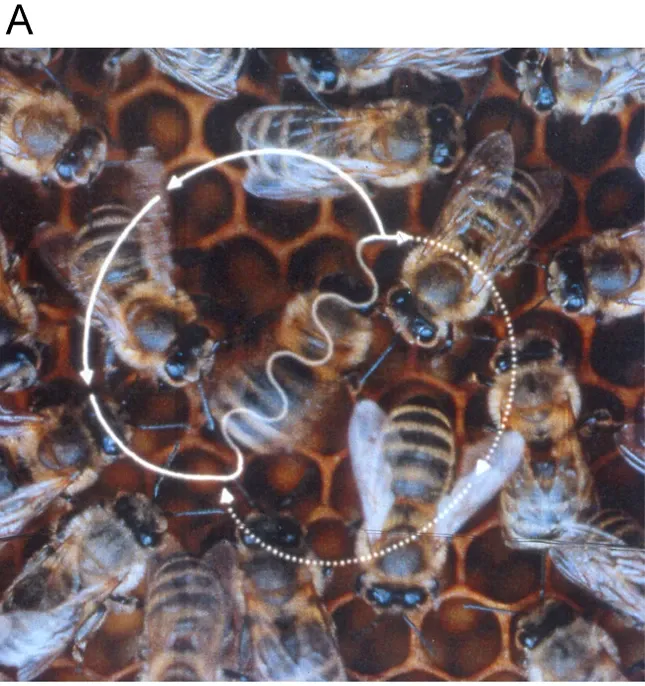
Photographic panel A with its original path overlay, from the published example of the Apis mellifera waggle dance.
J. Tautz and M. Kleinhenz, Beegroup Würzburg. Figure 1A in Chittka, PLOS Biology (2004). CC BY 2.5. CC BY 2.5 ↗ · Image source ↗
A few details change the picture.
Up inside the hive, toward the sun outside
Picture an upward reference line on the comb and a sunward flight reference outside. A run tilted to one side of the vertical line can correspond to a flight direction offset toward the same side of the sun line. These are two different spaces. The illustration places them side by side so the shared angle is easier to compare. [1]
A duration can carry distance information
A longer waggle phase generally corresponds to a greater flight distance in the system the researchers describe. Changes in visual surroundings can also influence a bee’s experience of how far it has flown. A longer run is therefore not a human-scale ruler with the same calibration everywhere. The angle and duration give a visiting bee different pieces of information. [1]
Look for a response outside the hive
A viewer can see the dancer and describe the movement. To test what a recipient uses, a study tracked the flight paths of bees recruited by a dance. Their initial flight paths broadly matched the direction indicated by the signal. They could then search near the expected area. A record of flight closes part of the gap between the observed movement and its possible use. [2]
Arrival can involve more than one cue
Odor and information about where bees have found food before can have a role as well. The dance offers useful guidance even when it does not pinpoint one flower. Researchers can ask what changes under different landscape, food or experience conditions. This example concerns a named bee species and a documented behavior rather than a general description of all bees. [2][3]
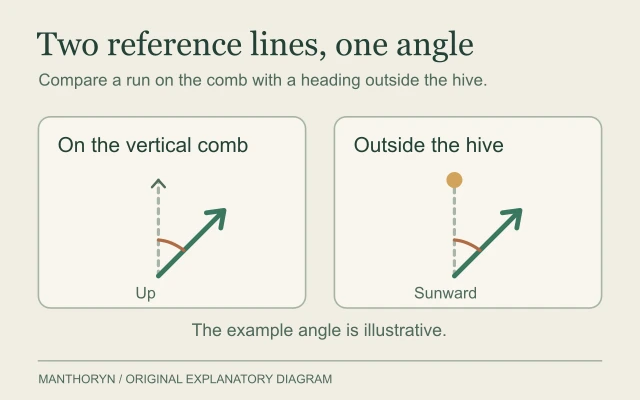
Original direction comparison. The marks show an illustrative angle rather than a measured dance or actual flight track.
Original Manthoryn educational illustration · CC BY 4.0. Image rights ↗ · Image source ↗
Keep a little curiosity.
Enjoying a discovery is enough. These optional questions may become a deeper investigation.
How could you tell whether a bee’s first turn came from a dance or from a route it already knew?
This is a question about comparing cues, not a claim that any one cue controls every trip.
A complete CEL answer is not published yet.
Plant a Seed for this question →Sources & image notes.
Facts are tied to the references below. This is a source-checked editorial discovery, rather than an assessment or a claim of independent expert review.
- Dances as Windows into Insect Perception ↗
Lars Chittka, PLOS Biology. Exact species, angle and duration, illustrative photographic figure and environmental interpretation.
Checked 2026-11-17. - The flight paths of honeybees recruited by the waggle dance ↗
J. R. Riley and colleagues, Nature. Harmonic radar and observed flight inferred from recruitment behavior.
Checked 2026-11-17. - Informational conflicts created by the waggle dance ↗
Royal Society primary behavioral study. Movement, food odor and prior experience as potentially competing information sources.
Checked 2026-11-17.
Image provenance and modifications
Some collection cards show a labelled detail crop. The full image above retains its source framing.
Photograph
Photographic panel A with its original path overlay, from the published example of the Apis mellifera waggle dance.
J. Tautz and M. Kleinhenz, Beegroup Würzburg. Figure 1A in Chittka, PLOS Biology (2004). CC BY 2.5.
Creator/publisher: J. Tautz and M. Kleinhenz, Beegroup Würzburg (figure design) / PLOS Biology, figure published by Lars Chittka.
Source record · Original image · The original open PLOS Biology figure’s exact photographic panel carries CC BY 2.5, confirmed in the linked Commons panel record.
Changes: Extracted panel A from the published two-panel image, preserving its A label, entire photographic frame and source path overlay. Full two-panel original remains linked.
Rights/source metadata checked 2026-11-17. Images identify the object or work; factual claims rely on the editorial references.
Illustration
Original direction comparison. The marks show an illustrative angle rather than a measured dance or actual flight track.
Original Manthoryn educational illustration · CC BY 4.0.
Creator/publisher: Original Manthoryn educational illustration / Manthoryn.
Source record · Original image · Original Manthoryn educational illustration, CC BY 4.0 International.
Changes: Original vector artwork proportionally rasterized at two widths.
Rights/source metadata checked 2026-11-17. Images identify the object or work; factual claims rely on the editorial references.
Discovery entry.ce3-nature-honeybee-dance · revision 1.0.0. Raise a content or image concern →. This prepares a local note; no report is delivered.