Giant Pacific octopus
Arms that gather information while they reach.
A giant Pacific octopus does not explore only with its eyes. Its eight flexible arms bring a surface within reach, and its suckers help it hold objects while sensing what it encounters. The animal is Enteroctopus dofleini, a coastal Pacific octopus—not a generic picture of every octopus species. [1]
How do arms and suckers help it explore its surroundings? They combine movement, contact and chemical information. A sucker is useful both because it can attach and because contact can reveal more than a distant view. That combination matters to an animal searching a complicated seafloor for food. [3]
← Explore Oceans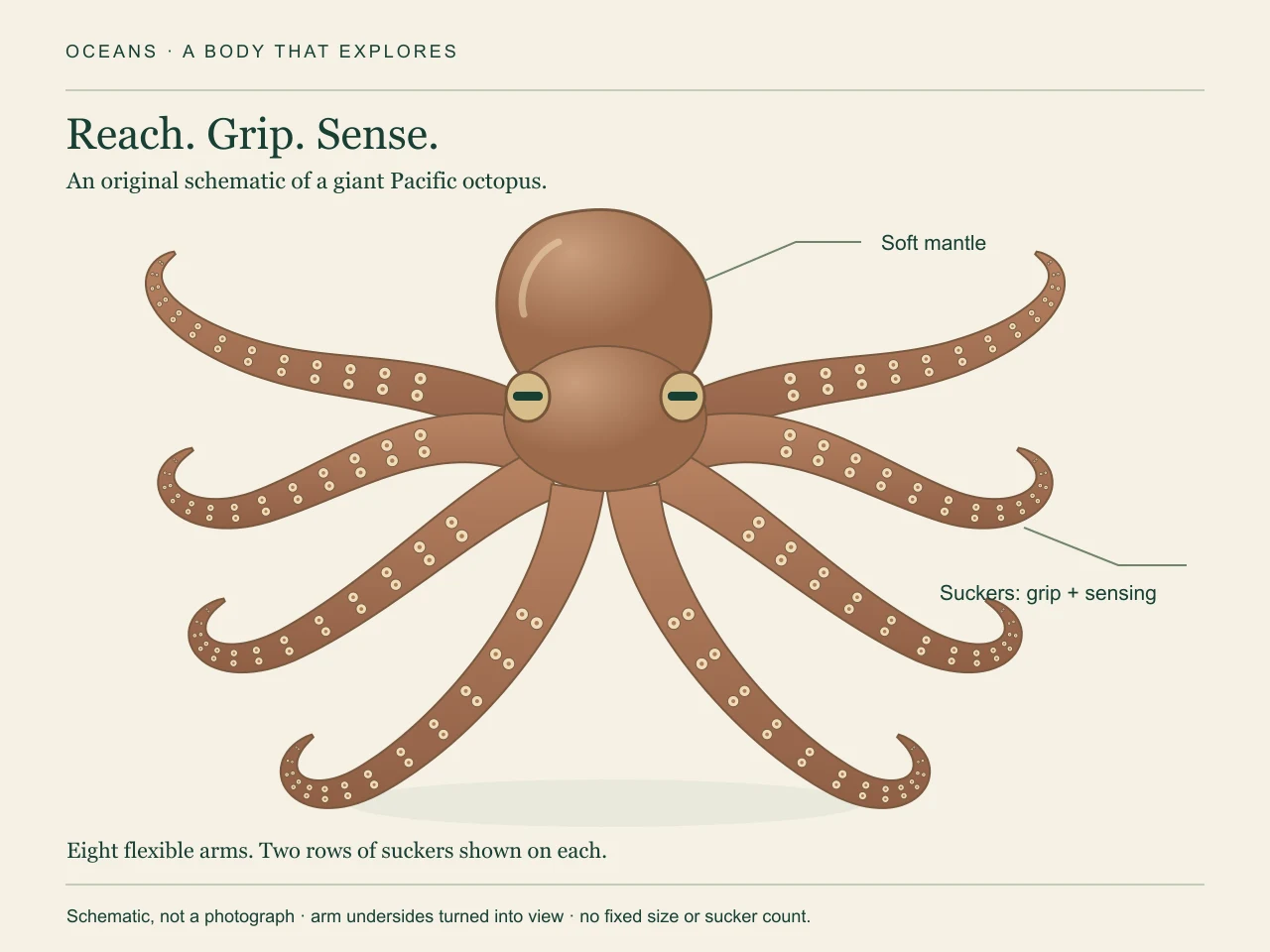
Original educational schematic, not a photograph or an identification record of a specimen. Arm undersides are turned into view to show sucker features; proportions, poses and the displayed number of suckers are illustrative.
Original Manthoryn educational illustration, 2026. CC BY4.0. Full composition retained in responsive derivatives. CC BY 4.0 ↗ · Image source ↗
A few details change the picture.
A way to reach around the obstacle
Seattle Aquarium describes giant Pacific octopuses as den-dwellers, often tucked into rocky spaces. A flexible body and arms can make use of an irregular setting. Reaching does not need to follow the straight, joint-limited path of a human forearm: an arm can bend around an edge while other arms remain in contact elsewhere. [2]
This is a useful way to read the labelled schematic: look for the relationship between the soft arm and the surface it meets, rather than searching for a human-style hand at its end. The animal’s shape makes contact possible in many positions. [2]
Contact is also information
Shedd Aquarium describes chemical sensors in the suckers alongside their ability to grasp and release. In everyday language this is often called tasting or smelling with the arms. The important idea is chemical sensing at a contact surface, not that an octopus experiences a human meal in each sucker. [3]
Seeing an object and contacting it answer different questions. A distant outline can indicate where something lies; contact can supply information about the encountered surface. That distinction explains why reaching and sensing belong in the same story. [3]
Finding is different from holding
Arms and suckers participate in finding and securing prey. California Sea Grant describes the giant Pacific octopus using them together, with subsequent handling depending on the prey. Locating a crab is one problem; preventing that crab from escaping is another. [4]
The explanation is therefore a sequence: explore the surroundings, encounter something, obtain sensory information and hold or manipulate it. This is an explanatory summary of the described functions, not a claim that every hunt follows one recorded script. [4]
The arms belong to a whole animal
Monterey Bay Aquarium places these abilities within a larger hunting repertoire that includes camouflage and movement through water. The suckers do not act in isolation from the rest of the body or the environment. Their usefulness depends on what the animal encounters and what it is doing. [1]
Our illustration names the body features discussed here; it is not a specimen photograph or a record of a wild hunt. Neither a drawn pose nor an aquarium photograph can measure what the animal thinks. [1]
Wonder without an intelligence contest
The worthwhile discovery is already remarkable: the same arms help this animal move, handle food and gather information. We do not need to rank its intelligence against a person’s or treat every curious movement as evidence of a human-like intention. [4]
A better next observation is precise: which suckers contact a surface, which parts of an arm move, and what changes when contact is released? Such questions keep the animal’s real body and behaviour at the centre. [2]
Keep a little curiosity.
Enjoying a discovery is enough. These optional questions may become a deeper investigation.
How can a sensory cell respond to a chemical at a surface?
A deeper mechanism question, not answered by a current published CEL gateway. This discovery remains complete to read without it.
A complete CEL answer is not published yet.
Plant a Seed for this question →Sources & image notes.
Facts are tied to the references below. This is a source-checked editorial discovery, rather than an assessment or a claim of independent expert review.
- Giant Pacific octopus ↗
Monterey Bay Aquarium. Species identity, eight sucker-bearing arms, chemical senses, hunting and coastal habitat; no intelligence ranking.
Checked 2026-11-17. - Giant Pacific octopus ↗
Seattle Aquarium. Den use, flexible body, arm use in finding and holding prey; no universal sucker count inferred.
Checked 2026-11-17. - Giant Pacific Octopus ↗
Shedd Aquarium. Individually controlled suckers and chemical sensing; aquarium enrichment is distinguished from wild behavior.
Checked 2026-11-17. - Giant Pacific Octopus ↗
California Sea Grant / UC San Diego. Arms and suckers in feeding, prey handling and species description.
Checked 2026-11-17.
Image provenance and modifications
Some collection cards show a labelled detail crop. The full image above retains its source framing.
Illustration
Original educational schematic, not a photograph or an identification record of a specimen. Arm undersides are turned into view to show sucker features; proportions, poses and the displayed number of suckers are illustrative.
Original Manthoryn educational illustration, 2026. CC BY4.0. Full composition retained in responsive derivatives.
Creator/publisher: Original Manthoryn educational illustration / Manthoryn.
Source record · Original image · Original Manthoryn code-authored illustration, released under CC BY4.0. No third-party photograph, traced diagram or downloaded artwork.
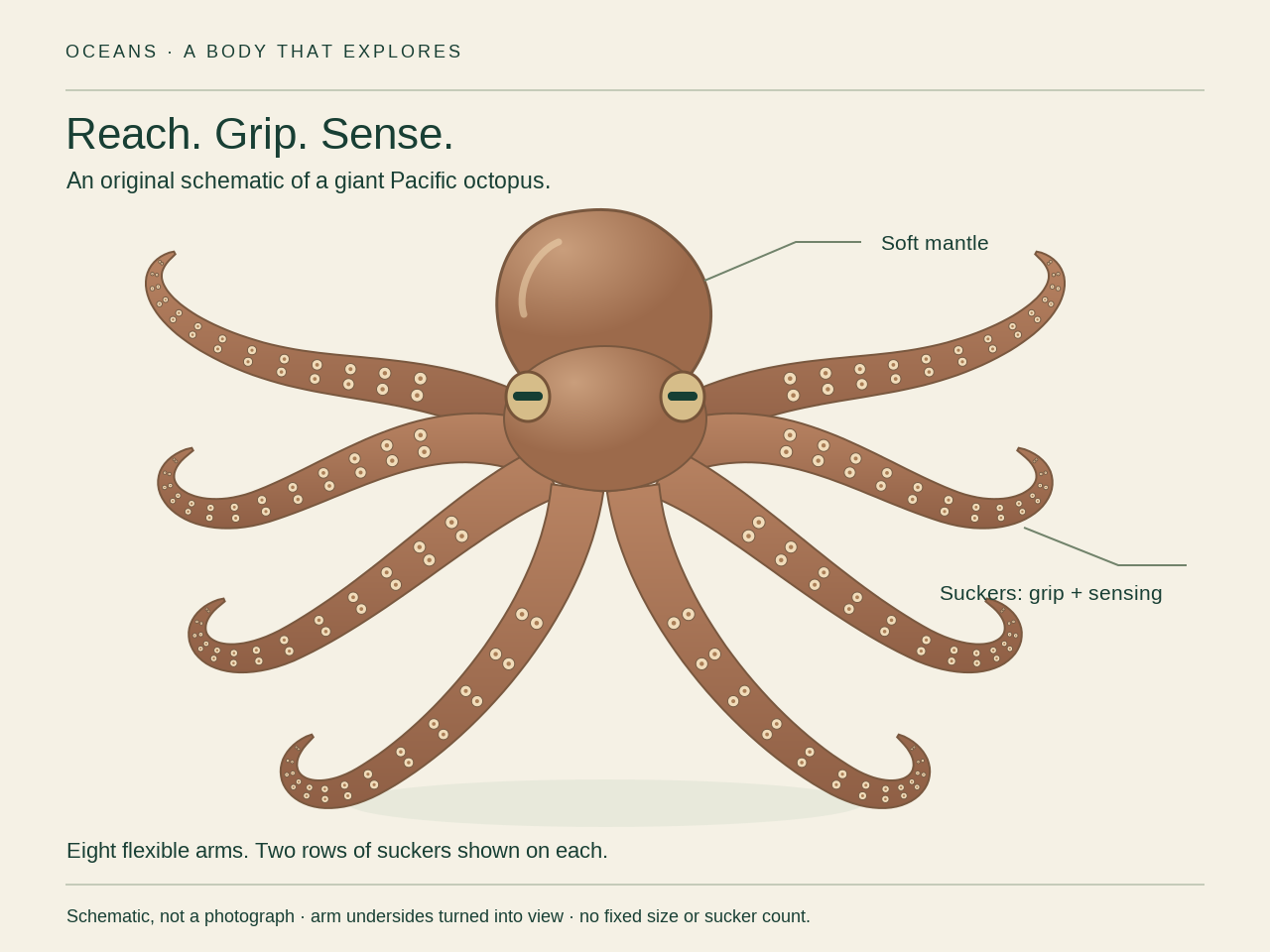
Changes: Original SVG rendered at640px and 1280px widths into WebP. No photographic source or documentary reconstruction; no crop, stretching or added scientific measurements.
Rights/source metadata checked 2026-11-17. Images identify the object or work; factual claims rely on the editorial references.
Discovery entry.ce1-pacific-octopus · revision 1.0.0. Raise a content or image concern →. This prepares a local note; no report is delivered.