The Braille slate and stylus: writing to be read by touch
A dot made from one side of a page can become a letter on the other.
An ordinary note usually asks you to distinguish one mark from the next by sight. Braille makes writing available through the pattern of raised dots. A slate and stylus make the letter positions mechanically repeatable, even though the same tool can make many different words. [1][2][3]
Look at one conventional slate. A hinged guide holds a sheet and bounds where each character can go. Pressing the paper leaves a raised dot on its far side. The reader meets the pattern from that other side. That simple change of viewpoint determines where a writer makes their marks. [1][2]
← Explore Inventions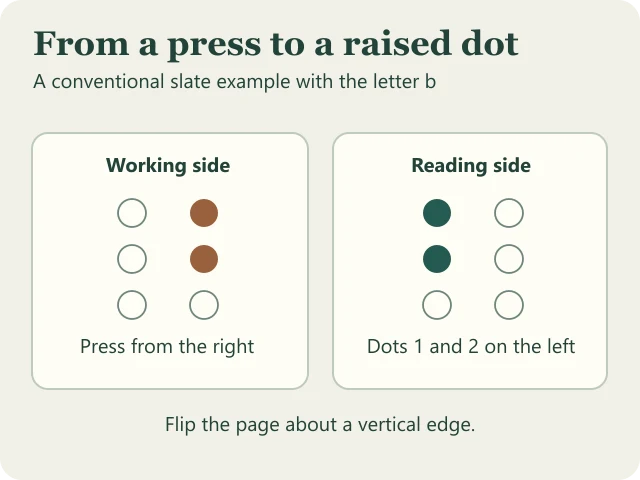
Original enlarged diagram of one conventional rear-writing slate example. All represented dots and positions are described in adjacent text.
Original Manthoryn educational illustration · CC BY 4.0. CC BY 4.0 ↗ · Image source ↗
A few details change the picture.
A six-dot cell has two columns of three possible positions. The pattern of raised positions distinguishes symbols. [3]
A conventional rear-writing slate reverses left and right between stamping and reading. An APH object record identifies a separate set of guides that help position the stylus within each cell. [1][2]
The guide fixes space without fixing the letter
Each guide window establishes the space for a cell. A user embosses a chosen subset of its possible dot positions. Two raised dots at the top and middle of the reading-side left column make a lowercase b in the ordinary uncontracted alphabet. Move the raised dots to different positions and the same cell space can encode something else. [2][3]
It matters that a pattern can be repeated clearly enough to distinguish adjacent cells and positions. The tool supplies the spatial guide. The writer supplies the text. The original graphic uses enlarged numbered dots for someone reading on a screen. Its visual marks are a description of tactile form. [1][3]
Read where the dots come toward you
For a conventional slate, picture the paper held upright. A writer looking at the back of the page places the two b marks near the right side of its cell. When the page is turned left to right, the marks are raised on the left side from the reader’s view. For a line, what was written at the right is first at the left after the page turns. [2][3]
The small drawing labels working side and reading side separately and explains the two dot locations in text. Other designs can emboss in a different orientation. The original image shows the geometry of the conventional tool, and does not reproduce the APH catalog object or present its design as universal. [1][2][3]
A practical choice depends on the task and writer
The National Federation of the Blind gives examples such as writing labels for food containers. It also describes games with tactile tiles and other reading and writing choices. A slate can serve someone who wants a short tactile note with a portable tool. A writer can choose a different tool for a longer job. [2][4]
People use braille in different ways, and some blind people choose other reading or writing tools. The point of the example is a reliable material link between writing and reading. A historical device is more understandable when its users’ purposes are part of the explanation. [1][4]
Keep a little curiosity.
Enjoying a discovery is enough. These optional questions may become a deeper investigation.
What changes if a writing device raises the dots directly on the reader’s side of the page?
This compares physical layouts. The page describes a conventional six-dot example and is not a braille training course.
A complete CEL answer is not published yet.
Plant a Seed for this question →Sources & image notes.
Facts are tied to the references below. This is a source-checked editorial discovery, rather than an assessment or a claim of independent expert review.
- Full-page braille slate, object 1992.61 ↗
Museum of the American Printing House for the Blind. Exact slate record describes an aluminum frame, its hinge and guided cells. Museum photo not copied.
Checked 2026-11-17. - Learning to Braille with a Slate and Stylus ↗
American Printing House. Illustrates the conventional tool, direction of writing and practical uses named by APH.
Checked 2026-11-17. - Braille Quick Reference Guide ↗
American Printing House. Dot numbering, left/right reversal for a conventional slate and standard examples.
Checked 2026-11-17. - About Blindness and Alaska NFB ↗
National Federation of the Blind of Alaska. Examples of how blind people choose to use braille for writing, toys and labels. Does not speak for all users.
Checked 2026-11-17.
Image provenance and modifications
Some collection cards show a labelled detail crop. The full image above retains its source framing.
Illustration
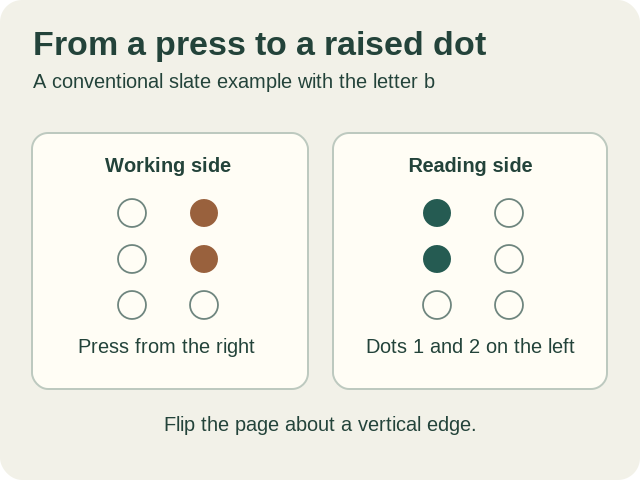
Original enlarged diagram of one conventional rear-writing slate example. All represented dots and positions are described in adjacent text.
Original Manthoryn educational illustration · CC BY 4.0.
Creator/publisher: Original Manthoryn educational illustration / Manthoryn.
Source record · Original image · Original Manthoryn illustration, CC BY 4.0. No third-party image or diagram was reproduced.
Changes: Original vector artwork rasterized and resized without cropping.
Rights/source metadata checked 2026-11-17. Images identify the object or work; factual claims rely on the editorial references.
Discovery entry.ce3-robots-braille-slate · revision 1.0.0. Raise a content or image concern →. This prepares a local note; no report is delivered.