ISS water recovery: a loop that needs looking after
If a crew cannot rely on frequent resupply, recovering water becomes everyday engineering.
During a long stay aboard the International Space Station, drinking water is part of a continuing supply problem. Some water leaves the crew in their breath, perspiration and urine. The station can capture and treat some of that water so it can go back to work. [1][2]
In 2023 NASA reported a demonstration of total recovery reaching 98% with added brine processing. The remaining two percent in that demonstration matters. A small fraction lost repeatedly adds up, which is why both recovery and replacement matter. [1][3]
← Explore Astronautics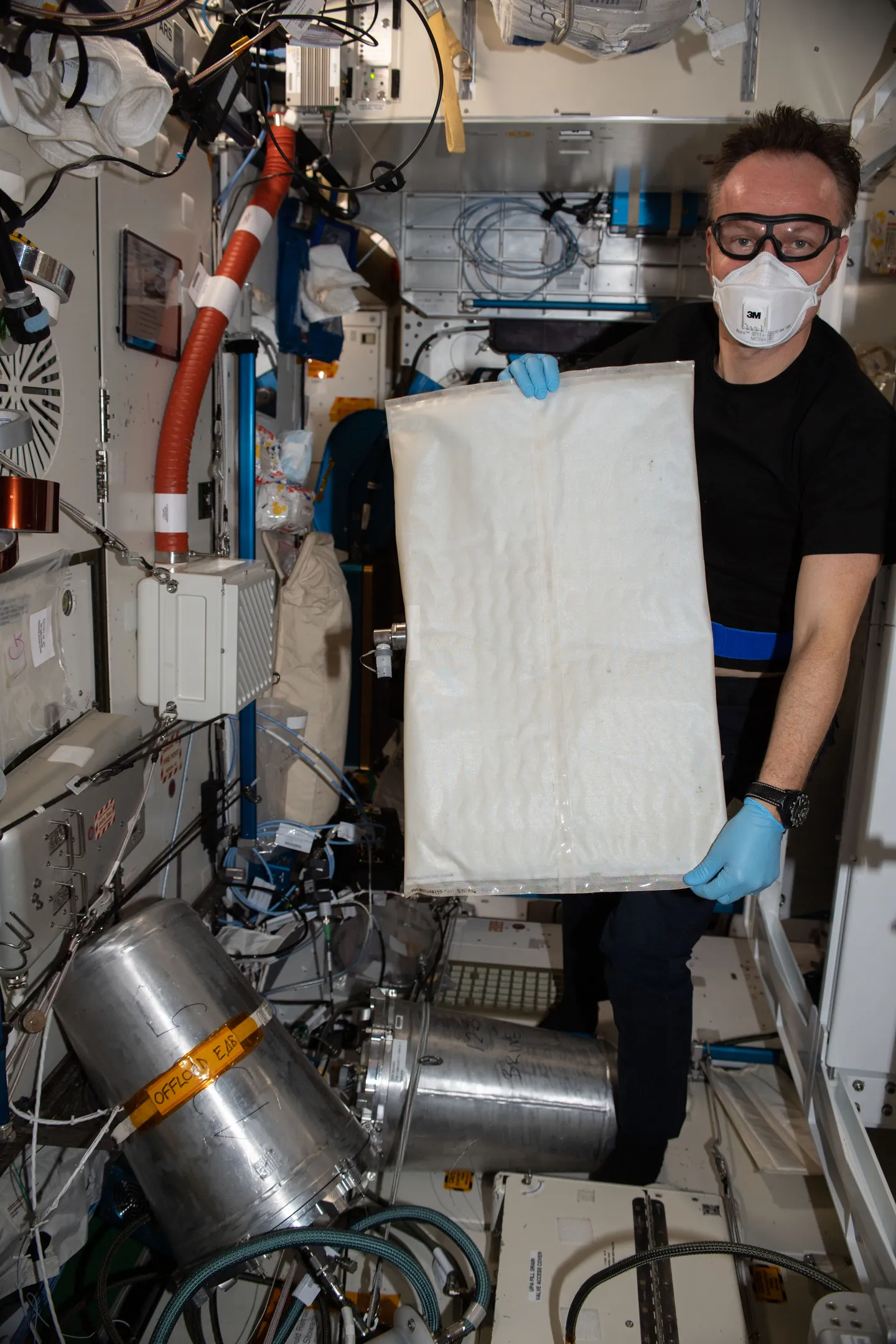
ESA astronaut Matthias Maurer changes the Brine Processor Assembly bladder aboard the International Space Station. NASA, documentation accompanying the June 2023 water-recovery report.
A few details change the picture.
Cabin humidity and treated urine are separate streams that can contribute water for further purification. [1][2]
The 98% figure is a dated demonstration result. It describes the demonstrated water recovery performance rather than guaranteeing the same result at every moment or on any other spacecraft. [1][3]
Find the water before treating it
Part of the collection system takes moisture from cabin air. Another part recovers water from urine, leaving behind a concentrated brine that still contains water. Brine processing opens up more of that remaining supply. These are ways of collecting water from different sources. The collected streams still have to be treated before they can go back to the crew. [1][2]
Return only acceptable water
The Water Processor Assembly treats collected water and monitors its quality. Water that does not meet the criteria is treated again. This is a separation and purification loop, with a quality decision before reuse. Changing how much is collected would not remove the need to check it before it goes back into the drinking supply. [1][2]
See the maintenance inside the loop
The picture shows an astronaut handling real equipment inside the station. His work is part of the process the recovery percentage summarizes: components need checks and replacement, and operation depends on reliable hardware, energy and consumables. A documented performance result describes what was achieved with a particular system. [1][3]
Plan for what still leaves the system
A sustainable water plan also asks how much make-up supply is needed and what will happen during maintenance. On a mission farther from Earth, there may not be a timely delivery to make up for an interrupted unit. That is why performance, quality, redundancy and repair are useful questions alongside the percentage recovered. [1][3]
Keep a little curiosity.
Enjoying a discovery is enough. These optional questions may become a deeper investigation.
If a spacecraft normally recovers almost all its water, what still determines how much reserve it must carry?
Apply the 2023 ISS demonstration to a limited comparison of gradual losses and interruptions.
A complete CEL answer is not published yet.
Plant a Seed for this question →Sources & image notes.
Facts are tied to the references below. This is a source-checked editorial discovery, rather than an assessment or a claim of independent expert review.
- NASA Achieves Water Recovery Milestone on International Space Station ↗
NASA International Space Station Research Communications Team. Dated 98% recovery demonstration with brine processing, moisture condensation, quality monitoring and exact documentary image of bladder maintenance.
Checked 2026-11-17. - Environmental Control and Life Support System (ECLSS) ↗
NASA. Water recovery as part of life support, sources and roles of equipment.
Checked 2026-11-17. - International Space Station Status, May 2023 ↗
NASA Advisory Council. The Brine Processor Assembly changes water recovery and requires reliability, operational maintenance and consumables.
Checked 2026-11-17.
Image provenance and modifications
Some collection cards show a labelled detail crop. The full image above retains its source framing.
Photograph
ESA astronaut Matthias Maurer changes the Brine Processor Assembly bladder aboard the International Space Station. NASA, documentation accompanying the June 2023 water-recovery report.
NASA
Creator/publisher: NASA / National Aeronautics and Space Administration.
Source record · Original image · NASA credited editorial photograph used to document ISS equipment maintenance under NASA factual educational media guidelines. Includes an identifiable astronaut; keep it in the factual educational article context and outside commercial promotion.

Changes: Original credited JPEG preserved locally. Full image resized to two WebP widths without cropping or app recolouring.
Rights/source metadata checked 2026-11-17. Images identify the object or work; factual claims rely on the editorial references.
Discovery entry.ce3-space-iss-water-recovery · revision 1.0.0. Raise a content or image concern →. This prepares a local note; no report is delivered.