Chandrayaan-3: a thermometer with a place
The landing gave the temperature measurements a location and a depth.
From a distance you can ask how warm the Moon’s surface looks. From a landing site you can ask a more local question: how does the temperature change a little way below the ground? India’s Chandrayaan-3 mission carried the ChaSTE experiment to make that second kind of measurement. [1][4]
The Vikram lander soft-landed on 23 August 2023 at southern high latitudes. Pragyan, the rover, carried other instruments for examining nearby material. The probe and rover answer different questions because their positions and instruments are different. [2][1]
← Explore Space Missions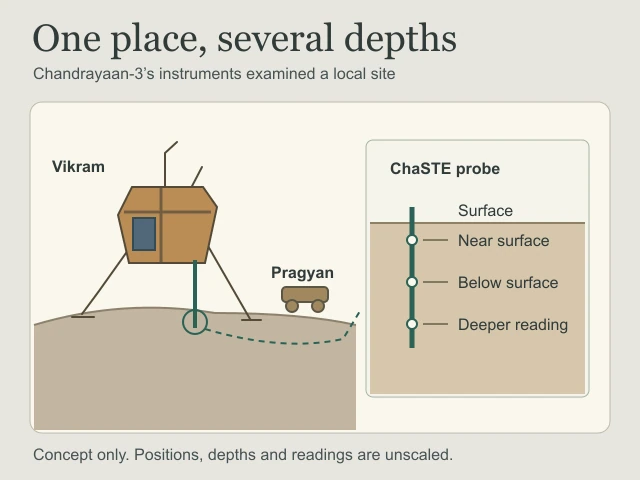
Original conceptual diagram of the ChaSTE measurement geometry on Chandrayaan-3. The lander and probe are unscaled. No temperatures or probe depths are estimated from the drawing.
Original Manthoryn educational illustration · CC BY 4.0. CC BY 4.0 ↗ · Image source ↗
A few details change the picture.
Why a landing goal changes the payload
One mission can both demonstrate a controlled landing and carry scientific tools. The lander’s instruments for judging its motion and the surface had a job before touchdown. ChaSTE had a different job after landing. It needed contact with the local surface so readings could be associated with depth. [1][4]
Temperature changes over a small distance
At the chosen location, measurements at different depths recorded a substantial gradient. This is consistent with a top layer that does not readily conduct heat. The reading at the surface should not be copied to every point underneath. Surface conditions and local terrain also affect results. The illustration shows the measurement idea without claiming a particular temperature or depth scale. [4]
A rover changes which places can be examined
The rover moved around the landing site and tested nearby material using separate tools for elemental analysis. That helps scientists compare what is in local soil and rock. Those measurements are additional evidence about the region. They are not part of the temperature profile recorded at the lander. [1][2]
Keep the place attached to the number
The completed science release describes measurements from the landing region, not a full map of the Moon. A colder spot elsewhere, a different time, or a different amount of sunlight can change the result. One profile can test a prediction about this place. A wider claim requires other measurements and a model explaining how the sites differ. [2][4]
Keep a little curiosity.
Enjoying a discovery is enough. These optional questions may become a deeper investigation.
What would you need to record to compare a thermal profile at one landing site with another?
This remains a question about selected local observations, not a claim about every lunar polar location.
A complete CEL answer is not published yet.
Plant a Seed for this question →Sources & image notes.
Facts are tied to the references below. This is a source-checked editorial discovery, rather than an assessment or a claim of independent expert review.
- Chandrayaan-3 Details ↗
Indian Space Research Organisation. Mission goals, intended landing area, payload names and supported placements.
Checked 2026-11-17. - Release of Chandrayaan-3 science data to the Scientific Community ↗
Indian Space Research Organisation. Vikram 23 August 2023 soft landing at southern high latitudes; Pragyan traverse and actual sampled observations.
Checked 2026-11-17. - The first observations from the ChaSTE payload onboard Vikram Lander ↗
Indian Space Research Organisation. Direct mission archive with ChaSTE observations and other separate instruments.
Checked 2026-11-17. - India Bags the Credit for First-Ever In-Situ Measurement of the Topmost Fluffy Layer of the Moon’s Surface at Southern Higher Latitudes ↗
Indian Space Research Organisation. ChaSTE measured a depth-dependent local temperature profile, with substantial temperature differences within the upper soil.
Checked 2026-11-17.
Image provenance and modifications
Some collection cards show a labelled detail crop. The full image above retains its source framing.
Illustration
Original conceptual diagram of the ChaSTE measurement geometry on Chandrayaan-3. The lander and probe are unscaled. No temperatures or probe depths are estimated from the drawing.
Original Manthoryn educational illustration · CC BY 4.0.
Creator/publisher: Original Manthoryn educational illustration / Manthoryn.
Source record · Original image · Original Manthoryn illustration, CC BY 4.0. No historical photograph, institution diagram or third-party artwork reproduced.
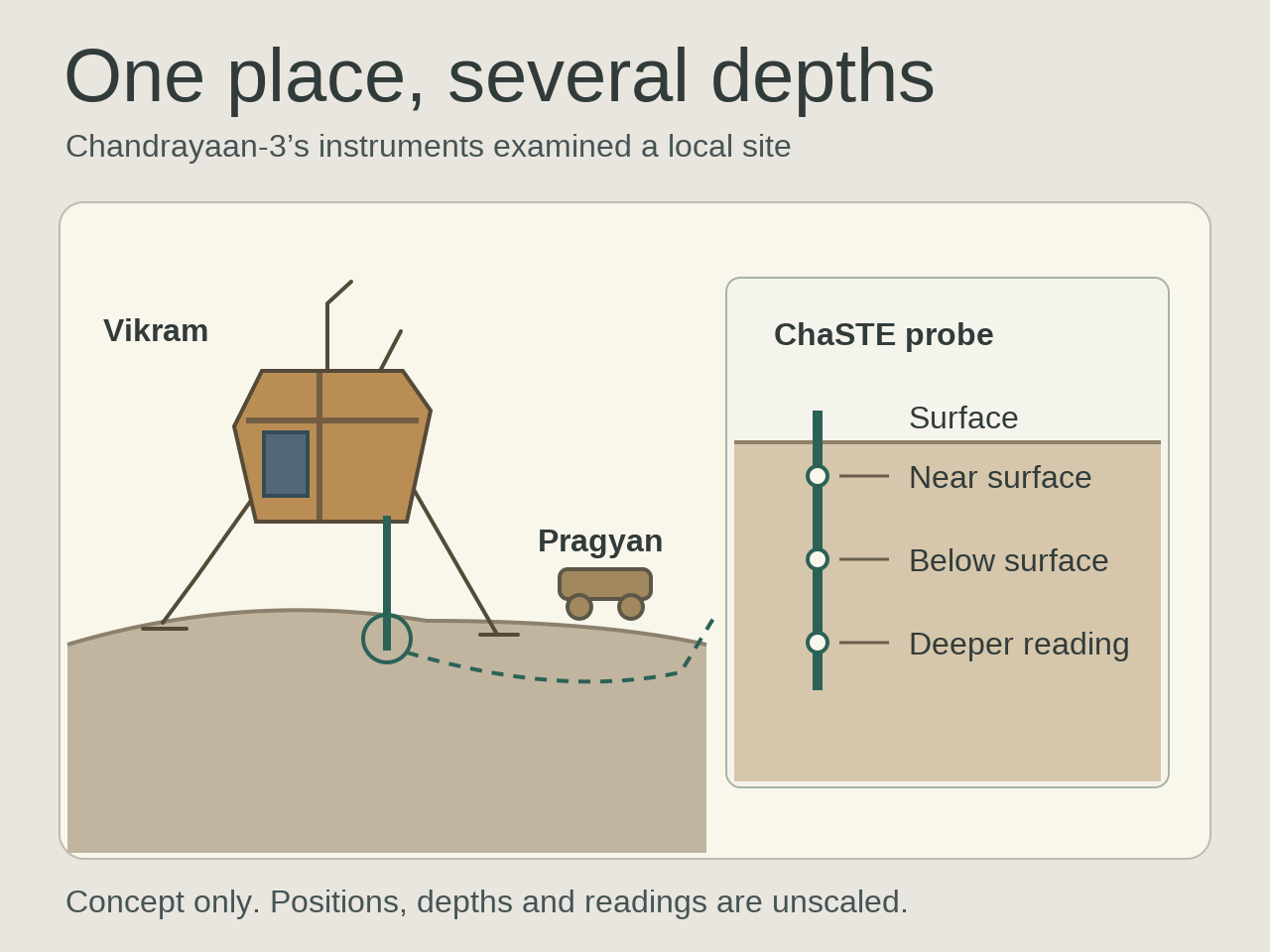
Changes: Original explanatory SVG rasterized to two WebP widths without cropping.
Rights/source metadata checked 2026-11-17. Images identify the object or work; factual claims rely on the editorial references.
Discovery entry.ce3-space-chandrayaan-3-local-moon · revision 1.0.0. Raise a content or image concern →. This prepares a local note; no report is delivered.