Voyager 1
A planetary flyby craft that crossed into interstellar space.
Voyager 1 began as a close-up visitor to Jupiter and Saturn. The same spacecraft later crossed the heliopause, carrying instruments—and a record of Earth—far beyond the planets it was built to inspect. [1]
← Explore Spacecraft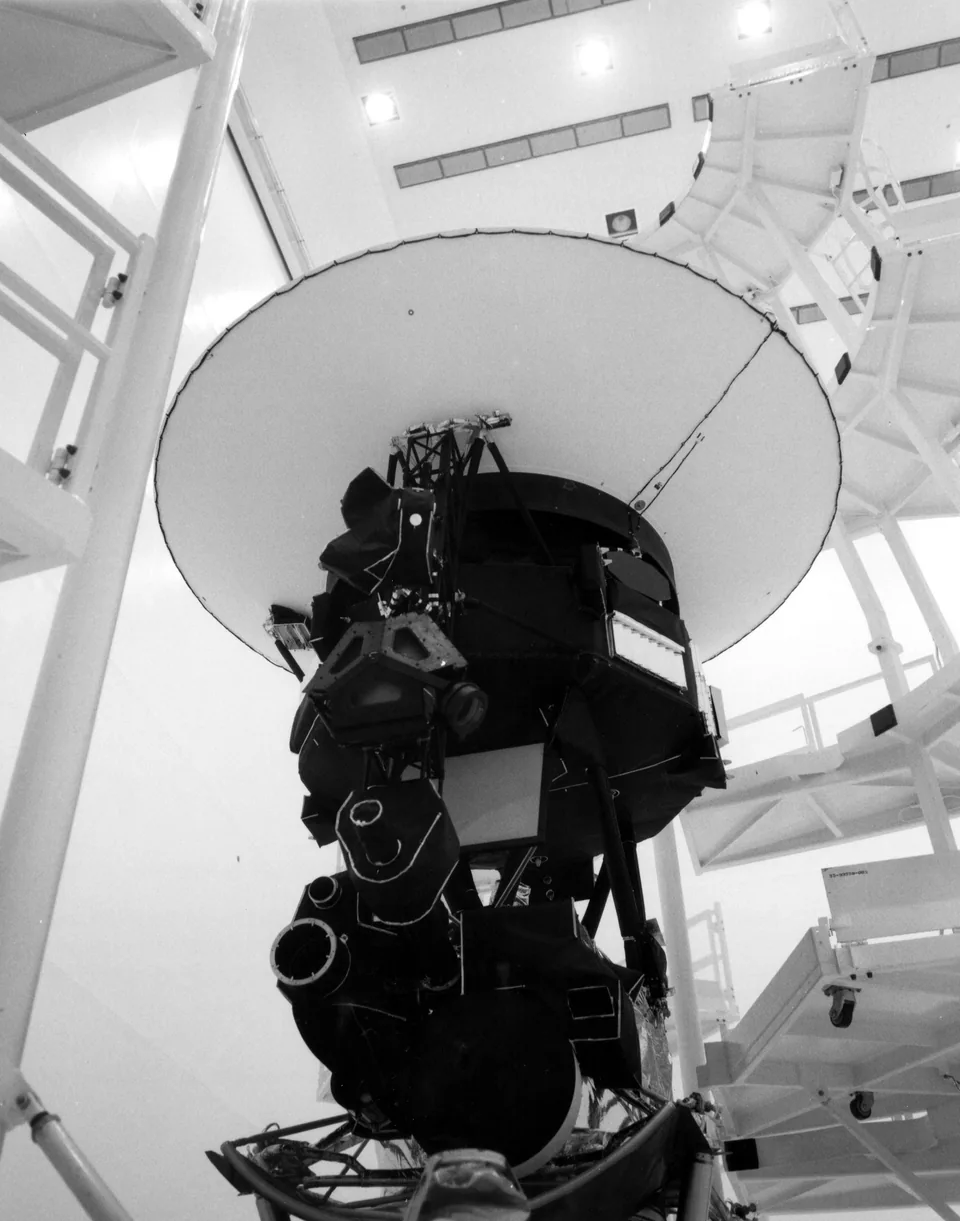
Voyager 1 during prelaunch processing in Kennedy Space Center’s Spacecraft Assembly and Encapsulation Facility-1, 27 August 1977.
NASA, 101-KSC-77P-229. Resized and converted to WebP. NASA/JPL image-use policy ↗ · Image source ↗
A few details change the picture.
Brief encounters, lasting discoveries
The Jupiter encounter revealed a faint ring and the moons Thebe and Metis. At Saturn, Voyager 1 examined rings and moons, including haze-wrapped Titan. That Titan encounter helped determine its onward path: instead of continuing to Uranus and Neptune, it headed out of the plane of the planets. Its route was shaped by the science it was sent to do. [1]
What does “interstellar” mean here?
The heliosphere is the region shaped by the Sun’s outward-flowing solar wind. Voyager 1 passed beyond its outer boundary in 2012. The much more distant Oort cloud is a different boundary for discussions of the Solar System. Calling the spacecraft interstellar describes the environment it entered; it does not mean that it had already passed beyond the Sun’s entire gravitational domain. [2]
A spacecraft is more than its camera
Voyager 1’s final imaging sequence in 1990 produced a Solar System family portrait, including the famous distant view of Earth. The cameras were then switched off to conserve resources for other science. Later exploration concerns fields and particles, rather than a continuing stream of new photographs. [2]
Keep a little curiosity.
Enjoying a discovery is enough. These optional questions may become a deeper investigation.
How can a spacecraft communicate across interstellar distances?
A deeper CEL explanation for this question is not published in the current collection.
A complete CEL answer is not published yet.
Plant a Seed for this question →How can heat from radioactive decay supply a spacecraft with electricity?
A deeper CEL explanation for this question is not published in the current collection.
A complete CEL answer is not published yet.
Plant a Seed for this question →Another story to explore.
Editorial suggestions for browsing, with the reason shown. These are not canonical knowledge-graph relationships.
Sources & image notes.
Facts are tied to the references below. This is a source-checked editorial discovery, rather than an assessment or a claim of independent expert review.
- Voyager 1: The Farthest Spacecraft ↗
NASA Science. Historical launch and encounter dates, trajectory, discoveries, generators and interstellar crossing.
Checked 2026-11-13. - Voyager Frequently Asked Questions ↗
NASA Science. Antenna size, camera shutdown and heliosphere/Oort-cloud distinction.
Checked 2026-11-13. - Voyager 1 prelaunch processing — 101-KSC-77P-229 ↗
NASA Kennedy Space Center. Specific Voyager 1 identity in prelaunch assembly/encapsulation facility, August 1977.
Checked 2026-11-13.
Image provenance and modifications
Some collection cards show a labelled detail crop. The full image above retains its source framing.
Photograph
Voyager 1 during prelaunch processing in Kennedy Space Center’s Spacecraft Assembly and Encapsulation Facility-1, 27 August 1977.
NASA, 101-KSC-77P-229. Resized and converted to WebP.
Creator/publisher: NASA / NASA Kennedy Space Center.
Source record · Original image · NASA informational/editorial reuse under its Images and Media Usage Guidelines; no third-party copyright restriction is identified in the asset metadata. No endorsement is implied.

Changes: Auto-oriented, proportionally resized and converted to WebP. No crop, retouching or generated additions.
Rights/source metadata checked 2026-11-13. Images identify the object or work; factual claims rely on the editorial references.
Discovery entry.voyager-1 · revision 1.0.0. Raise a content or image concern →. This prepares a local note; no report is delivered.