A running blade returns some of the energy it receives
The athlete and ground load a passive blade. Its shape changes and then recovers.
A passive running blade can bend when the runner loads it against the ground. As that load changes, the bent material tends back toward its earlier shape. The deformation can store energy temporarily, and the shape change can later return part of it. [1]
The Cheetah family is documented in Smithsonian design archives and a biomechanics study examined a Cheetah Xtend alongside other devices. Those are particular designs. The diagram isolates one passive spring idea without suggesting that runners or their needs are interchangeable. [2][1]
← Explore Human Movement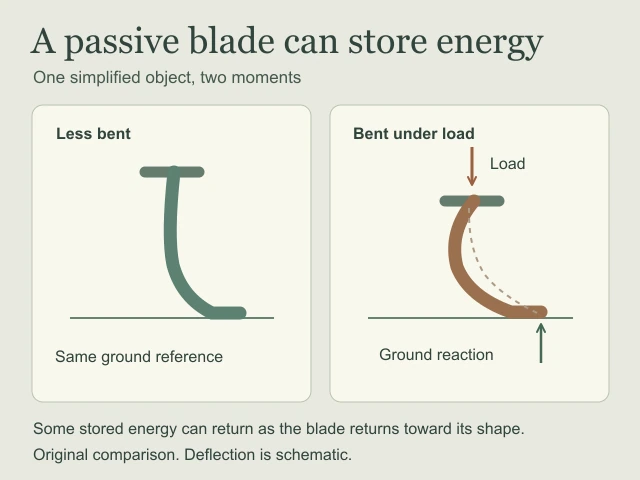
Original simplified passive blade comparison, without a person or manufacturer design. Deflection and arrows are illustrative and do not imply fitting specifications.
Original Manthoryn educational illustration · CC BY 4.0. CC BY 4.0 ↗ · Image source ↗
A few details change the picture.
Follow energy into the curved shape
An athlete applies force through the running system and the blade presses against the ground. The blade’s shape can deflect under the resulting load. If the material tends to return toward its prior shape, some work done in bending it is recoverable. That is the limited sense in which the blade is spring-like. [1]
Recovering energy is not making it
When loading decreases, the blade can give back some of the energy it has stored. A passive return and a muscle supplying new mechanical work are different jobs. Some energy is dissipated in the deformation cycle, so a simple picture of a spring is useful without implying perfect recovery. [1]
The same curve does not tell every runner’s story
Measurements can differ depending on loading direction, material behavior and device geometry. In use, the runner’s movement and their connection to the device also matter. Those are reasons to treat the athlete as the expert in their own experience and to separate a lab comparison from clinical decisions. [1][3]
A device characteristic is not a result or a rule
An energy-return comparison does not by itself tell us how a person will move, what fit is appropriate or whether a device is eligible for an event. The original study asks specific mechanical questions. It supports that narrower comparison, while the archive documents a real design lineage. [1][2]
Keep a little curiosity.
Enjoying a discovery is enough. These optional questions may become a deeper investigation.
What could explain two blades returning different amounts of energy after the same initial loading?
This is a passive mechanics comparison. It supplies no clinical recommendation, prescribing, selection or sporting eligibility determination.
A complete CEL answer is not published yet.
Plant a Seed for this question →Sources & image notes.
Facts are tied to the references below. This is a source-checked editorial discovery, rather than an assessment or a claim of independent expert review.
- Characterizing the Mechanical Properties of Running-Specific Prostheses ↗
Owen N. Beck, Paolo Taboga and Alena M. Grabowski. Mechanical tests of passive running-specific prostheses, repeated loading and differences by shape and test conditions.
Checked 2026-11-17. - Design drawings for the Flex Sprint and Cheetah ↗
Smithsonian National Museum of American History Archives Center. Documented family of named running-prosthesis development and archival context.
Checked 2026-11-17. - Arielle Rausin’s Invention Fits Like a Glove ↗
Smithsonian Lemelson Center. Reference context for athlete expertise and the importance of listening to users in adaptive sports equipment.
Checked 2026-11-17.
Image provenance and modifications
Some collection cards show a labelled detail crop. The full image above retains its source framing.
Illustration
Original simplified passive blade comparison, without a person or manufacturer design. Deflection and arrows are illustrative and do not imply fitting specifications.
Original Manthoryn educational illustration · CC BY 4.0.
Creator/publisher: Original Manthoryn educational illustration / Manthoryn.
Source record · Original image · Original Manthoryn educational illustration, CC BY 4.0. No photograph, brand artwork, athlete likeness or proprietary diagram reproduced.
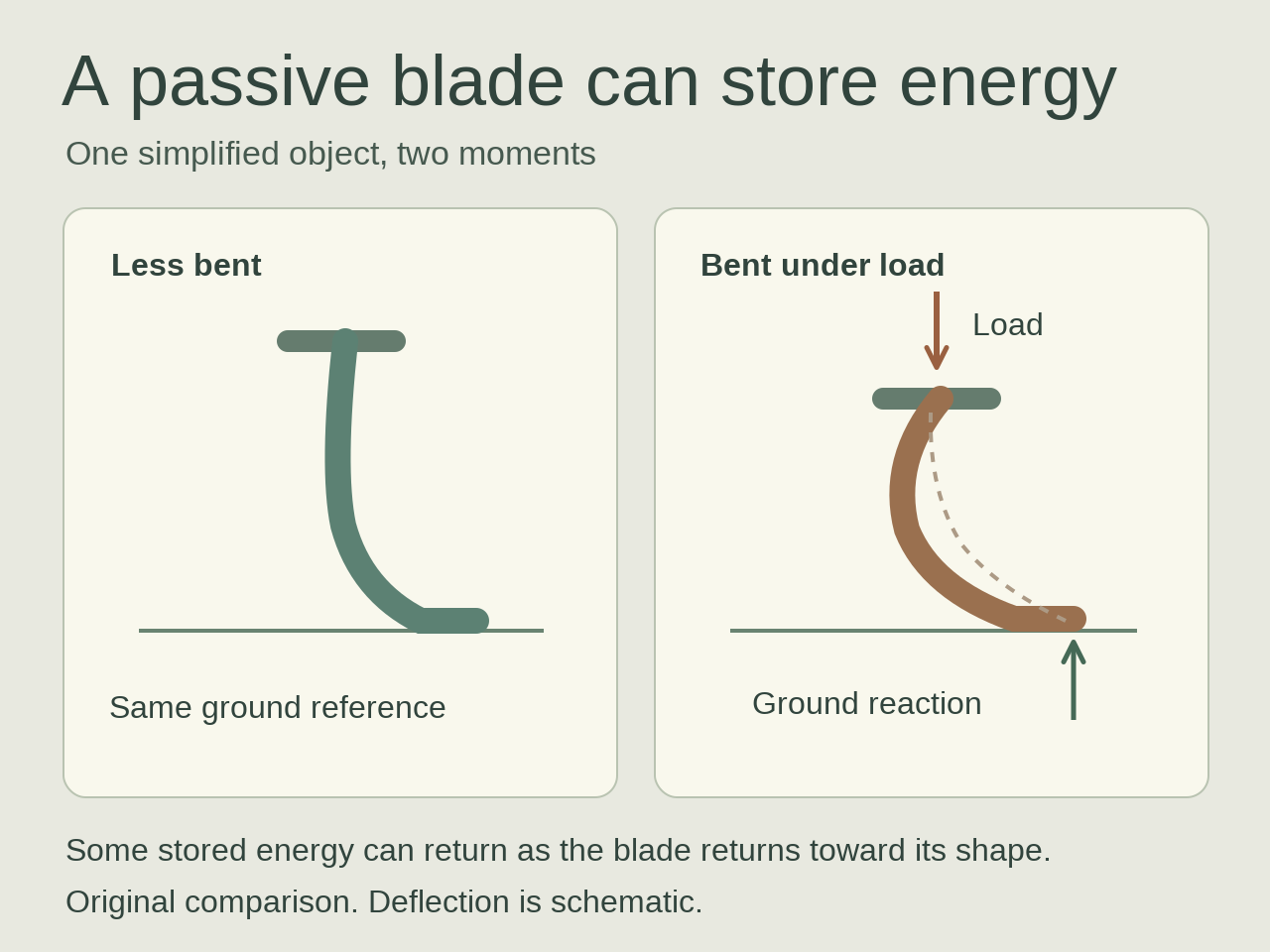
Changes: Original labelled SVG rasterized to two WebP widths without cropping.
Rights/source metadata checked 2026-11-17. Images identify the object or work; factual claims rely on the editorial references.
Discovery entry.ce3-sports-prosthetic-running-blade · revision 1.0.0. Raise a content or image concern →. This prepares a local note; no report is delivered.