Hoover Dam: follow water to a generator
Stored water can do work as it flows downhill. A turbine and generator make two different transfers.
Water released from the reservoir at Hoover Dam has a path to a much lower level. As it moves through the powerplant, it gives up some of the energy associated with that difference in height. The work of the plant is to let some of that change drive electrical generation. [1][2]
The turbine is where flowing water makes a shaft turn. The generator is where rotation contributes to an electric current. The motor-like appearance of the equipment can obscure that these are two different jobs. [1][2]
← Explore Power Plants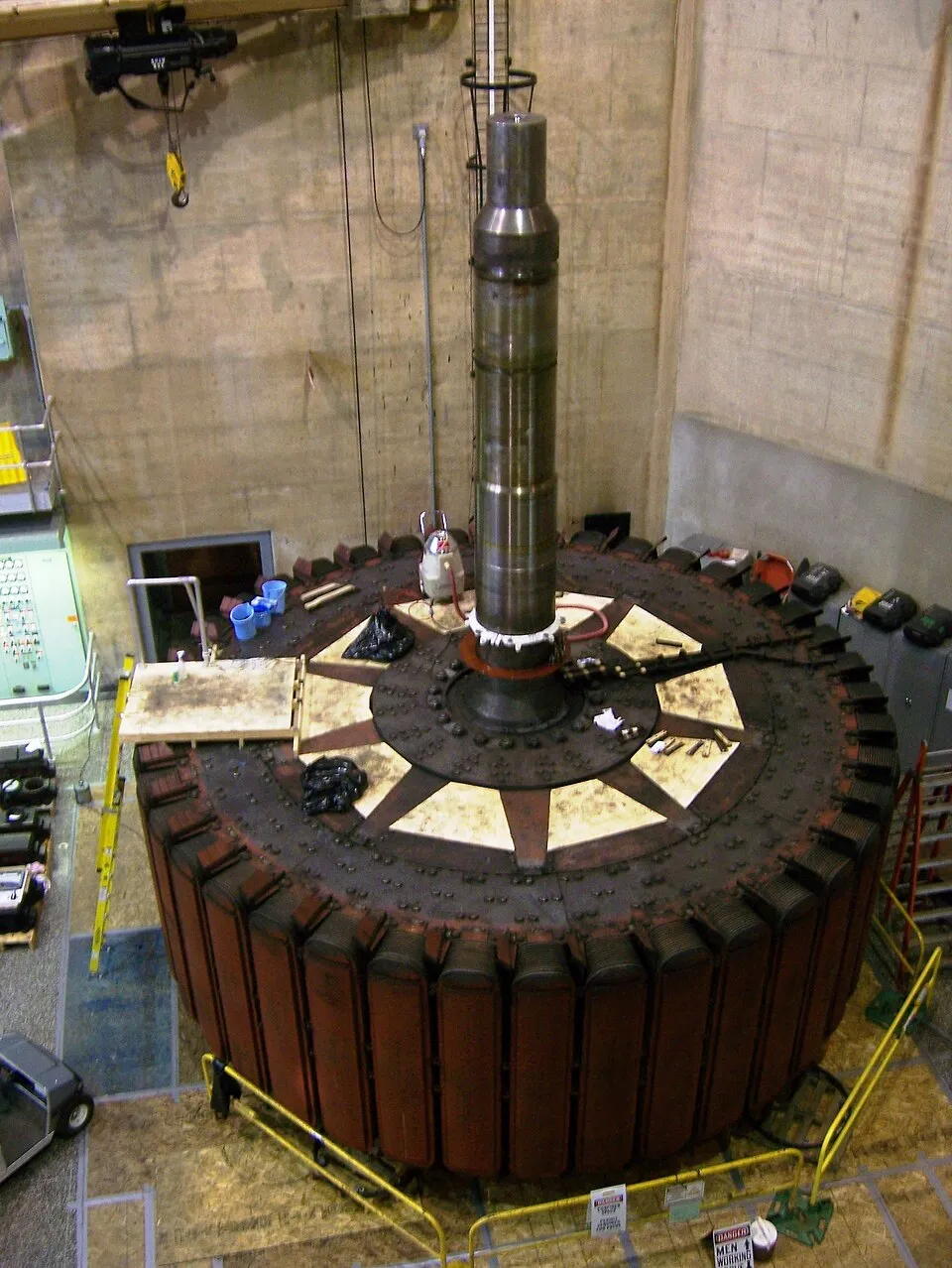
A Hoover Dam generator assembly during service in 2007. The separate schematic shows how water drives the turbine. Jarek Tuszyński, CC BY-SA 4.0.
Jarek Tuszyński · CC BY-SA 4.0. CC BY-SA 4.0 ↗ · Image source ↗
A few details change the picture.
Begin upstream and end downstream
A conduit carries water downward from the reservoir to the turbine. The turbine’s passages redirect the moving water, and the water exerts force on the blades as it passes them. The water leaves at a lower level. It is not consumed as a fuel, though when and where it moves changes. [1][2]
Trace the rotation beyond the water
A shaft connects the water-driven runner to the generator rotor. A changing magnetic field relative to stationary windings produces an electric effect. The generator can supply electrical power because the turbine keeps doing mechanical work, not because the water itself travels through the wires. [1][2]
Keep the energy accounting honest
The amount available from the water depends on the difference in level and how much water passes through. Practical equipment has losses from changes in flow and from the mechanical and electrical systems. A cutaway helps distinguish the transfers. It does not give an output without the conditions and the equipment’s performance. [2][1]
Generation shares a river with other uses
Dams and changes in releases can alter water conditions and affect habitat. Hydropower engineering therefore also involves questions about how the site serves surrounding ecosystems and other uses. The conversion from water motion to electricity addresses one part of that larger decision. [3][1]
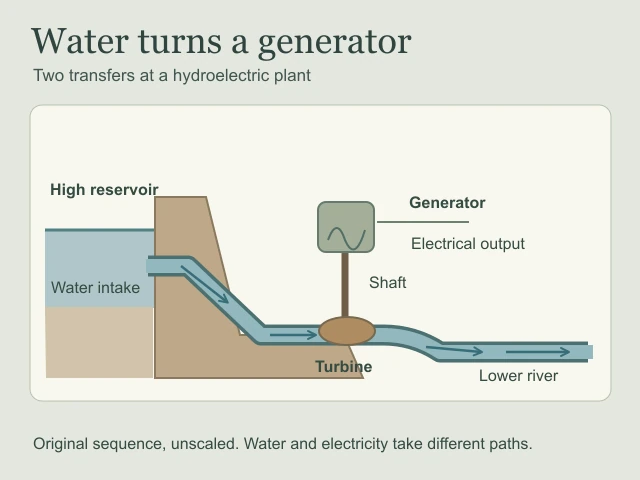
Original functional sequence based on the documented Hoover Powerplant. This cutaway is not a survey, plan or mechanical drawing.
Original Manthoryn educational illustration · CC BY 4.0. Image rights ↗ · Image source ↗
Keep a little curiosity.
Enjoying a discovery is enough. These optional questions may become a deeper investigation.
If less water reaches a turbine each second, which other quantity in the water supply would you check before predicting output?
The question concerns the basic roles of water flow and available head, with no site operating advice.
A complete CEL answer is not published yet.
Plant a Seed for this question →Sources & image notes.
Facts are tied to the references below. This is a source-checked editorial discovery, rather than an assessment or a claim of independent expert review.
- Hoover Dam Power FAQs ↗
United States Bureau of Reclamation. Named powerplant, operating agency, energy transfer from moving water through turbine and generator.
Checked 2026-11-17. - Hydroelectric Power ↗
United States Bureau of Reclamation. Reservoir head, conduit, turbine rotation and generator role; flow and head matter.
Checked 2026-11-17. - R&D to Improve Environmental Performance ↗
US Department of Energy. Environmental and operating trade-offs including fish, habitat and water management.
Checked 2026-11-17. - Hoover Dam Generator ↗
Jarek Tuszyński. Exact documentary photograph and explicit licence attribution.
Checked 2026-11-17.
Image provenance and modifications
Some collection cards show a labelled detail crop. The full image above retains its source framing.
Photograph
A Hoover Dam generator assembly during service in 2007. The separate schematic shows how water drives the turbine. Jarek Tuszyński, CC BY-SA 4.0.
Jarek Tuszyński · CC BY-SA 4.0.
Creator/publisher: Jarek Tuszyński / Wikimedia Commons.
Source record · Original image · Photographer’s Creative Commons Attribution-ShareAlike 4.0 release. Full-frame WebP renditions retain the original image licence.


Changes: Complete licensed image converted to two WebP widths, without cropping or recolouring. Native upload retained when practical; otherwise the complete Commons download rendition is retained.
Rights/source metadata checked 2026-11-17. Images identify the object or work; factual claims rely on the editorial references.
Illustration
Original functional sequence based on the documented Hoover Powerplant. This cutaway is not a survey, plan or mechanical drawing.
Original Manthoryn educational illustration · CC BY 4.0.
Creator/publisher: Original Manthoryn educational illustration / Manthoryn.
Source record · Original image · Original Manthoryn illustration, CC BY 4.0. No third-party image, map or photograph reproduced.
Changes: Rasterized to two WebP widths without changing the original framing.
Rights/source metadata checked 2026-11-17. Images identify the object or work; factual claims rely on the editorial references.
Discovery entry.ce3-structures-hoover-dam-hydropower · revision 1.0.0. Raise a content or image concern →. This prepares a local note; no report is delivered.