Taipei 101: why put a pendulum in a tower?
A suspended mass moves relative to the tower and gives its motion another place to go.
Near the top of Taipei 101 hangs a large steel sphere. Its size is memorable, but its movement explains why it is there. A tall building can sway when wind keeps pushing on it. The sphere is able to move relative to the building, so some of the tower’s motion can drive a separate moving system. [1][2]
The operator lists the sphere at about 660 metric tonnes. Its large mass matters, but weight alone would do little if it were fixed in place. The suspension and dampers allow an energy transfer that a fixed lump of steel would not provide. [1][2]
← Explore Skyscrapers
The tuned mass damper ball inside Taipei 101, Taiwan, photographed 18 May 2005. Huaiwei, CC BY-SA 2.5.
Huaiwei · CC BY-SA 2.5. Image rights ↗ · Image source ↗
A few details change the picture.
Some movement is easier to feel than see
A building does not need to look dramatically bent to give a person a sense of motion. The Taipei 101 design record discusses acceleration and comfort near the upper floors, in addition to the forces the structure must carry. Reducing the uncomfortable response was one reason to add the damper. [2]
Compare the tower with its suspended mass
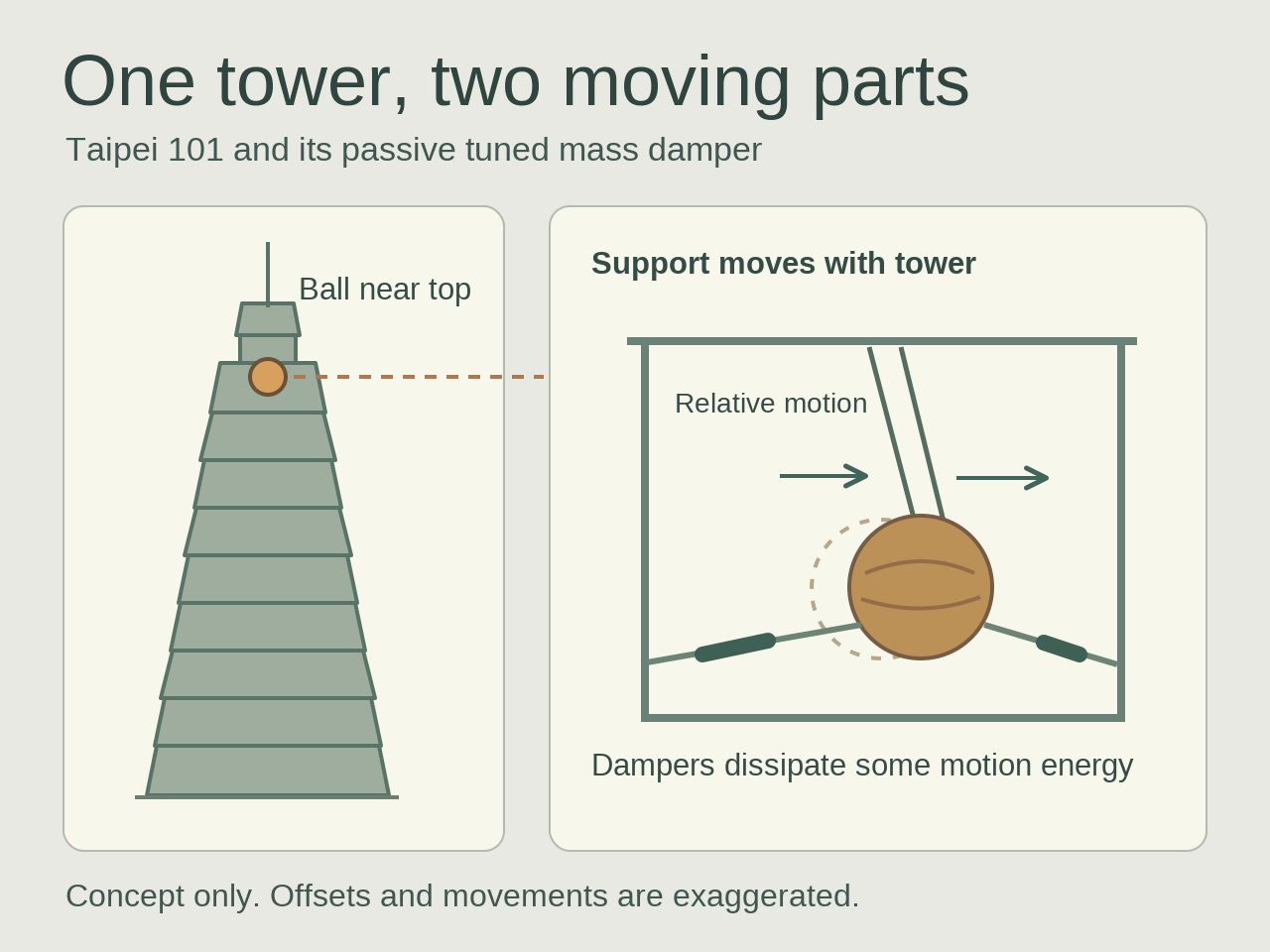
Imagine the attachment points moving with a swaying floor while the sphere moves on its own suspension. At some instants they are moving differently and change their position relative to each other. The consultant’s plan-view simulation shows that the ball is not simply a counterweight always pushing the other way. [3][2]
Tuning helps the parts exchange energy
The suspended mass responds strongly around the motion range the designers intend it to address. Relative movement strokes the dampers, which dissipate some mechanical energy. The key when reading the illustration is that the ball can move, the attachments move with the tower, and the dampers connect the two. [2][3]
A damper is one part of a tower
The tower, its stiffness, structural frame, foundations and other systems still have their own jobs. A tuned response aimed at a range of wind motions does not itself promise a result in every storm or earthquake. The engineering report discusses it as part of the building design, rather than as a replacement for that design. [2][1]
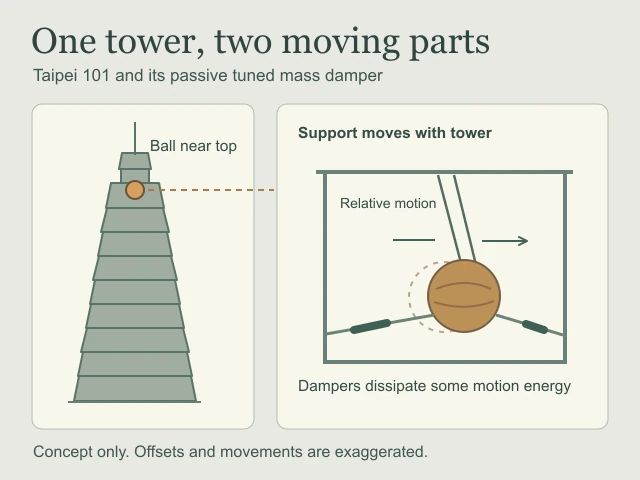
Original unscaled tower and damper illustration. Inset movement and component spacing are schematic.
Original Manthoryn educational illustration · CC BY 4.0. Image rights ↗ · Image source ↗
Keep a little curiosity.
Enjoying a discovery is enough. These optional questions may become a deeper investigation.
How would a change in the tower’s main sway frequency affect a tuned damper?
This is a conceptual question about a passive system. It gives no structural design, damping ratio or earthquake-performance advice.
A complete CEL answer is not published yet.
Plant a Seed for this question →Sources & image notes.
Facts are tied to the references below. This is a source-checked editorial discovery, rather than an assessment or a claim of independent expert review.
- Taipei 101 Observatory features ↗
Taipei 101. Exact sphere mass and dimensions, wind-damper arrangement and visitor-facing purpose.
Checked 2026-11-17. - Taipei 101 Structural Engineering Planning and Design Record ↗
Taiwan Architecture and Building Research Institute. Records consultancy, wind-comfort analysis and selected passive pendulum with hydraulic dampers.
Checked 2026-11-17. - Taipei 101 Tuned Mass Damper Windstorm Simulation – Plan View ↗
Thornton Tomasetti and RWDI. Consultant simulation distinguishes relative motion and a simple opposite-direction counterweight story.
Checked 2026-11-17. - Taipei101 damper ↗
Huaiwei. Exact documentary photograph and explicit licence attribution.
Checked 2026-11-17.
Image provenance and modifications
Some collection cards show a labelled detail crop. The full image above retains its source framing.
Photograph
The tuned mass damper ball inside Taipei 101, Taiwan, photographed 18 May 2005. Huaiwei, CC BY-SA 2.5.
Huaiwei · CC BY-SA 2.5.
Creator/publisher: Huaiwei / Wikimedia Commons.
Source record · Original image · Photographer’s Creative Commons Attribution-ShareAlike 2.5 release. Full-frame WebP renditions retain the original image licence.


Changes: Complete licensed image converted to two WebP widths, without cropping or recolouring. Native upload retained when practical; otherwise the complete Commons download rendition is retained.
Rights/source metadata checked 2026-11-17. Images identify the object or work; factual claims rely on the editorial references.
Illustration
Original unscaled tower and damper illustration. Inset movement and component spacing are schematic.
Original Manthoryn educational illustration · CC BY 4.0.
Creator/publisher: Original Manthoryn educational illustration / Manthoryn.
Source record · Original image · Original Manthoryn illustration, CC BY 4.0. No third-party image, map or photograph reproduced.
Changes: Rasterized to two WebP widths without changing the original framing.
Rights/source metadata checked 2026-11-17. Images identify the object or work; factual claims rely on the editorial references.
Discovery entry.ce3-structures-taipei-101-damper · revision 1.0.0. Raise a content or image concern →. This prepares a local note; no report is delivered.