Why does an object’s location matter as much as the object itself?
An object’s position, layer and associations help connect it to human actions and events. An identical object can support a different interpretation in a floor deposit and a later layer of reused soil. Location matters because it records a relationship, but archaeologists must check how the deposit formed and changed.
An object can attract attention while the surrounding evidence explains why it is there. Without a reliable account of how it was found, many questions become harder or impossible to answer.
Start with the question
The answer, the explanatory gap and useful foundations.
Read in your own way
Start with the answer, refresh a foundation when you need it, or follow the explanation through. Read the ordered explanatory sections and check their stated sources and limits.
Everything here is open without an account. Saving is optional. The public subject tree is a map of published ideas; My Forest contains the subjects you choose to plant.
See the public Archaeology tree →A foundation, without a detour.
Recognize that a thing can be made, used, moved and left somewhere at different times. The place of discovery need not be where it was made or used.
Position through time
Provenience describes where an object was recovered. Its context also includes what surrounded it, the sequence of deposits and evidence about how those deposits formed.
Develop the model
Follow the first explanatory steps without losing their qualifications.
Give one kind of object two settings
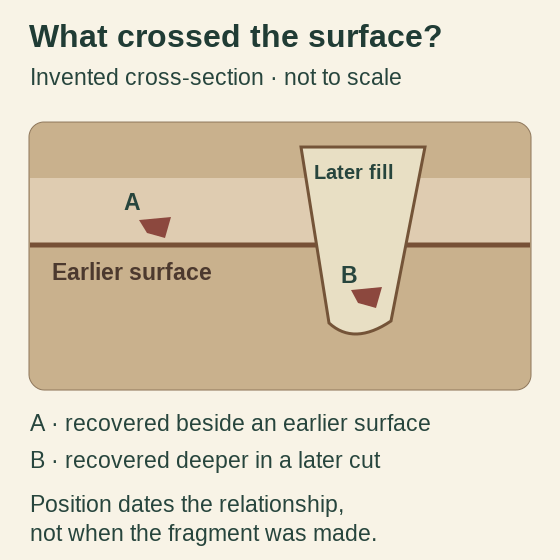
In an invented archaeological record, two glazed pottery fragments have the same thickness and decoration. One was recorded beside a worn surface covered by a later deposit. The other came from soil used to backfill a narrow trench that cut through the earlier surface. Looking at the fragments alone, you would probably describe them in much the same way.
Now consider the question “What was happening when the worn surface was in use?” The fragment near the surface may be relevant if it was deposited while that surface was exposed. The other might have moved into the trench with soil from somewhere else. It can tell us something about what the fill contained. It has a weaker direct relation to the activities on the earlier surface.
A similar appearance does not guarantee a similar relationship to the place and event.
Distinguish the cut from the layer it crosses
Layers often accumulate with earlier deposits below later ones. But a later feature, such as a pit, can cut through an earlier layer and be filled with later materials or old materials brought back up. An object near the bottom of that fill can be deeper than an earlier object beside it. Depth alone would then put them in the wrong order.
The important observation is the shape of the boundary and what it interrupts. In this invented record, the trench crosses the worn surface. That tells us that making the trench was later than whatever it cut. It does not prove the pottery was made later. Each object’s manufacture and deposition are separate events with potentially different evidence.
Compare boundaries and associations before using depth as a clock.
Investigate and refine
Predict, compare the lenses and carry the explanation further.
The next sections refine the explanation. No interactive investigation has been attached to this publication.
Ask what kind of connection the find supports
Suppose notes show other vessel fragments near the worn surface, and some of them fit together. That can strengthen the link between fragments and a shared deposit. A separate charcoal stain nearby might suggest another activity, but nearness alone cannot tell you that all the traces occurred at once. Look for how the relevant materials relate to the surface and to an interpretable event.
People connected to a site may also hold histories and knowledge that are absent from an object label. A documentary record about an earlier building use or a community’s account of a place can make other questions possible. The source of that knowledge, the context of its sharing and permission to use it matter to its interpretation.
A find is useful in relation to a question, other traces and appropriate sources.
State what removing the fragment would lose
Imagine displaying the first fragment in a case with no field record. A viewer could still observe its material and decoration. They could not recover its position near the worn surface or judge whether it lay inside a later feature. Labels such as “old pottery” could not replace the missing relationship.
A careful interpretation in this case is that one fragment has comparatively stronger evidence of association with the earlier surface, subject to how that deposit formed. The other was recovered from a later fill and may be older than the fill. The difference shows why the record of recovery matters and why disturbance should change the strength of a claim.
Protect the information that connects an object to the events you want to understand.
Apply and connect
Try a new case, follow genuine relationships and check the sources.
Consider another case.
If a deposit near the surface has moved, what other evidence could help separate when the fragment was made, used and buried?
No assessment item is attached. Reading or marking this explanation studied does not award assessment evidence.
A useful explanation has edges.
- The surfaces, cut and pottery are an invented schematic case. They do not describe a known site or teach excavation or object removal.
- This introduction does not settle ownership, custody or repatriation. Those matters require the relevant communities, records and responsible authorities.
Follow the concepts.
A map can help you find a useful foundation or a different view. Every line below has a stated reason and a limit.
No direct published relationship is recorded for this selection yet. No connection is invented to fill the diagram.
Find a connected question with Seed Shuffle →Sources & authorship
This explanation was released through an explicit editorial review. Structural checks and an Owner or delegated editorial decision are not independent expert or scientific certification.
The sources below identify claim scope and consultation dates. Check the original material and its limits.
- National Park Service · What Is Archeological Context? ↗
Explains chronological, geographic, historical and cultural contexts and associations between objects, features and other evidence. It supports the general method, not the invented workshop excavation.
Source consulted 2026-11-17 - Southeast Archeological Center · Learn about archeology ↗
The Pieces of the Puzzle section explains superposition in deposits and disturbance by animals or human activity. The case is a fictional interpretation exercise, not excavation instruction.
Source consulted 2026-11-17
Lesson lesson.archaeology.object-and-context · Revision 1.0.0. Found a problem? Raise a content concern. This prepares a local note; no report is delivered by opening it.