How can a building moderate heat without relying only on powered cooling?
A building can reduce unwanted heat entry, slow or delay some temperature changes, and release heat when the surroundings allow. Shade, insulation, thermal mass and ventilation act on different parts of the heat account. Their usefulness depends on climate, use and time.
“Cooler” can mean fewer afternoon heat gains, a later temperature peak or actual loss of stored heat. A building strategy has to match the effect that is needed.
Start with the question
The answer, the explanatory gap and useful foundations.
Read in your own way
Start with the answer, refresh a foundation when you need it, or follow the explanation through. Read the ordered explanatory sections and check their stated sources and limits.
Everything here is open without an account. Saving is optional. The public subject tree is a map of published ideas; My Forest contains the subjects you choose to plant.
See the public Architecture tree →A foundation, without a detour.
When sunlight is absorbed by a surface, it can increase that surface’s internal energy. A warmer building surface can later transfer energy to cooler surroundings. A temperature difference helps give this transfer a direction.
Storage changes timing
A massive wall or slab can receive energy while its temperature changes gradually. That energy remains somewhere in the account until it transfers onward.
Develop the model
Follow the first explanatory steps without losing their qualifications.
Begin with the sunlit reading room
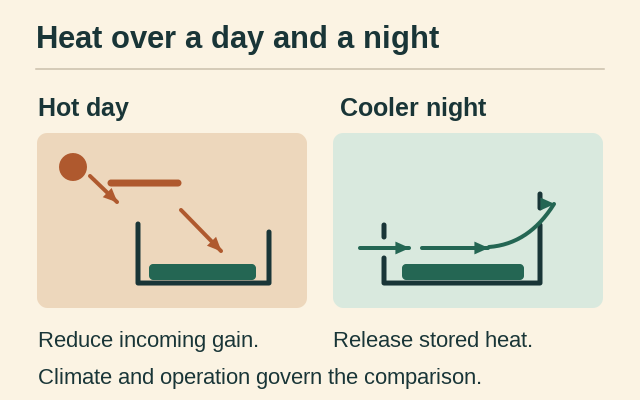
Imagine a small reading room in a place with hot afternoons and substantially cooler nights. In the unshaded first sketch, sunlight passes through a window and falls on a floor. Part of that sunlight is absorbed by the floor and other interior surfaces. Occupants and equipment can add heat even when no sun enters.
Now place a shade outside the window in the simplified comparison. During the selected hot part of the day it intercepts some light that would have reached the floor. This prevents part of the gain from reaching the room. An interior blind may reduce glare, but solar energy already inside the glazing can still warm interior material. These are two different ways to affect the room.
Shade changes an input before heat has to be stored or removed.
Delay is distinct from disposal
Picture a room with a substantial exposed slab compared to a lightweight one. An effective thermal mass can take up energy while its temperature changes relatively slowly. The slab can moderate or delay a peak over a daily cycle. The amount of energy it receives depends on contact and radiation paths, material and time. A slab hidden behind a thick floor finish may not take up heat in the same way.
The evening account still needs a destination. Without a way to release the stored energy or reduce repeated daytime gains, the mass can gradually warm or make the room warmer later than desired. Insulation reduces heat exchange through an assembly, which can help block heat from outside and can also slow release through that path. Neither material choice cancels the need for an energy budget.
Thermal mass can shift a change in temperature. It does not eliminate the energy.
Investigate and refine
Predict, compare the lenses and carry the explanation further.
The next sections refine the explanation. No interactive investigation has been attached to this publication.
Release heat under suitable conditions
When evening air is cooler than the reading room, ventilation can bring cool air into contact with warmer materials and carry energy out with the leaving air. In the example, this makes capacity available for the next day. The driving factors can include wind and differences in buoyancy, depending on openings and conditions. The diagram leaves those rates unspecified.
Reverse the assumption. If nights stay warm, bring poor outdoor air quality, or are too humid for an intended use, opening a path can fail to cool the room or create other problems. Some buildings need safe mechanical ventilation, humidity control or powered cooling. A different climate changes the decisions even when the reading-room drawing stays the same.
A passive discharge path works only when the actual surroundings and operation support it.
Ask what should be checked before relying on the sketch
The right shade depends on where the sun is at the relevant hours and season. An overhang that blocks high sun may admit low sun. A design may welcome winter solar gain that it wants to block on summer afternoons. Likewise, a night-flush assumption needs local weather and a safe way to operate openings.
For a real room, a designer would check climate, air quality, use, daylight, comfort and practical operation along with heat flow. The conceptual account separates three interventions: reduce the unwanted gain, manage when temperature changes, and find a safe path for energy to leave. The balance of those jobs is the design question.
Name the climate and purpose, then check which part of the account each choice changes.
Apply and connect
Try a new case, follow genuine relationships and check the sources.
Consider another case.
How would three days of warmer nights change the usefulness of the same slab and window strategy?
No assessment item is attached. Reading or marking this explanation studied does not award assessment evidence.
A useful explanation has edges.
- This is an invented seasonal scenario with no simulation, cooling performance prediction or dimensioned construction design.
- Climate, building use, pollution, humidity, fire and safety rules and other local requirements can change the choices. Implementation requires qualified site-specific review.
Follow the concepts.
A map can help you find a useful foundation or a different view. Every line below has a stated reason and a limit.
No direct published relationship is recorded for this selection yet. No connection is invented to fill the diagram.
Find a connected question with Seed Shuffle →Sources & authorship
This explanation was released through an explicit editorial review. Structural checks and an Owner or delegated editorial decision are not independent expert or scientific certification.
The sources below identify claim scope and consultation dates. Check the original material and its limits.
- Los Alamos National Laboratory · Sustainable Design Guide, Building Architectural Design ↗
The solar shading and passive solar subsections discuss blocking unwanted solar gain, season and local climate, and the use of thermal mass.
Source consulted 2026-11-17 - U.S. Department of Energy · Natural Ventilation and Cooling ↗
The briefing ties nighttime ventilation to outdoor temperature, wind, humidity and air quality, and describes removing stored heat using cooler air.
Source consulted 2026-11-17
Lesson lesson.architecture.passive-heat-moderation · Revision 1.0.0. Found a problem? Raise a content concern. This prepares a local note; no report is delivered by opening it.