Why is an orbit a kind of continual falling?
Gravity accelerates an orbiting body toward Earth. Its sideways motion carries it onward while gravity continuously bends its path. Where the speed and direction fit a bound path that misses the surface, the body keeps falling around Earth.
The same idea explains why things fall and why astronauts can float inside a spacecraft while Earth still pulls on them.
Start with the question
The answer, the explanatory gap and useful foundations.
Read in your own way
Start with the answer, refresh a foundation when you need it, or follow the explanation through. Read the ordered explanatory sections and check their stated sources and limits.
Everything here is open without an account. Saving is optional. The public subject tree is a map of published ideas; My Forest contains the subjects you choose to plant.
See the public Astronomy & Space Science tree →A foundation, without a detour.
Velocity tells us speed and direction. Acceleration means that velocity changes. A path can curve even at a steady speed because the direction changes.
Use a tangent to describe one instant
A tangent follows the instantaneous direction of motion along a curved path. In the small span after that moment, gravity starts turning the motion away from the tangent.
Develop the model
Follow the first explanatory steps without losing their qualifications.
A capsule above a spherical Earth
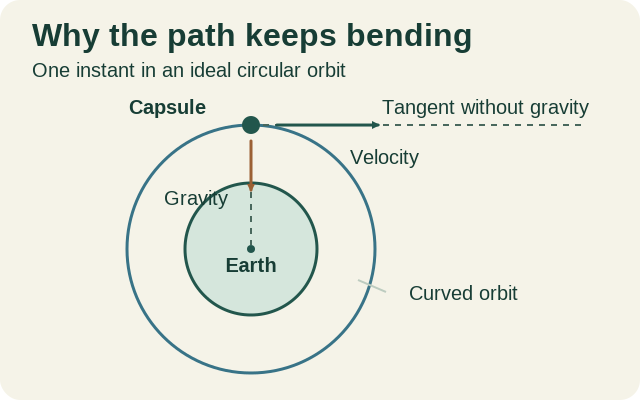
Imagine a tiny empty capsule already high above an ideal round Earth. Its engines are off. Ignore air and the gravity of the Moon and Sun for now. Draw an arrow showing its velocity at that moment. With no force, the capsule would continue in a straight line in the direction of the arrow. Earth’s gravity pulls the motion away from that line.
Gravity points inward, along the line from the capsule toward Earth’s center. As the capsule moves along its bent path, the inward direction rotates. An inward acceleration is a change to velocity, not an extra inward speed that piles up independently while the sideways speed stays fixed forever.
The direction of the unforced path and the direction of gravity are different at the moment shown.
A circle is a special balance of speed and curvature
Start with the velocity exactly sideways, perpendicular to the line to Earth’s center. For the right speed at that distance, Earth’s inward acceleration is just enough to keep the capsule on a circular path. Over a short step, the circle lies inward of the straight tangent. The acceleration sends the capsule the needed amount inward while the sideways motion carries it forward.
In that particular circle, gravity changes the velocity direction but the speed stays constant. Other starting speeds or directions produce other paths. An ellipse can also be an orbit, with distance and speed changing along the way. Some paths hit Earth. With enough energy, a path can also escape instead of looping.
Gravity turns the velocity. A circle requires a particular speed at a particular distance.
Investigate and refine
Predict, compare the lenses and carry the explanation further.
The next sections refine the explanation. No interactive investigation has been attached to this publication.
Set the boundaries of the picture
In a real spacecraft, gravity may vary slightly from one end to another. Air drag, equipment motion and occasional maneuvers can also change what objects do. The picture has no prediction for those small effects. It treats the capsule as small compared with its distance from Earth’s center.
To decide whether the next circuit will still miss the atmosphere or ground, a trajectory calculation needs the speed, direction and starting position together. Seeing a body high above Earth does not tell you its orbit. The point of the capsule model is to connect the motion along the path with the acceleration that keeps changing it.
Height alone does not establish which path the object will take.
Apply and connect
Try a new case, follow genuine relationships and check the sources.
Consider another case.
When speed changes along an elliptical orbit, where can gravity have a component along the motion?
No assessment item is attached. Reading or marking this explanation studied does not award assessment evidence.
A useful explanation has edges.
- Spherical, stationary Earth in an idealized Newtonian model. The schematic omits atmosphere, other bodies, changes in mass distribution and engines.
- The tangent and force arrows show one instant. No orbital distance, timing or maneuver is inferred from the figure.
Follow the concepts.
A map can help you find a useful foundation or a different view. Every line below has a stated reason and a limit.
No direct published relationship is recorded for this selection yet. No connection is invented to fill the diagram.
Find a connected question with Seed Shuffle →Sources & authorship
This explanation was released through an explicit editorial review. Structural checks and an Owner or delegated editorial decision are not independent expert or scientific certification.
The sources below identify claim scope and consultation dates. Check the original material and its limits.
- NASA Glenn Research Center · What is Microgravity? ↗
The orbit thought experiment and onboard examples connect sideways motion, free fall and reduced apparent weight.
Source consulted 2026-11-17 - NASA · Basics of Space Flight, Gravity & Mechanics ↗
Overview of gravity and Newtonian orbital motion. The lesson uses its qualitative account and treats the circle as a special case.
Source consulted 2026-11-17
Lesson lesson.astronomy-space-science.orbit-continual-falling · Revision 1.0.0. Found a problem? Raise a content concern. This prepares a local note; no report is delivered by opening it.