What is conserved when substances react?
In an ordinary chemical reaction, each element keeps the same number of atoms across the complete reaction. The total electric charge also balances. Atoms end up grouped in different substances, so the number of molecules, the volume and the state of matter can all change. To ordinary chemical precision, the total mass stays the same when the accounting includes everything. A balance that weighs only the solid can miss material that leaves as a gas.
A disappearing solid or a heavier piece of metal can look like a contradiction. A particle inventory and a clearly drawn system boundary let you tell a real gap in the explanation from a gap in what you weighed.
Stages organize this explanation. They do not mark it studied or award understanding.
Start with the question
The answer, the explanatory gap and useful foundations.
Read in your own way
Start with the answer, refresh a foundation when you need it, or follow the explanation through. The investigation lets you predict and compare reasoning before trying a new case.
Everything here is open without an account. Saving is optional. The public subject tree is a map of published ideas; My Forest contains the subjects you choose to plant.
See the public Chemistry tree →A foundation, without a detour.
You can recognize that a gas takes up space even when you cannot see it. That gas can carry some of the atoms and mass that used to belong to a solid.
An element has an identity
The number of protons in an atom’s nucleus identifies its element. Ordinary chemical reactions can move electrons and rearrange bonds while leaving those nuclei intact.
Every phase belongs in the inventory
A solid, a liquid and a gas all contribute mass. To use a scale reading in an explanation, say exactly which matter is included at the start and finish.
Develop the model
Follow the first explanatory steps without losing their qualifications.
Start with what the balance can see
Imagine reading the record of a laboratory that followed a pure sample of calcium carbonate, the compound in calcite. Under conditions that favor decomposition, some of the solid becomes solid calcium oxide and carbon dioxide gas. In the idealized record, the balance accounts for the solid and the carbon dioxide passes out of that part of the apparatus. A smaller solid mass is an expected result. Where did the missing part go?
Draw a boundary around the solid and watch for anything that crosses it. Before the reaction, the boundary contains the calcium carbonate. After it, the boundary contains the oxide and any remaining carbonate, while gas has carried some carbon and oxygen outward. We can also draw a broader boundary that counts the released gas. The two inventories refer to the same event but capture different parts of it.
This is a reasoning example about an existing laboratory reaction. We compare records and invent no actual measurement. The wider boundary is an accounting choice, such as including the released gas in a separate measured stream. It does not require imagining that trapping gas leaves the reaction conditions unchanged.
Name what was included on both sides of the mass comparison.
Track element by element through the change
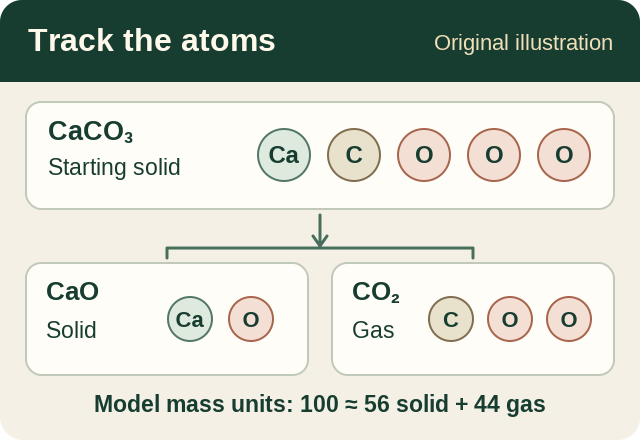
The net change is CaCO₃(s) → CaO(s) + CO₂(g), where (s) means solid and (g) means gas. A formula unit summarizes the proportions in an ionic solid. One CaCO₃ formula unit represents one calcium, one carbon and three oxygens in the bulk material. It does not picture a little isolated CaCO₃ molecule inside the crystal.
Now use the equation as a bookkeeping line. Calcium oxide accounts for one calcium and one oxygen. The carbon dioxide molecule accounts for one carbon and two oxygens. Added together, the products therefore count one calcium, one carbon and three oxygens. Each element has a destination. The oxygen count works because the gas contributes two of the three oxygens carried by the starting formula unit.
Scaling up doubles every amount together. If two formula units’ worth of carbonate reacts, the accounting yields two formula units’ worth of oxide and two molecules of carbon dioxide. Counting only the symbols before or after the arrow misses what the small numbers and leading multipliers mean. The formula describes the species. The multiplier says how many units enter this line of accounting.
Balance each element independently. A correct total atom count can still hide an error in one element.
Investigate and refine
Predict, compare the lenses and carry the explanation further.
Pause with a concrete case. Make a prediction, then compare the explanation before continuing.
Which record should be lighter?
Carbon dioxide contains the carbon that left the solid and two oxygens per carbon. The solid-only account leaves that part out. Counting both products recovers the full starting mass to the precision of this model.
What the records include
The solid-only record leaves out the outgoing gas. The combined record includes it. These are model accounts of the same change.
Find the destinations
Calcium stays in the oxide. Carbon moves into carbon dioxide. Oxygen is shared between the two products.
Read the rounded mass account
About 100 units of carbonate yield about 56 units of solid oxide plus 44 of carbon dioxide. Each value follows from the same simplified formula inventory.
Put the gas back into the mass account
Rounded atomic weights make an approximate mass comparison possible. Think of calcium as about 40 units, carbon as 12 and oxygen as 16 on the same relative scale. The calculation 40 + 12 + 3 × 16 gives about 100 units for the carbonate. The oxide accounts for about 56 units and the carbon dioxide for about 44. The solid has become lighter because the other 44 units are traveling with the gas.
Now compare a narrow record of the solid with a combined record of the solid and all gas from the same pure, fully converted sample. The narrow record predicts about 56 of the original 100 mass units. The combined record predicts about 100. These are proportional model values, not observations. A real sample can contain impurities, some carbonate can remain unreacted, and the balance has finite resolution.
For a boundary open to matter, a useful account is final amount = initial amount + amount entering − amount leaving. For total mass in this chemistry model, the reaction has no additional source or sink term. A particular substance does have one. Carbon dioxide can form inside the boundary even while the amount of carbon dioxide in that boundary remains small because it leaves.
A substance can be produced or consumed while all its constituent atoms are accounted for.
Count net charge as well as atoms
The carbonate equation uses electrically neutral formulas for both solids and the gas. That makes its charge check easy to overlook. In an ionic reaction, each charge matters. For example, Ag⁺ + Cl⁻ → AgCl(s) represents a silver ion and a chloride ion joining the solid silver chloride. The left side has one positive and one negative unit of charge, which sum to zero. The solid formula on the right is also neutral.
A single positive silver ion could not become a neutral silver atom all by itself just because there is one silver on each side. The electron needed to make that change must be present in the accounting. If charge is transferred across a boundary, the charge of the chosen region may change. A complete account includes the transfer and any reaction partners involved.
Atomic nuclei do not need to change for an ion’s net charge to change. Nor does a reaction have to preserve the number of freely moving ions or molecules. In both examples, identities at the level of individual elements persist even while quite different particles and materials emerge.
An atom tally and a charge tally are distinct checks. Both must close.
Use the model to ask for the missing evidence
Suppose the laboratory reports only that the solid lost mass. The carbonate model offers a reason to look for carbon dioxide, but a lower reading does not identify the gas. Water leaving a damp sample, loss of powder or a drifting balance could change the reading too. An independent gas identification and a check of the starting and remaining solids would test the model more directly.
Even a perfectly balanced equation is a constraint on possible descriptions. It tells you which atoms and charge must appear in the net account. It does not say how fast the reaction proceeds, what happens step by step or whether it goes to completion under the conditions. For this example, carbon dioxide around the solid can affect decomposition. Complete conversion was an explicit assumption of the rounded comparison.
Energy is another account. Decomposition can take in energy from outside while atoms stay within a chosen accounting boundary. At the precision used here, mass bookkeeping ignores the tiny mass-equivalent differences associated with energy. The practical lesson is to keep the matter and energy accounts visible instead of using one to explain away an unexplained gap in the other.
An equation proposes an inventory. Measurements test which materials and changes actually occurred.
Apply and connect
Try a new case, follow genuine relationships and check the sources.
Does your explanation travel?
Objective: Explain an apparent mass gain by accounting for matter that crossed the measured boundary.
What does this check show?
Select the account that includes the source of the oxygen that crossed into the solid. Distinguish a change within the narrow boundary from an unexplained change in the combined material.
This is a low-stakes authored choice question. A supported answer is evidence for this item’s objective, not certification or permanent mastery.
Explanatory feedback: The narrow boundary gained oxygen from outside. In a wider matter account the oxygen gained by the solid is oxygen lost by the gas. This explains the apparent gain without new atoms or an unchanged molecule count.
A useful explanation has edges.
- The sample record and rounded mass units are illustrative calculations for a pure, fully converted material. They are not benchmark results or a heating, sealing or gas-capture procedure.
- The net equation does not specify a temperature, pressure, microscopic pathway, reaction rate or whether a particular sample will fully react. Accumulated carbon dioxide can change the outcome.
- The explanation concerns ordinary chemical reactions, not nuclear change. Chemical mass accounting treats the mass-equivalent changes due to energy transfers as negligible at this precision.
Follow the concepts.
A map can help you find a useful foundation or a different view. Every line below has a stated reason and a limit.
No direct published relationship is recorded for this selection yet. No connection is invented to fill the diagram.
Find a connected question with Seed Shuffle →Sources & authorship
This explanation was released through an explicit editorial review. Structural checks and an Owner or delegated editorial decision are not independent expert or scientific certification.
The sources below identify claim scope and consultation dates. Check the original material and its limits.
- OpenStax Chemistry 2e §4.1 — Writing and Balancing Chemical Equations ↗
The sections on balancing and on ionic equations explain atom counts, coefficient ratios, species formulas and omitted spectator ions.
Source consulted 2026-11-17 - OpenStax Chemistry 2e §17.1 — Review of Redox Chemistry ↗
The half-reaction method shows that balancing atom counts and balancing net charge are separate requirements. The lesson uses its own examples.
Source consulted 2026-11-17 - Journal of Thermal Analysis and Calorimetry — Kinetic analysis of reversible solid-gas reactions in films ↗
The introduction gives the carbonate–oxide–carbon dioxide equation. The authors’ study of calcium carbonate films explains why the surrounding carbon dioxide partial pressure affects decomposition. The lesson does not reproduce the experimental conditions or results.
Source consulted 2026-11-17 - CIAAW — Abridged Standard Atomic Weights ↗
The carbon, oxygen and calcium entries provide the atomic weights used to compute the rounded 100 → 56 + 44 mass comparison for pure calcium carbonate.
Source consulted 2026-11-17 - Michigan State University — Conservation of mass: matter is accounted for too ↗
The conservation discussion distinguishes complete accounting from a measurement that leaves out escaping gases or material entering the environment.
Source consulted 2026-11-17 - West Texas A&M University — Why is mass conserved in chemical reactions? ↗
The distinction between exact element inventories and ordinary chemical mass accounting, including the tiny rest-mass effect of binding energy and energy exchange.
Source consulted 2026-11-17
Lesson lesson.chemistry.reaction-conservation · Revision 1.0.0. Found a problem? Raise a content concern. This prepares a local note; no report is delivered by opening it.