How can the same words support more than one sentence meaning?
Words can combine into groups in more than one way. If the same phrase can describe either an action or a person involved in it, the same sentence may support two readings. Context can favor one reading without erasing the other structure.
A confusing sentence is sometimes doing more than using a vague word. Understanding its possible structures tells you what you need to ask or rewrite.
Start with the question
The answer, the explanatory gap and useful foundations.
Read in your own way
Start with the answer, refresh a foundation when you need it, or follow the explanation through. Read the ordered explanatory sections and check their stated sources and limits.
Everything here is open without an account. Saving is optional. The public subject tree is a map of published ideas; My Forest contains the subjects you choose to plant.
See the public English Language & Linguistics tree →A foundation, without a detour.
A phrase is a group of words that works as a unit within a larger expression. One ordinary job of a phrase is to say something about another group of words.
One phrase can do different jobs
“With a drone” can describe equipment used for an action. It can also identify someone carrying that equipment. The particular sentence determines which attachments are possible.
Develop the model
Follow the first explanatory steps without losing their qualifications.
A photograph with an ambiguous description
Mira writes, “I photographed the cyclist with a drone.” The cyclist was moving along a track. Mira had a camera and the cyclist had a bag. The sentence does not say what was in the bag or how Mira made the picture. Before imagining more details, try writing out two different scenes that would make her report true.
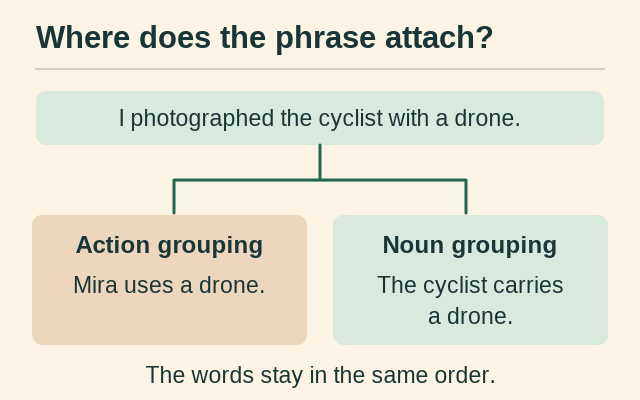
In one, Mira operates a drone to photograph the cyclist. In the other, Mira uses a camera on the ground and photographs the cyclist who is carrying a drone. Those scenes assign different jobs to the same words “with a drone.” The example is fictional and the noun drone can refer to the same kind of object in both readings.
The ambiguity is about who is associated with a drone and how it enters the action.
Draw the two groupings
In the first reading, group “photographed the cyclist” and add “with a drone” as a description of how Mira photographed. Linguists call this attachment to the verb phrase. In the second, group “the cyclist with a drone” as the person photographed. The added phrase belongs within the noun phrase.
You can test your reading with a paraphrase. “Using a drone, I photographed the cyclist” makes the equipment the means of photographing. “I photographed the cyclist who was carrying a drone” puts the drone with the cyclist. The paraphrases add clarity because they make the intended relationship explicit.
The same word sequence can support different constituent boundaries.
Investigate and refine
Predict, compare the lenses and carry the explanation further.
The next sections refine the explanation. No interactive investigation has been attached to this publication.
The likely reading can shift
A preceding sentence about aerial cameras would make equipment used by Mira a natural interpretation. A preceding sentence about selecting a rider from a crowd, one who carried equipment for filming later, could make the second interpretation easier. A likely reading is an inference made with the surroundings of the sentence.
Spoken delivery and gestures might help a listener. Written punctuation or a clearer wording can help a reader. If the distinction matters to who receives credit for a photograph, ask which of the two events happened. Confidence that an interpretation is common does not identify the facts of a particular case.
Context can resolve an ambiguity in use without changing the general grammar.
Know what kind of ambiguity you found
Compare a report that says “A crane is blocking the view.” If the ambiguity is between a bird and a piece of lifting equipment, it may arise from the meanings the word crane can carry. Mira’s photograph example works even if drone retains one meaning throughout. The ambiguity lies in the grouping.
These sketches address a specific written English example. People can judge the naturalness of the readings differently, and other languages organize modifiers differently. Analysis begins with what the actual sentences allow in their contexts. It does not use an unusual construction as an excuse to rank its speakers.
Check whether the difference comes from a word’s meaning or from the structure around it.
Apply and connect
Try a new case, follow genuine relationships and check the sources.
Consider another case.
How might a speaker’s pauses help listeners detect which grouping was intended, and when would pauses be insufficient?
No assessment item is attached. Reading or marking this explanation studied does not award assessment evidence.
A useful explanation has edges.
- The original example is in written English. The simplified groupings omit other layers of syntactic analysis.
- Usage and context can favor a reading. The diagram does not predict equal frequencies or represent all varieties.
Follow the concepts.
A map can help you find a useful foundation or a different view. Every line below has a stated reason and a limit.
No direct published relationship is recorded for this selection yet. No connection is invented to fill the diagram.
Find a connected question with Seed Shuffle →Sources & authorship
This explanation was released through an explicit editorial review. Structural checks and an Owner or delegated editorial decision are not independent expert or scientific certification.
The sources below identify claim scope and consultation dates. Check the original material and its limits.
- Essentials of Linguistics, 2nd ed., §6.17 · Trees: Structural ambiguity ↗
Pages 349–352 explain ambiguity from noun-phrase versus verb-phrase attachment. The example and attachment sketch in this lesson are original.
Source consulted 2026-11-17
Lesson lesson.english-language-linguistics.structural-ambiguity · Revision 1.0.0. Found a problem? Raise a content concern. This prepares a local note; no report is delivered by opening it.