Why can extra nutrients reduce oxygen available to aquatic life?
Extra nutrients can stimulate growth. When organic matter from that growth is broken down, organisms consume dissolved oxygen. If mixing and other sources supply less oxygen than is being consumed, the oxygen concentration can fall enough to stress aquatic life.
A surface bloom can produce oxygen in sunlight while deeper water loses it. Following the different depths and processes helps explain both observations at once.
Start with the question
The answer, the explanatory gap and useful foundations.
Read in your own way
Start with the answer, refresh a foundation when you need it, or follow the explanation through. Read the ordered explanatory sections and check their stated sources and limits.
Everything here is open without an account. Saving is optional. The public subject tree is a map of published ideas; My Forest contains the subjects you choose to plant.
See the public Environmental Science tree →A foundation, without a detour.
Dissolved oxygen is oxygen gas present in water. Many aquatic organisms use it in respiration. Nutrients such as compounds containing nitrogen or phosphorus can support growth where they are limiting.
An oxygen budget counts sources and sinks
Photosynthesis and exchange can add oxygen to a layer. Respiration uses it. Movement between layers can change whether supply reaches the organisms that need it.
Develop the model
Follow the first explanatory steps without losing their qualifications.
More growth at the surface
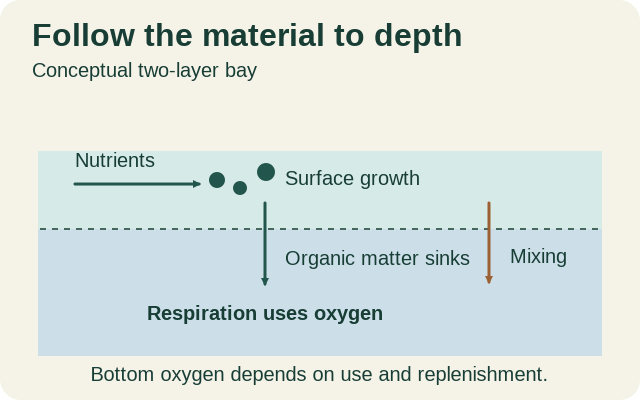
Picture an invented shallow coastal bay with light reaching the top layer. A river carries additional dissolved nutrients into the bay. If one of those nutrients had limited growth, and there is enough light and suitable temperature, phytoplankton may grow faster. Photosynthesis can add oxygen in the well-lit layer during the day.
Extra nutrients do not carry a simple instruction for oxygen to disappear. The result depends on which organisms grow, where the water goes and what happens to the new organic material. Hold onto that distinction as something from the surface drifts downward.
A nutrient input can increase production under suitable conditions. That is the first step.
Respiration consumes oxygen deeper down
Some organic matter reaches deeper water. Aerobic microbes break part of it down and consume oxygen dissolved there. Animals and other microbes also respire. If little light reaches the lower layer, it has less local photosynthetic oxygen production than the surface.
The lower layer receives oxygen when oxygenated water mixes into it or flows through it. If the bay has a light surface layer above denser bottom water, stratification can restrict exchange. The oxygen concentration falls when use exceeds replenishment. Better mixing could increase supply even during a period with similar production above.
Low bottom oxygen follows from a local imbalance in the rate of supply and consumption.
Investigate and refine
Predict, compare the lenses and carry the explanation further.
The next sections refine the explanation. No interactive investigation has been attached to this publication.
A survey captures one period and place
A NOAA-supported ship survey on July 21–26, 2024 estimated roughly 6,705 square miles of low-oxygen water in the northern Gulf of Mexico. The estimate concerns a particular survey over a particular area. It is not directly a measurement of how many fish were lost, or a fixed yearly extent.
The NOAA integrated assessment brings together evidence on nutrient loading, production, sinking organic matter and circulation. Water-column conditions and weather can alter the pattern. Two surveys of the same surface area might also measure different oxygen concentrations at a given station or different thicknesses of the oxygen-poor layer. These distinctions matter when relating a map to the conditions organisms experience.
Keep the dated measurements distinct from a process-based explanation of their causes.
What could make a different result?
Imagine two years with similar nutrient inputs. One summer keeps waters strongly layered for longer. The other brings more mixing during the time the material sinks. The bottom need not lose oxygen at the same rate, even if the surface blooms look similar.
Researchers can compare oxygen measurements across depth and time with the river loads, water temperature, salinity and circulation. Species can differ in how they respond to low oxygen and in their ability to move away. The model explains a mechanism without using water color or a nutrient number by itself to judge an ecosystem’s condition.
Measure production, oxygen use and replenishment at the depths where each occurs.
Apply and connect
Try a new case, follow genuine relationships and check the sources.
Consider another case.
What observations would distinguish faster oxygen consumption from slower replenishment when bottom oxygen falls?
No assessment item is attached. Reading or marking this explanation studied does not award assessment evidence.
A useful explanation has edges.
- The diagram models a hypothetical bay. The real Gulf number refers to a July 2024 survey estimate, and does not indicate this year’s extent or any count of affected animals.
- Nutrient limitation, mixing and oxygen requirements vary. The model does not identify one universal response to enrichment.
Follow the concepts.
A map can help you find a useful foundation or a different view. Every line below has a stated reason and a limit.
No direct published relationship is recorded for this selection yet. No connection is invented to fill the diagram.
Find a connected question with Seed Shuffle →Sources & authorship
This explanation was released through an explicit editorial review. Structural checks and an Owner or delegated editorial decision are not independent expert or scientific certification.
The sources below identify claim scope and consultation dates. Check the original material and its limits.
- NOAA National Ocean Service · An Integrated Assessment of Hypoxia in the Northern Gulf of Mexico ↗
The assessment describes nutrient enrichment, organic material reaching deeper water, oxygen depletion, stratification and the remaining physical influences.
Source consulted 2026-11-17 - NOAA · Gulf of Mexico Dead Zone Larger Than Average, 1 August 2024 ↗
The release reports the approximate area found by the July 21–26, 2024 survey and distinguishes measurements from the prior forecast. No photography or graph from this release is reused.
Source consulted 2026-11-17
Lesson lesson.environmental-science.nutrients-and-low-oxygen · Revision 1.0.0. Found a problem? Raise a content concern. This prepares a local note; no report is delivered by opening it.