How can a stage direct attention without changing the script?
A production presents speech alongside movement, light, sound, positions and timing. Changing where those cues fall can make a different action available or prominent, even when the written dialogue and events stay the same.
A script can leave designers and performers many choices about how a moment becomes visible. Describing an actual cue and its possible effect is more useful than assuming there is one correct staging.
Start with the question
The answer, the explanatory gap and useful foundations.
Read in your own way
Start with the answer, refresh a foundation when you need it, or follow the explanation through. Read the ordered explanatory sections and check their stated sources and limits.
Everything here is open without an account. Saving is optional. The public subject tree is a map of published ideas; My Forest contains the subjects you choose to plant.
See the public Film & Theatre Studies tree →A foundation, without a detour.
A script records words and may specify actions or positions. A performance realizes those directions from many different viewpoints at once. Blocking places and moves performers in the space.
Salience is a relation
A figure in a brighter area can be easier to notice against nearby dimmer areas. The result depends on where the figure is, what else moves, and what a particular viewer can see.
Develop the model
Follow the first explanatory steps without losing their qualifications.
Two performers, one short exchange
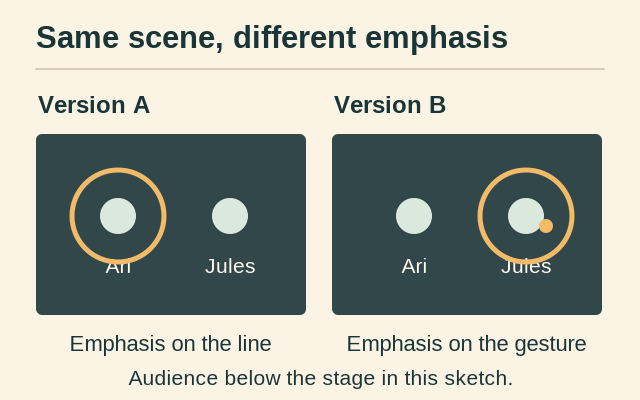
In an invented stage scene, Ari speaks the line “I’ll be back before dark.” Jules says nothing and slips a brass button into a pocket. Keep the words and silent action unchanged in both versions. The action is in the script in this case, but the script does not assign a spot on stage or say what should be brightest.
In version A, Ari stands inside the most immediately noticeable pool of light, downstage closer to the audience. Jules’s hands remain in a dimmer part of the scene. A viewer who attends to the speech may miss the button and understand the exchange around Ari’s promise. That is a plausible reading, not a measurement of viewers.
The script holds constant while a production varies which evidence is prominent.
Shift emphasis with the same words
In version B, Jules stands where the hand movement is visible. A modest change in light makes the button catch a highlight just before it goes into the pocket. Ari still says the same line at the same point. The visual cue can invite the audience to hear Ari’s promise against Jules’s concealed action.
Position, movement and light support each other here. If Jules blocks the object with a turned body, more light may not make the hand visible from some seats. If another performer crosses at the same time, the brief motion can compete with the cue. You can trace the proposed effect as an interaction among choices rather than a single beam deciding for everyone.
An emphasized gesture still needs a usable sightline and room among other cues.
Investigate and refine
Predict, compare the lenses and carry the explanation further.
The next sections refine the explanation. No interactive investigation has been attached to this publication.
A moment arrives through more than sight
A director could place a short silence before the action or an audible click when the button touches another object. Those choices produce a different form of emphasis from brightness. A visible gesture and its sound can reinforce each other, or the performance might let one remain uncertain. Depending on the production, access services can communicate a detail by another channel.
It matters who the audience is and where the performers stand. An intimate stage or a stage surrounded by people offers very different sightlines from a single framed view. Interpretations of the button can also vary even if every viewer notices it. Visibility is a condition for some readings, not evidence that every viewer formed the same one.
Design can change available evidence without determining every response to it.
Describe the cue in terms someone can check
From several positions, ask whether it is possible to identify the hand action, and when the movement becomes visible. Compare with the words and sound that overlap it. If the same gesture only reads from one region of the room, moving the performer or altering the composition may accomplish more than making the light stronger.
Document what you changed and what you could see, then reserve interpretations such as suspicion or tenderness for a separate discussion of the whole scene. The production can direct attention by controlling how evidence arrives. It cannot ensure what any particular viewer will conclude from that evidence.
Check concrete cue timing and visibility before claiming what the scene means.
Apply and connect
Try a new case, follow genuine relationships and check the sources.
Consider another case.
How could the same button action become meaningful to people in opposite parts of the audience without adding a spoken explanation?
No assessment item is attached. Reading or marking this explanation studied does not award assessment evidence.
A useful explanation has edges.
- The dialogue, staging and diagram are invented. There are no audience data or borrowed performance images.
- The illustration is conceptual and not an equipment, hanging, wiring or accessibility plan. Interpretation depends on production and viewing position.
Follow the concepts.
A map can help you find a useful foundation or a different view. Every line below has a stated reason and a limit.
No direct published relationship is recorded for this selection yet. No connection is invented to fill the diagram.
Find a connected question with Seed Shuffle →Sources & authorship
This explanation was released through an explicit editorial review. Structural checks and an Owner or delegated editorial decision are not independent expert or scientific certification.
The sources below identify claim scope and consultation dates. Check the original material and its limits.
- NYU Resource Guide · Design: Lighting ↗
The focus and visibility notes identify relative intensity as one means of making elements salient. The lesson does not generalize the guide’s examples of color and mood.
Source consulted 2026-11-17
Lesson lesson.film-theatre-studies.stage-attention · Revision 1.0.0. Found a problem? Raise a content concern. This prepares a local note; no report is delivered by opening it.