Why can two loans with the same advertised rate cost different amounts?
An interest rate tells you part of how the amount owed changes. Total borrowing cost also depends on fees, how long a balance stays unpaid and when payments are due. Loans with the same stated interest rate can therefore have different net cash amounts and total repayments.
A percentage is short enough to put in an advertisement. To understand what a contract would cost in a worked example, rewrite it as money received, outgoing payments and dates.
Stages organize this explanation. They do not mark it studied or award understanding.
Start with the question
The answer, the explanatory gap and useful foundations.
Read in your own way
Start with the answer, refresh a foundation when you need it, or follow the explanation through. The investigation lets you predict and compare reasoning before trying a new case.
Everything here is open without an account. Saving is optional. The public subject tree is a map of published ideas; My Forest contains the subjects you choose to plant.
See the public Finance tree →A foundation, without a detour.
You know that 6 percent of 1,000 is 60. In this lesson the rate matters because we identify which amount it is applied to and how long that amount remains outstanding.
Principal and interest
Principal is the amount borrowed or still unpaid. Interest is an amount charged for using that money. An origination fee is a separate charge in our example.
Time stays in the calculation
Amounts can occur on different dates. Adding them gives a nominal money total, which has a different meaning from an annualized comparison.
Develop the model
Follow the first explanatory steps without losing their qualifications.
Start with two deliberately similar loans
Imagine two classroom contracts labelled A and B. Each advances 1,000 units of money, charges 6 percent simple interest for one year and requires a single repayment at year end. Assume the full amount stays outstanding until then. There are no late payments, variable rates, taxes, extra products or early repayment. These clauses make the interest calculation the same for both contracts.
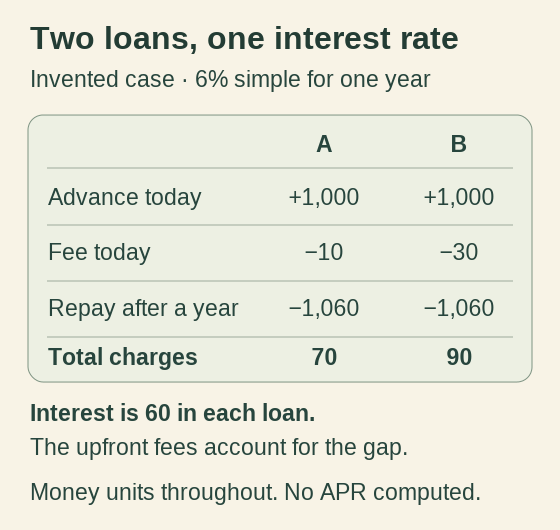
Multiply the one-year balance of 1,000 by 0.06. Each interest charge is 60. The end-of-year payment is 1,060 in both cases because it returns the principal as well. The difference shows up at the start. A charges a fee of 10, paid immediately. B charges 30 in the same way. The rate headline does not contain those cash movements.
Equal interest charges need the same relevant conditions as well as an equal rate.
Write a dated ledger for each loan
For A, record +1,000 and −10 at the start, then −1,060 after one year. The borrower’s net cash on the first date is 990. The sum of outgoing payments is 1,070. Subtract the 1,000 borrowed to isolate 70 in interest and fees. This is a nominal currency amount under the stated timetable.
For B, the first-day movements are +1,000 and −30, leaving 970. The last payment remains 1,060. The outgoing sum is 1,090, so the borrowing charges add to 90. The fee difference of 20 explains the full gap in this case. Both ledgers record the same principal and the same rate. Keeping the fees on their actual dates makes the difference visible.
The upfront cash available and the total charges are different quantities.
Investigate and refine
Predict, compare the lenses and carry the explanation further.
Pause with a concrete case. Make a prediction, then compare the explanation before continuing.
When does the fee leave the borrower?
Paid upfront in these cases, the fee does not add to principal. The parties have the same end payment and different initial cash and total charges.
Contract facts
Both advance 1,000 and repay 1,060 after one year under the stated simple interest rule. The fees are paid separately.
Keep the cash in a ledger
Place each upfront movement on the first date and the repayment on the final date. Track fees and interest separately from returned principal.
Initial cash and nominal charges
A starts with net 990 and totals 70 in charges. B starts with net 970 and totals 90 in charges.
Change the balance or timing and follow the consequence
Imagine a revised contract in which a 30-unit fee is added to the borrowed balance rather than paid immediately. The original 1,000 units can now reach the borrower without a separate 30-unit payment at the outset. If the contract charges the same simple rate on the full 1,030 balance for this year, the interest is 61.80 and the final payment is 1,091.80. The rate did not change, but the amount to which it was applied did.
Similarly, two loans with regular repayments may carry different balances over time. More of the principal can stay unpaid for longer under one schedule. A smaller monthly payment can coexist with higher total interest. This does not follow from the payment size alone, and we did not measure either schedule in the original single-payment example. You would need its actual repayment terms.
Interest depends on what is outstanding and when, while fees can themselves change what is outstanding.
Keep an interest rate, an APR and a total in different columns
The Consumer Financial Protection Bureau uses U.S. borrowing examples to explain the difference between the stated interest rate and an annual percentage rate, or APR. An APR is designed as an annualized measure including applicable charges under the rules of a particular disclosure. It is not calculated here by simply adding a currency amount to a percentage. Which fees count and how dates enter can depend on the product and jurisdiction.
What did we establish? Loan A had 70 units of nominal charges in the stated classroom case and B had 90. These are totals, not APRs. Turning the cash-flow schedule into an annualized measure is a different calculation. Even an annualized comparison does not tell you the raw total paid without other information such as the amount and term. Put both quantities beside the schedule before interpreting them.
Label the unit of every number. A currency total and an annualized percentage answer different questions.
State what the advertisement leaves unanswered
Suppose the only information visible for a third loan is “6 percent.” You do not know whether that describes an interest rate, a promotional period or a legally defined APR. You also cannot infer the net amount received, fees, duration or repayment pattern. The strongest conclusion is that equal headlines leave those terms unresolved.
The useful next action for the model is to fill in the missing ledger entries from actual terms, not guess a better contract from the headline. Apply the same comparison assumptions to both. If one schedule includes a late charge or a contingent change, separate the ordinary scheduled costs from the uncertain event that would create that payment. A clear ledger exposes where the uncertainty lives.
Before comparing two loan costs, identify the amount, dates, fees and meaning of the advertised number.
Apply and connect
Try a new case, follow genuine relationships and check the sources.
Does your explanation travel?
Objective: Compare nominal charges and start-of-loan cash under an explicitly shared interest rule.
What does this check show?
Retain the original amount, interest calculation, and specified timing of the fees. Distinguish interest, final payment and total cost.
This is a low-stakes authored choice question. A supported answer is evidence for this item’s objective, not certification or permanent mastery.
Explanatory feedback: The 25-unit interest is shared. The fees differ by 10 and are not financed, so the final payments are equal and the nominal total fees and interest differ by 10.
A useful explanation has edges.
- All amounts are invented and expressed in classroom units. No offer, product, rate forecast or borrowing recommendation is presented.
- The example assumes simple interest on a constant balance for one year unless the contract is changed explicitly. It does not implement APR regulations or cover every repayment structure.
- Disclosure rules vary by place, product and date. Qualified financial accuracy review is needed before publication.
Follow the concepts.
A map can help you find a useful foundation or a different view. Every line below has a stated reason and a limit.
No direct published relationship is recorded for this selection yet. No connection is invented to fill the diagram.
Find a connected question with Seed Shuffle →Sources & authorship
This explanation was released through an explicit editorial review. Structural checks and an Owner or delegated editorial decision are not independent expert or scientific certification.
The sources below identify claim scope and consultation dates. Check the original material and its limits.
- Consumer Financial Protection Bureau · What is the difference between a loan interest rate and the APR? ↗
The U.S. consumer agency distinguishes the interest rate from a broader annualized measure that includes applicable loan fees. Its disclosure discussion is scoped to its own context. The classroom example performs only money arithmetic.
Source consulted 2026-11-17 - Consumer Financial Protection Bureau · How do I compare auto loan offers? ↗
The agency’s term example shows that monthly payment and lifetime interest are different amounts. The new lesson uses an original single-repayment model and no current offer.
Source consulted 2026-11-17
Lesson lesson.finance.loan-cash-flows · Revision 1.0.0. Found a problem? Raise a content concern. This prepares a local note; no report is delivered by opening it.