How can a game teach a rule through feedback rather than instruction?
When a game clearly shows the consequence of a choice, a player can compare attempts and infer a rule. A small, reversible encounter helps separate relevant differences from other changes. Feedback can support learning without guaranteeing that every player will discover the rule.
A result can be correct and still leave a player unable to tell why it happened. Designers can make causal differences easier to notice and then check whether a new player can apply that knowledge elsewhere.
Start with the question
The answer, the explanatory gap and useful foundations.
Read in your own way
Start with the answer, refresh a foundation when you need it, or follow the explanation through. Read the ordered explanatory sections and check their stated sources and limits.
Everything here is open without an account. Saving is optional. The public subject tree is a map of published ideas; My Forest contains the subjects you choose to plant.
See the public Game Design & Interactive Media tree →A foundation, without a detour.
A game state includes the current positions, counters or other values. An action changes the state or leaves it as it was. Feedback is the perceptible response to what the game accepted or refused.
A failure can say very little
A gate remaining closed tells us it did not open. A nearby status indicator can reveal which condition is still unmet, giving the next attempt a reason.
Develop the model
Follow the first explanatory steps without losing their qualifications.
A gate and two reversible turns
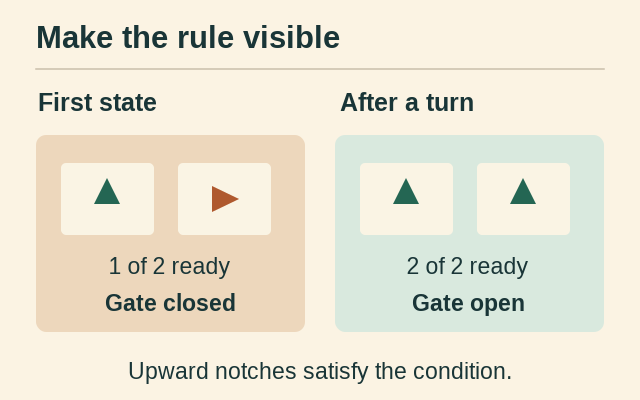
Imagine a small invented puzzle. Two square tokens each have a triangular notch on one edge. To open a gate, both notches must point up. At the start the left notch already points up and the right notch points sideways. A player can turn either token ninety degrees at a time, and can undo any turn. In the example these are the only state-changing actions in this encounter.
In a minimal version, the player sees only a closed gate. Turning the right token once may open it. A lucky first try gives a correct outcome but little reason to believe the player knows the rule. When nothing opens after an action, the player may not know whether the turn registered or whether the position mattered.
One successful transition can leave several explanations consistent with what the player observed.
Add feedback that narrows the explanation
Place a small indicator next to each token. It changes visibly when that token’s notch points up. Add a separate indicator at the gate that shows one of two or two of two conditions met. Rotating the right token can now be followed from action to state to result. Return it to its starting position and the token and gate indicators change back.
The player can vary one token while the other stays put. If the count changes only when a notch points up, that provides support for a reusable rule. A different design might use a shape, a short sound or labels and states that can be read by assistive technology. Color alone would prevent some players from receiving the intended comparison.
A good cue identifies a relevant change at the time a player can still connect it with an action.
Investigate and refine
Predict, compare the lenses and carry the explanation further.
The next sections refine the explanation. No interactive investigation has been attached to this publication.
A second layout is a fairer check
For the next room, start the right token pointing up and the left token pointing down. The action that worked first in the previous room may now make matters worse. If the player turns the left token until both notches point up, then explains why the same rule worked in a different setup, that is better evidence than opening one gate by chance.
This kind of transfer check looks for more than completion time. A tester can explain what changed and what they predict before making the next move. If they cannot find the cue or repeatedly try irrelevant actions, observe where the reasoning stops. The design may need a clearer response, a written hint, or a less cluttered first encounter.
Test a new initial state to distinguish an understood rule from a remembered action.
Feedback and explicit directions can work together
Some rules cannot be understood from a few safe attempts, and some players prefer a direct statement. The design can present short instructions or an optional hint while still making state changes legible. Reversible failure and accessible channels make the first encounter easier to investigate. They do not remove the obligation to check an actual design with actual players.
Describe which clue was supposed to teach which rule, then compare the claim with observed playtesting. The MIT course’s assignment asks designers to collect first-time observations and explain how these affect revisions. Our gate example is one way to specify a testable claim about feedback. It supplies no findings about real players.
Use feedback to make a rule observable, then test whether it has become usable.
Apply and connect
Try a new case, follow genuine relationships and check the sources.
Consider another case.
Which player observations would show that a cue is clear but the underlying rule remains misunderstood?
No assessment item is attached. Reading or marking this explanation studied does not award assessment evidence.
A useful explanation has edges.
- The invented puzzle has no observed playtest and no proprietary game materials.
- Feedback alone can be inaccessible or insufficient. The example does not establish a universal tutorial or a measure of learning.
Follow the concepts.
A map can help you find a useful foundation or a different view. Every line below has a stated reason and a limit.
No direct published relationship is recorded for this selection yet. No connection is invented to fill the diagram.
Find a connected question with Seed Shuffle →Sources & authorship
This explanation was released through an explicit editorial review. Structural checks and an Owner or delegated editorial decision are not independent expert or scientific certification.
The sources below identify claim scope and consultation dates. Check the original material and its limits.
- MIT OpenCourseWare CMS.608 · Written Rules Style Guide ↗
The course guide separates components, turn sequence, exceptions and objectives and uses visual states to illustrate rules. No example game or text is carried over.
Source consulted 2026-11-17 - MIT OpenCourseWare CMS.301 · Assignment 8, Step 4 ↗
The assignment distinguishes describing a prototype from observing first-time playtesters and revising a design using actual observations.
Source consulted 2026-11-17
Lesson lesson.game-design-interactive-media.feedback-and-rule-learning · Revision 1.0.0. Found a problem? Raise a content concern. This prepares a local note; no report is delivered by opening it.