How does a narrator shape what a reader can know?
A narrator selects which events, thoughts and explanations to report and when to report them. A reader may be given access to one character’s suspicions and left to infer another character’s motives until further evidence appears.
A story can change its meaning by changing access to the event rather than changing the event itself. Separating what is reported from what is inferred makes interpretations easier to defend.
Start with the question
The answer, the explanatory gap and useful foundations.
Read in your own way
Start with the answer, refresh a foundation when you need it, or follow the explanation through. Read the ordered explanatory sections and check their stated sources and limits.
Everything here is open without an account. Saving is optional. The public subject tree is a map of published ideas; My Forest contains the subjects you choose to plant.
See the public Literature tree →A foundation, without a detour.
A writer creates an account of an event. Within that account, the narrator is the voice doing the telling. A character whose experience guides what we see may also be the voice, or those roles may be separate.
A belief inside a story is still a belief
“I knew the room had been locked to keep me out” gives the narrator’s confidence. A later sentence can confirm or contradict the supposed motive.
Develop the model
Follow the first explanatory steps without losing their qualifications.
A lock that seems personal
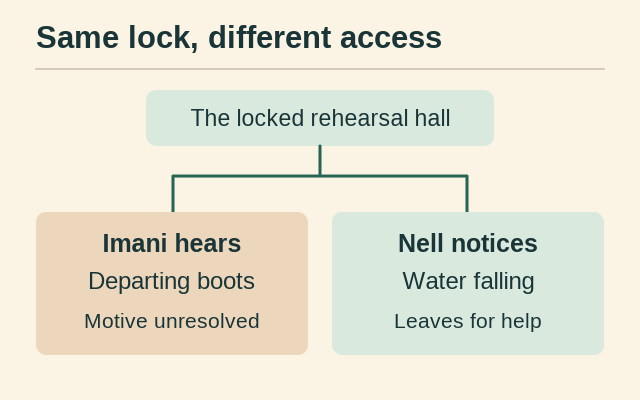
Read a line from our invented rehearsal story: “The key was gone. I put my ear to the hall door and heard the caretaker’s boots retreat.” Imani, the actor telling this version, thinks her rehearsal has been canceled to make room for another cast. The sound and missing key are available to her. The caretaker’s reason is not.
Notice the invitation to infer a connection. The boots retreat just when Imani looks for the key. The account reports a sequence, and a reader may infer a deliberate exclusion. But “retreat” is already a choice of description, and the bare fact that someone walked away cannot explain that intention on its own.
Distinguish the clue the narrator gives from the motive a reader supplies.
Give the event another range of access
Here is a second original version of that instant: “Nell tucked the key in her pocket. Behind the door a bead of water fell from one ceiling tile onto another. She went to find the repair number.” This version reports an observation and a goal that Imani’s earlier position leaves out. The lock and the departing boots can be unchanged.
The sequence also changes the reader’s relation to Imani’s fear. If the leak is revealed first, a reader may know more than Imani as she approaches the hall. If it is revealed only several pages later, a reader may reconsider their earlier inference about the caretaker. Timing matters along with what any single sentence says.
Withholding or releasing a detail changes the reader’s knowledge at a particular moment.
Investigate and refine
Predict, compare the lenses and carry the explanation further.
The next sections refine the explanation. No interactive investigation has been attached to this publication.
Third person can still be limited
“Imani heard the boots retreat” uses third person and can still restrict access to her experience. Replacing “I” with “she” need not open the caretaker’s thoughts. A third-person account can also alternate between characters or offer information unavailable to any of them. Listen for who tells, then check whose knowledge the telling follows.
Limited access need not make a narrator deceitful. Imani might report every available sign accurately and still draw the wrong conclusion. A later account outside her viewpoint can clarify what she reasonably overlooked. The same technique can make an accurate report tense without changing the reported event.
Grammatical person and permitted knowledge are related choices, not identical ones.
Explain the effect with textual evidence
A defensible claim for this example is that limiting the first version to Imani makes the caretaker’s intention an open question. Point to the audible boots and the absence of the leak. If you claim the caretaker is definitely hostile after the first passage, those clues do less work than the claim requires.
Different readers may suspect different causes. Compare the wording, the order of evidence and the reader’s access at each point. That practice leaves room for more than one reading while giving us a way to say why one explanation fits the passage better.
Support an interpretation with what each version actually reports and omits.
Apply and connect
Try a new case, follow genuine relationships and check the sources.
Consider another case.
How would the effect change if the narrator told the truth about the leak but deliberately omitted the fact that Imani was beside the door?
No assessment item is attached. Reading or marking this explanation studied does not award assessment evidence.
A useful explanation has edges.
- Both passages and characters are original fiction.
- The example isolates information access; real narratives can switch voices, quote testimony, handle time unevenly or leave motives unresolved.
Follow the concepts.
A map can help you find a useful foundation or a different view. Every line below has a stated reason and a limit.
No direct published relationship is recorded for this selection yet. No connection is invented to fill the diagram.
Find a connected question with Seed Shuffle →Sources & authorship
This explanation was released through an explicit editorial review. Structural checks and an Owner or delegated editorial decision are not independent expert or scientific certification.
The sources below identify claim scope and consultation dates. Check the original material and its limits.
- OpenStax Writing Guide with Handbook §4.6 · Characterization and Point of View ↗
The sections on first and third person distinguish who tells a story from which observations and thoughts that choice can present.
Source consulted 2026-11-17
Lesson lesson.literature.narrator-access · Revision 1.0.0. Found a problem? Raise a content concern. This prepares a local note; no report is delivered by opening it.