Why does changing motion require a net force?
A net external force changes the velocity of a constant-mass object. Acceleration follows the direction of the net force. An object with no net force can stay still or continue moving at constant velocity.
A forward push is easy to notice, so we often treat it as the reason anything keeps moving. The force account is more precise. It predicts when an object speeds up, slows down, or changes direction.
Start with the question
The answer, the explanatory gap and useful foundations.
Read in your own way
Start with the answer, refresh a foundation when you need it, or follow the explanation through. The investigation lets you predict and compare reasoning before trying a new case.
Everything here is open without an account. Saving is optional. The public subject tree is a map of published ideas; My Forest contains the subjects you choose to plant.
See the public Physics tree →A foundation, without a detour.
Think of a cart observed from the floor of a lab. Speed tells how fast it travels. Velocity records both speed and direction. A change in either one is a change in velocity.
Direction belongs in the calculation
Call east positive. A 6-newton force east and a 2-newton force west add to +4 newtons. The negative sign on the westward contribution encodes direction.
Develop the model
Follow the first explanatory steps without losing their qualifications.
Start with a moving cart
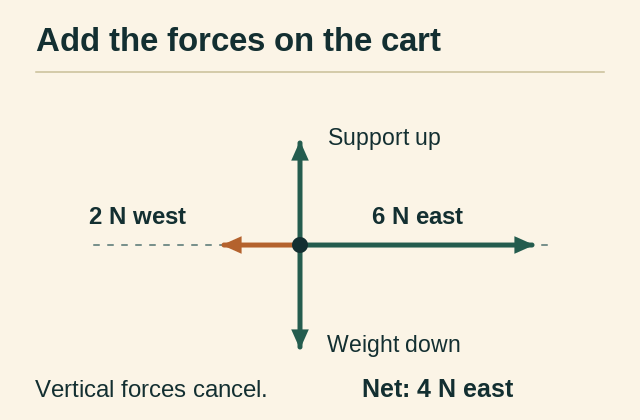
Picture a 2-kilogram cart already rolling east at 3 metres per second along a level track. Take the cart as the system, not the hand, track or room. A hand pushes east with 6 newtons. A stipulated resistance acts west with 2 newtons. Gravity pulls the cart down and the track supports it upward with an equal force in this simplified example.
List each force acting on the cart. The cart also pushes back on the hand, but that force acts on the hand and belongs in a different list. Gravity and the support here cancel vertically because both act on the cart. Their cancellation does not mean they are a pair from the same interaction. Keeping the boundary fixed prevents us from combining forces on different objects.
Add only forces acting on the chosen system.
Find what survives the sum
The vertical contribution is zero. Horizontally we get +6 − 2 = +4 newtons. A positive net force points east. Newton’s second law relates that force to the mass times the acceleration. Dividing 4 newtons by 2 kilograms gives an acceleration of 2 metres per second per second east.
Acceleration describes the change in velocity during an interval. If those forces and the mass held steady for one second, the original eastward 3 metres per second would become 5 metres per second east. The same net force applied to a 4-kilogram cart would give half the acceleration. The force describes the change and the mass describes how much acceleration the same force produces.
A 4-newton net force on 2 kilograms gives 2 metres per second squared.
Investigate and refine
Predict, compare the lenses and carry the explanation further.
Pause with a concrete case. Make a prediction, then compare the explanation before continuing.
Keep the cart moving, change the push
The force sum is zero, so velocity stays unchanged. The two forces are real, and neither one alone determines the acceleration.
Name the starting motion
The cart is already rolling east.
Add horizontal forces
+2 newtons − 2 newtons = zero. Vertical forces are balanced.
Velocity over time
A horizontal velocity-time line at +5 metres per second depicts no change.
Balance can preserve motion
Now suppose the hand reduces its push to 2 newtons while the resistance still acts west with 2. The sum is zero, so acceleration is zero. The cart’s existing velocity does not suddenly become zero. It continues moving at its current speed and direction for as long as the balance holds.
If the hand withdraws and the 2-newton resistance continues for a short interval, the net force points west. While the cart is still sliding east, the acceleration and velocity point in opposite directions. The eastward velocity shrinks. This does not mean the track must send the cart west after it stops. The resistance model is stipulated only while the cart is moving in that direction.
Net force determines acceleration. Starting velocity still matters.
A turn also changes velocity
Think of a cart that turns from east toward north while holding its speed. A velocity arrow now has to rotate, even if its length stays the same. Rotation of a velocity arrow is a change in velocity, so acceleration is present. An inward net force can produce such a turn. The push does not need to point along the existing velocity.
The same account therefore handles speeding up, slowing down and steering. Choose the system and reference frame, add the external forces as arrows, and compare the direction of the resulting acceleration with the existing velocity. Knowing how fast the cart is moving alone will never tell you which way its next velocity change points.
A change in direction is acceleration even when the speed stays fixed.
Apply and connect
Try a new case, follow genuine relationships and check the sources.
Does your explanation travel?
Objective: Predict the initial effect of a net force opposite to velocity.
What does this check show?
Identify acceleration as 6 ÷ 3 south and keep it distinct from the current northward velocity.
This is a low-stakes authored choice question. A supported answer is evidence for this item’s objective, not certification or permanent mastery.
Explanatory feedback: Divide the southward net force by the mass. The southward acceleration reduces the existing northward velocity at first.
A useful explanation has edges.
- The cart model uses a level track, constant mass and ordinary speeds in a nearly inertial frame. The force values are illustrative.
- The resistance is specified for a short interval. Friction and drag can change with speed and after the cart stops.
- The law describes the motion of the system’s center of mass. Predicting wheel rotation or deformation needs additional details.
Follow the concepts.
A map can help you find a useful foundation or a different view. Every line below has a stated reason and a limit.
No direct published relationship is recorded for this selection yet. No connection is invented to fill the diagram.
Find a connected question with Seed Shuffle →Sources & authorship
This explanation was released through an explicit editorial review. Structural checks and an Owner or delegated editorial decision are not independent expert or scientific certification.
The sources below identify claim scope and consultation dates. Check the original material and its limits.
- OpenStax College Physics 2e §4.3 · Newton’s Second Law of Motion: Concept of a System ↗
The section defines acceleration as a velocity change, identifies the external-force sum after choosing a system, and relates acceleration to net force and mass.
Source consulted 2026-11-17
Lesson lesson.physics.net-force-motion · Revision 1.0.0. Found a problem? Raise a content concern. This prepares a local note; no report is delivered by opening it.