1903 Wright Flyer: keeping control
A new way to steer in the air made a short flight a different kind of achievement.
The first Wright flight on 17 December 1903 ended only 120 feet from where it began. The National Park Service records twelve seconds in the air with Orville Wright at the controls. That short distance makes the question sharper. A machine can leave the ground and still be unable to correct a tilt, or to point its nose where the person aboard intends it to go. [1]
The Flyer was a biplane with a forward elevator and a movable rudder at the rear. Its parts make sense when you read the aircraft as a conversation between the air and a pilot who had to respond to it. Getting propulsion working was one part of that conversation. Getting the aircraft to change its attitude deliberately was another. [1][3]
← Explore Aircraft & Jets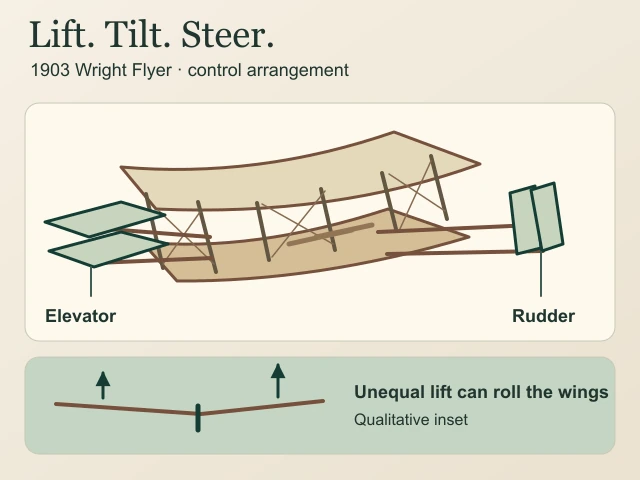
Original schematic of the Flyer’s control arrangement. The right-hand inset shows a qualitative roll mechanism. No dimensions or flight settings are shown.
Original Manthoryn educational illustration · CC BY 4.0. CC BY 4.0 ↗ · Image source ↗
A few details change the picture.
Three ways to turn without a road
A tilted wing, a raised nose and a nose pointing sideways are different changes, even if they happen together. Engineers call these rotations roll, pitch and yaw. The Flyer addressed each of them. Its pilot did not have conventional aircraft controls at their present locations: the pitch surface sat ahead of the main wings, while the rudder was behind them. [1][2]
One wing can lift harder
Follow one imagined disturbance. If one wingtip dips, the goal is to raise that side relative to the other. The Flyer could twist its outer wing portions in opposite senses, changing how each one met the air. NASA’s qualitative model shows why unequal lift tends to roll an aircraft. A higher-lift side tends to rise relative to its companion. The real result depends on airflow and the aircraft’s state, so this is an explanation of the mechanism, not a control recipe. [1][2]
Roll and yaw still interact
Changing the wing shapes also changes how they meet the moving air. A pilot can ask for roll and get a sideways change of heading as well. The Flyer’s linked rudder and wing-warping arrangement addressed this coupled problem. It gave the pilot a way to influence what the nose did while the wings changed attitude. It did not make the machine self-correcting. [1][2]
Read the short flight carefully
Four flights were made that day, according to the park account. Their value was not distance alone: the machine combined powered flight with control inputs a pilot could use during it. The preserved Flyer is evidence for an important episode in that particular combination. It does not decide every broader claim about first flight, which depends on whether the comparison concerns gliders, balloons, demonstrations, or sustained controlled powered aircraft. [1][3]
Keep a little curiosity.
Enjoying a discovery is enough. These optional questions may become a deeper investigation.
What can make a wing respond to the same control input differently at another speed?
This invites an aerodynamic comparison beyond the historical control arrangement. No flight prescription follows from it.
A complete CEL answer is not published yet.
Plant a Seed for this question →Sources & image notes.
Facts are tied to the references below. This is a source-checked editorial discovery, rather than an assessment or a claim of independent expert review.
- The Wright Flyer ↗
National Park Service. Original configuration and pilot controls; 17 December 1903 flights, first flight distance and duration.
Checked 2026-11-17. - Wing Warping Interactive ↗
NASA Glenn Research Center. Qualitative differential lift, roll and banking. The generic NASA control illustration is not a mechanical depiction of the 1903 machine.
Checked 2026-11-17. - 1903 Wright Flyer ↗
Smithsonian National Air and Space Museum. Catalogued object A19610048000 and research history. Indexed catalogue summary read; the direct record is sometimes inaccessible.
Checked 2026-11-17.
Image provenance and modifications
Some collection cards show a labelled detail crop. The full image above retains its source framing.
Illustration
Original schematic of the Flyer’s control arrangement. The right-hand inset shows a qualitative roll mechanism. No dimensions or flight settings are shown.
Original Manthoryn educational illustration · CC BY 4.0.
Creator/publisher: Original Manthoryn educational illustration / Manthoryn.
Source record · Original image · Original Manthoryn educational illustration, CC BY 4.0 International. No third-party photo or illustration was reproduced.
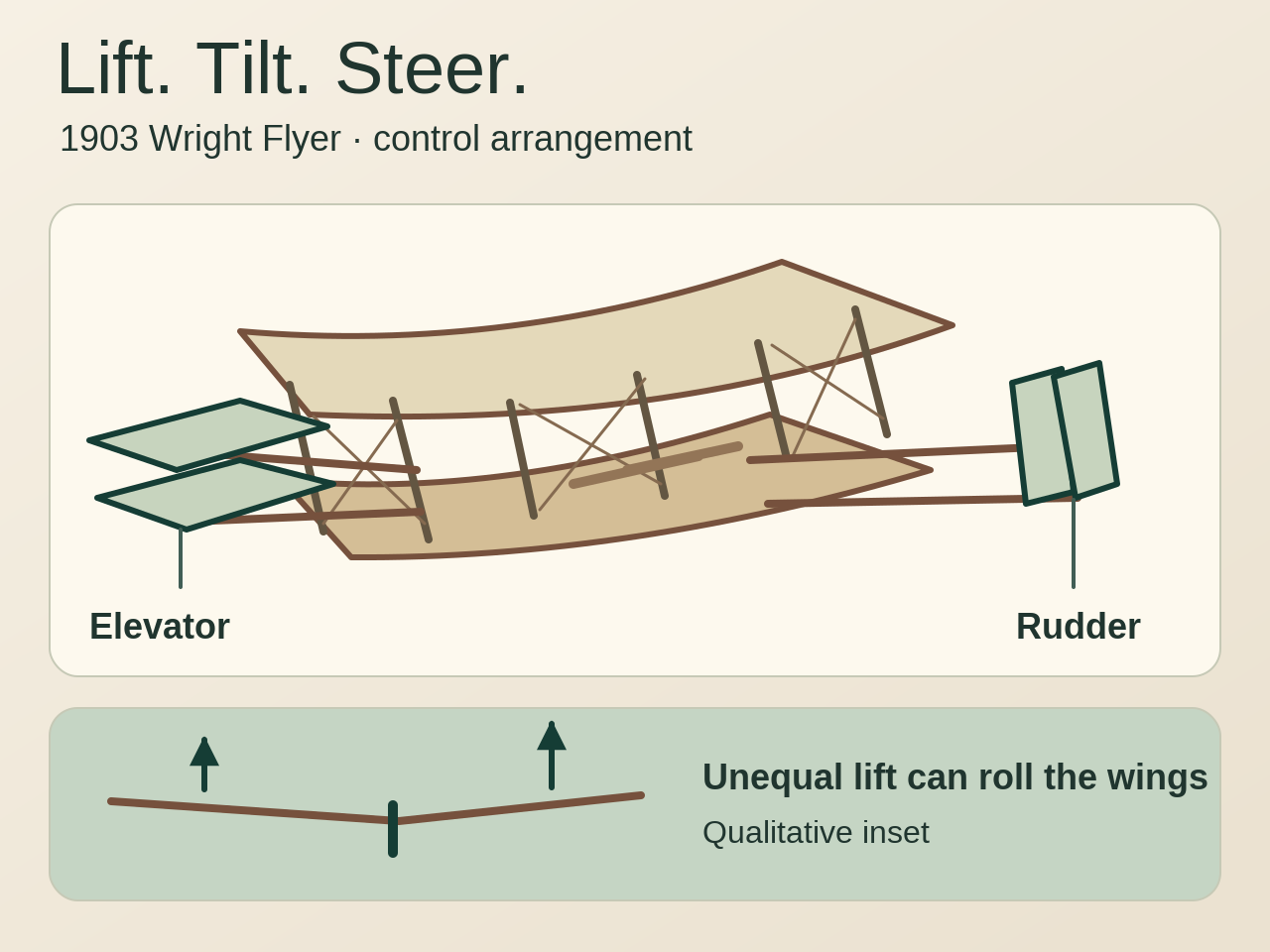
Changes: Created as an original SVG, then proportionally rasterized to WebP at two widths without cropping.
Rights/source metadata checked 2026-11-17. Images identify the object or work; factual claims rely on the editorial references.
Discovery entry.ce3-machines-wright-flyer · revision 1.0.0. Raise a content or image concern →. This prepares a local note; no report is delivered.