Citroën DS 19: a body that finds its height
A bump and a heavier passenger load ask the suspension to do two different things.
Picture a wheel climbing a shallow ridge in the road. It has to move upward, but you would rather the seat did not follow every millimetre. A different problem appears when passengers climb in and stay: the body can begin lower and remain low. Citroën’s DS 19, introduced at the 1955 Paris Motor Show, used a suspension that could respond to both situations. [1]
Its gas and hydraulic fluid did different jobs. That separation is the interesting part. A springy response to the wheel’s motion can coexist with a system that restores the car’s ride height after a sustained change in load. [1][2]
← Explore Cars & Supercars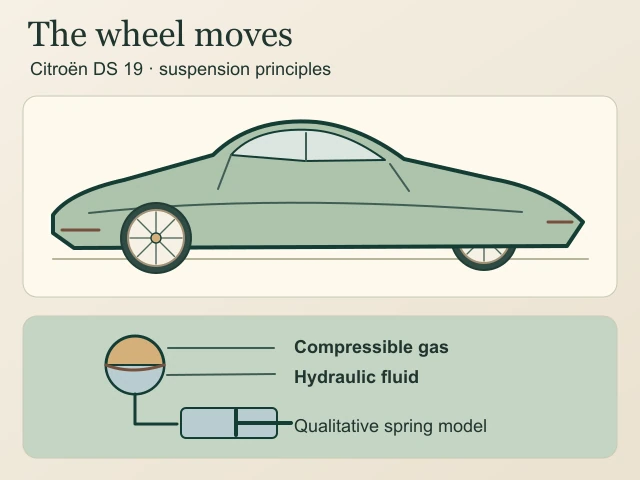
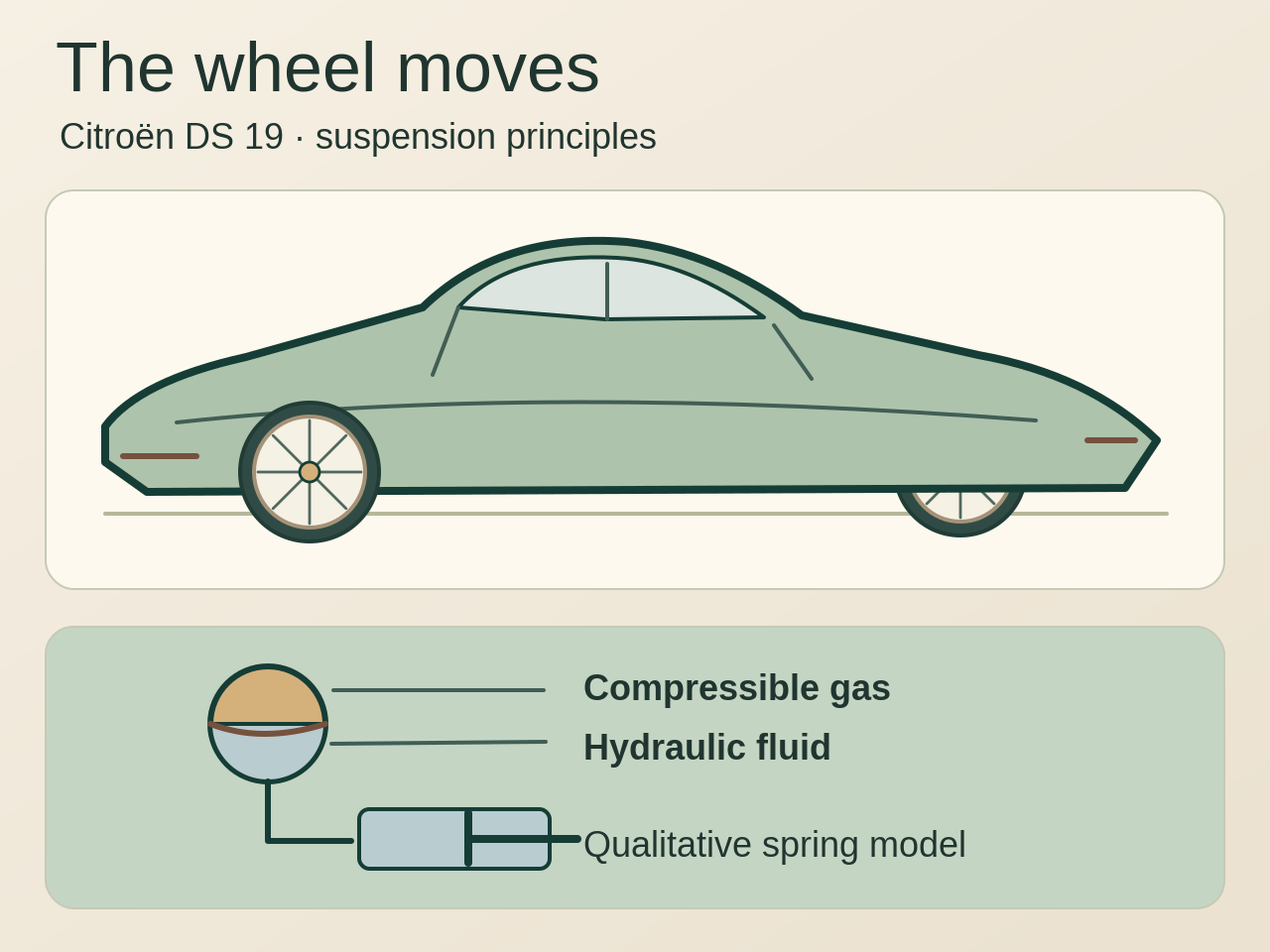
Original illustration inspired by the early DS 19 silhouette. The gas and fluid inset explains the spring effect, not an exact service diagram.
Original Manthoryn educational illustration · CC BY 4.0. CC BY 4.0 ↗ · Image source ↗
A few details change the picture.
Where the wheel’s motion goes
In the simplified suspension view, the wheel moves a linkage and piston. That displacement acts through liquid to squeeze gas into a smaller volume behind a separating membrane. The gas resists compression and pushes back. The wheel can therefore rise relative to the body while the load still has a spring beneath it. The drawing shows the relationship, not the exact routing or parts of a particular production year. [1][3]
A longer change needs a different response
Now compare the passenger load. A spring alone can support the heavier body, but in general it settles at a different position. A self-levelling system changes how much hydraulic fluid the suspension holds so that the body can approach its intended height again. Citroën describes an engine-driven hydraulic pump and self-levelling struts. The important idea is a correction to a persistent position change, separate from the immediate spring effect. [1][2]
Level is an approximate outcome
A moving car still has inertia, and no suspension can erase every disturbance. A wheel can run out of travel and the body can pitch or roll. Ride height also differs from whether a seat feels comfortable during a sudden bump. Citroën’s phrase about ride quality is a manufacturer description. The supported claim is a different spring medium and self-levelling, not proof that occupants felt no motion. [1][2]
A better way to look at the car
The rounded silhouette is easy to notice, but it says little by itself about this engineering distinction. Compare the wheel, the lower body line and the gas sphere inset in the illustration. Imagine a short upward displacement, then a longer change in loading. Ask which part supplies the spring force and which part can change the body’s resting position. Neither answer requires identifying a repair or pressure setting. [1][3]
Keep a little curiosity.
Enjoying a discovery is enough. These optional questions may become a deeper investigation.
What makes a springy system stop bouncing after a bump?
This is a question about damping and energy transfer. The qualitative DS 19 diagram cannot predict a particular ride.
A complete CEL answer is not published yet.
Plant a Seed for this question →Sources & image notes.
Facts are tied to the references below. This is a source-checked editorial discovery, rather than an assessment or a claim of independent expert review.
- Citroën: Almost 100 Years of History in Comfort Class ↗
Citroën / Stellantis Media. 1955 DS 19 introduction, fluid and gas spheres, pump, self-levelling and alternative ride heights. Manufacturer comfort superlatives are not used.
Checked 2026-11-17. - Citroen type DS19 automatically guided motor car ↗
Science Museum Group. Reference object 1969-98, an experimental modified DS19; corroborates the underlying DS19 high-pressure hydraulic and self-levelling suspension.
Checked 2026-11-17. - Pascal’s Principle and Hydraulics ↗
OpenStax, Rice University. General principle of pressure transmission through enclosed fluid, not a specific DS 19 service diagram.
Checked 2026-11-17.
Image provenance and modifications
Some collection cards show a labelled detail crop. The full image above retains its source framing.
Illustration
Original illustration inspired by the early DS 19 silhouette. The gas and fluid inset explains the spring effect, not an exact service diagram.
Original Manthoryn educational illustration · CC BY 4.0.
Creator/publisher: Original Manthoryn educational illustration / Manthoryn.
Source record · Original image · Original Manthoryn educational illustration, CC BY 4.0 International. No third-party photo or illustration was reproduced.
Changes: Created as an original SVG, then proportionally rasterized to WebP at two widths without cropping.
Rights/source metadata checked 2026-11-17. Images identify the object or work; factual claims rely on the editorial references.
Discovery entry.ce3-machines-citroen-ds19 · revision 1.0.0. Raise a content or image concern →. This prepares a local note; no report is delivered.