A Formula One front wing: grip begins in the air
The front wing pushes on the air and changes what reaches the rest of the car.
A racing car turning left needs a force toward the inside of the bend. Air pressing down on the front wing does not supply that sideways force directly. It changes how firmly the tyres bear against the track, which can give them more grip to do the turning. [3]
Look at the model Formula 1 unveiled to present its 2022 regulation concept. A broad wing sits close to the track ahead of the front wheels. Its location matters twice: it is near the front tyres, and the air reaches it before it passes those tyres and the rest of the car. This is a historical design reference, not one team’s actual race specification. [1]
← Explore Motorsports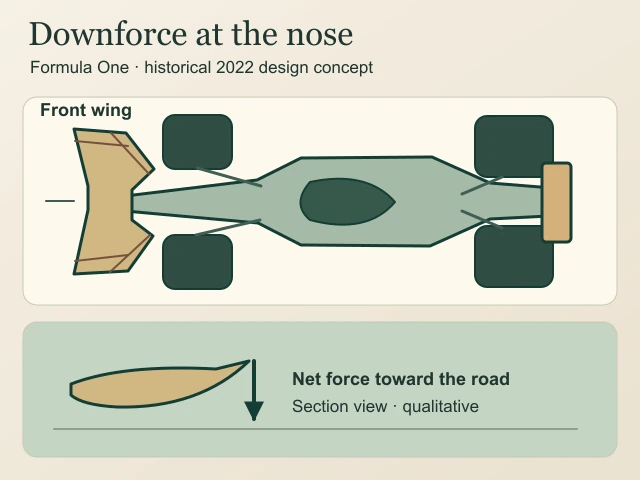
Original aerodynamic schematic, with the 2022 Formula 1 presentation concept as context. No team geometry, wind-tunnel data, design settings or speed claims are depicted.
Original Manthoryn educational illustration · CC BY 4.0. CC BY 4.0 ↗ · Image source ↗
A few details change the picture.
The pressure difference has a direction
Think of pressure pushing on every point of a curved surface. Add up the effects of those pushes on both faces of this wing and there can be a resultant toward the road. The wing’s contour, angle, mounting position and nearby surfaces matter. The simple arrows in our drawing show a direction of force and an approximate airflow deflection, not a measured pressure map. [2][3]
Pressing down changes the tyre task
The tyre’s interaction with the surface is what provides the force toward the inside of the bend. Increase the normal load on a tyre, under comparable conditions, and more sideways force may be available. That does not mean doubling downforce doubles useful grip. Temperature, the condition of the road and other demands on the tyre all enter the real result. The wing creates an opportunity for grip, not a guarantee of cornering speed. [3]
Air does not end at the front axle
With a front wing, the oncoming air cannot just be counted twice as though it reached the next part untouched. The wing and exposed wheels change the wake. In its presentation of the 2022 concept, Formula 1 described a wing and nose that would direct the wheel wake differently and seek more consistent effects for following cars. This was a design objective. It is not evidence that a particular race had more overtaking. [1][2]
A choice with a cost
A design that makes more downward force can also cost more drag, and the front and rear will not necessarily gain in the same proportion. That is why the decision concerns the whole circuit and the whole car. Reading the wing as a single magic source of speed hides the questions that actual designers had to balance. [3]
Keep a little curiosity.
Enjoying a discovery is enough. These optional questions may become a deeper investigation.
Why might the same car handle differently when another car is just ahead?
The 2022 design objective motivates a deeper explanation of aerodynamic wakes and directional balance.
A complete CEL answer is not published yet.
Plant a Seed for this question →Sources & image notes.
Facts are tied to the references below. This is a source-checked editorial discovery, rather than an assessment or a claim of independent expert review.
- 10 things you need to know about the all-new 2022 F1 car ↗
Formula 1. Formula 1’s actual full-size 2022 presentation car and the design intentions for its front wing and front-wheel wake. Scope is the 2022 design, not current rules.
Checked 2026-11-17. - How the front wing on the all-new 2022 cars has been designed to improve overtaking ↗
Formula 1, Mark Hughes. Contemporaneous 2022 account of pressure distribution, wing elements, geometry constraints and intended wake behaviour.
Checked 2026-11-17. - F1 Explains: Downforce and why F1 cars have wings ↗
Formula 1, interview with McLaren aerodynamicist Emel Cankaya. Practitioner distinction between downforce, added grip, drag and front/rear/floor contributions. General mechanism only.
Checked 2026-11-17.
Image provenance and modifications
Some collection cards show a labelled detail crop. The full image above retains its source framing.
Illustration
Original aerodynamic schematic, with the 2022 Formula 1 presentation concept as context. No team geometry, wind-tunnel data, design settings or speed claims are depicted.
Original Manthoryn educational illustration · CC BY 4.0.
Creator/publisher: Original Manthoryn educational illustration / Manthoryn.
Source record · Original image · Original Manthoryn educational illustration, CC BY 4.0 International. No third-party photo or illustration was reproduced.
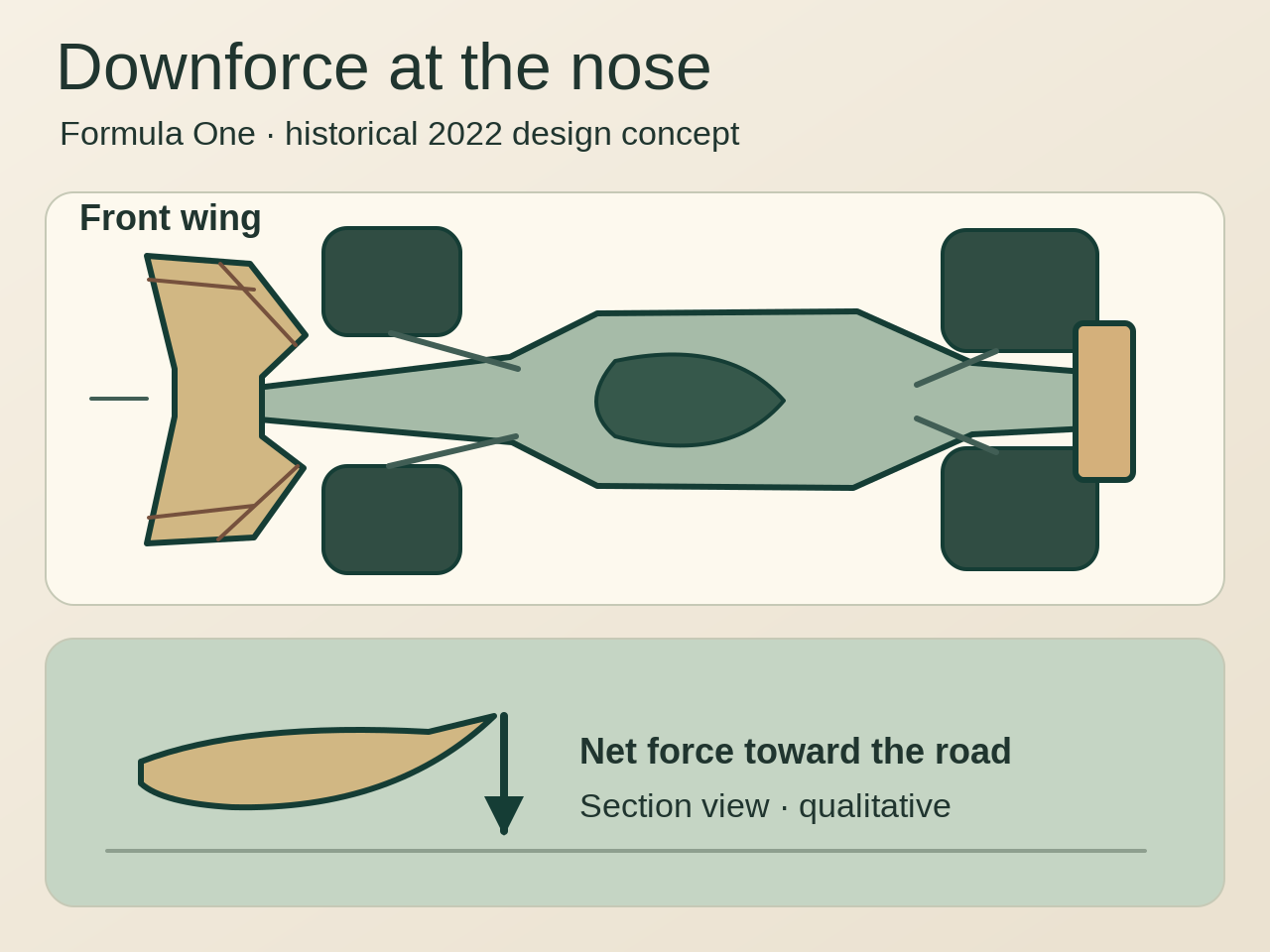
Changes: Created as an original SVG, then proportionally rasterized to WebP at two widths without cropping.
Rights/source metadata checked 2026-11-17. Images identify the object or work; factual claims rely on the editorial references.
Discovery entry.ce3-machines-formula-one-front-wing · revision 1.0.0. Raise a content or image concern →. This prepares a local note; no report is delivered.