SR-71 Blackbird
A reconnaissance aircraft that became a flying research platform.
The Blackbird was built for sustained flight beyond three times the speed of sound. Its long, dark form carried a demanding combination of speed, altitude and heat into the air. [1]
← Explore Aircraft & Jets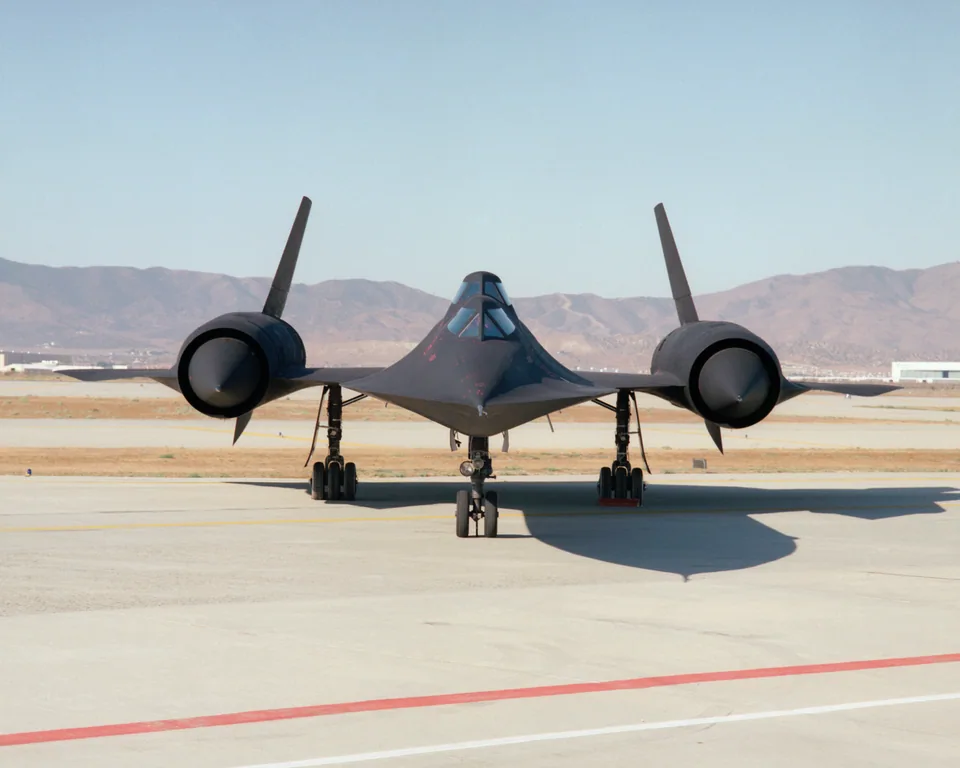
NASA's SR-71B trainer at Plant 42 in Palmdale, California, July 1991. The raised rear cockpit distinguishes it from an SR-71A.
NASA/Jim Bean, EC91-0365-7. Resized and converted to WebP. NASA/JPL image-use policy ↗ · Image source ↗
A few details change the picture.
Built around speed
At these speeds, the airframe was a thermal challenge as well as an aerodynamic one. NASA describes titanium construction and heat-soak temperatures above 600°F during sustained high-speed flight. The aircraft could cruise at Mach 3 for more than an hour. [1]
A second life in research
In the 1990s NASA used an SR-71A and an SR-71B for high-speed research. Projects included laser air-data sensing, ultraviolet astronomy and sonic-boom studies. The LASRE experiment later placed a small aerospike-engine test arrangement on an SR-71, turning the aircraft into a platform for collecting flight data. [1]
Look for the second cockpit
The photograph shows the trainer, not an SR-71A reconnaissance configuration. Its rear cockpit sits higher so both pilots can see ahead. NASA used this aircraft for proficiency and training alongside its SR-71A research aircraft. Looking closely at the canopy is a way to recognize that difference without treating every Blackbird photograph as the same variant. [2]
Keep a little curiosity.
Enjoying a discovery is enough. These optional questions may become a deeper investigation.
Why was the SR-71 designed for sustained high-altitude, high-speed flight?
A deeper CEL explanation for this question is not published in the current collection.
A complete CEL answer is not published yet.
Plant a Seed for this question →How do the inlet spikes and engines work together at supersonic speed?
A deeper CEL explanation for this question is not published in the current collection.
A complete CEL answer is not published yet.
Plant a Seed for this question →Another story to explore.
Editorial suggestions for browsing, with the reason shown. These are not canonical knowledge-graph relationships.
Sources & image notes.
Facts are tied to the references below. This is a source-checked editorial discovery, rather than an assessment or a claim of independent expert review.
- SR-71 Blackbird — NASA Facts FS-030 ↗
NASA Dryden Flight Research Center. Design, first flight, high-speed research, titanium structure and operating conditions.
Checked 2026-11-13. - SR-71B on the ramp at Plant 42 — EC91-0365-7 ↗
NASA Armstrong image archive. Photograph identity, trainer cockpit and NASA training/research use.
Checked 2026-11-13.
Image provenance and modifications
Some collection cards show a labelled detail crop. The full image above retains its source framing.
Photograph
NASA's SR-71B trainer at Plant 42 in Palmdale, California, July 1991. The raised rear cockpit distinguishes it from an SR-71A.
NASA/Jim Bean, EC91-0365-7. Resized and converted to WebP.
Creator/publisher: NASA/Jim Bean / NASA Armstrong Flight Research Center.
Source record · Original image · NASA informational/editorial reuse under its Images and Media Usage Guidelines; no third-party copyright restriction is identified in the asset metadata. No endorsement is implied.

Changes: Auto-oriented, proportionally resized and converted to WebP. No crop, retouching or generated additions.
Rights/source metadata checked 2026-11-13. Images identify the object or work; factual claims rely on the editorial references.
Discovery entry.sr-71-blackbird · revision 1.0.0. Raise a content or image concern →. This prepares a local note; no report is delivered.