Concorde
A passenger aircraft that made crossing the Atlantic a very different journey.
Concorde joined a narrow cabin and a slender delta-wing silhouette to a remarkable passenger experience: cruising at about Mach 2. Its story belongs to both engineering and the culture of air travel. [1][3]
← Explore Aircraft & Jets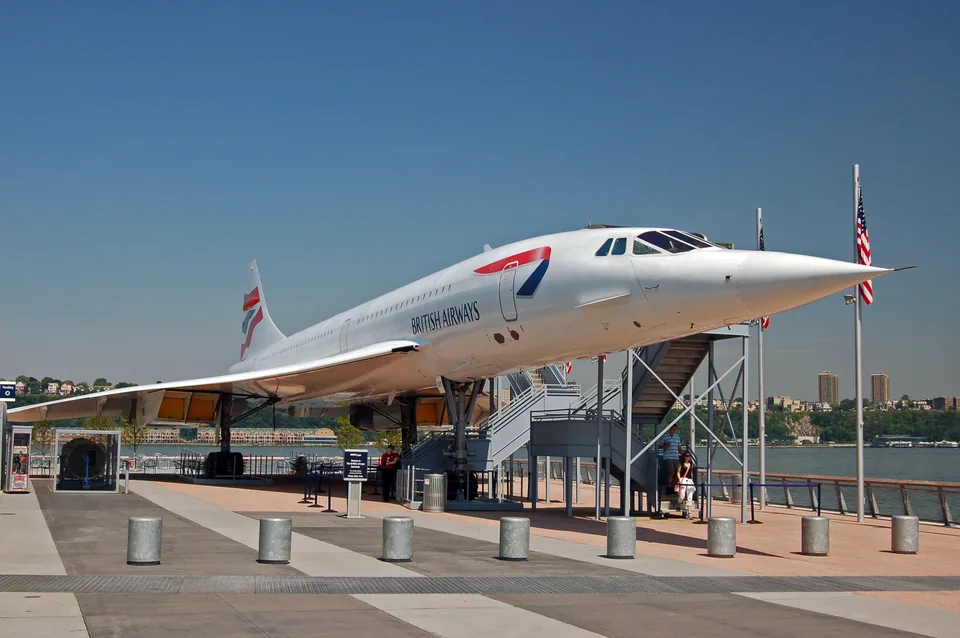
British Airways Concorde G-BOAD on display in New York, photographed by Rob Young on 7 June 2009.
British Airways Concorde G-BOAD — Rob Young, CC BY 2.0, via Wikimedia Commons. Resized and converted to WebP. CC BY 2.0 ↗ · Image source ↗
A few details change the picture.
An agreement made into an aircraft
The British and French governments signed the treaty to develop Concorde in November 1962. The French prototype flew from Toulouse in March 1969; the British prototype followed from Filton a few weeks later. Air France and British Airways began commercial operations in January 1976. The aircraft made a transatlantic journey feel shorter, while its distinctive shape made it recognizable even to people who never flew aboard. [2]
Speed changed the aircraft itself
British Airways records that heating in flight stretched the nearly 62-metre fuselage by roughly 6–10 inches. A specially developed white finish helped manage heat. Its engines used reheat for take-off and the transition to supersonic flight. Speed was not simply a larger number on a timetable; it imposed choices throughout the aircraft. [1]
A remarkable service with a small market
Supersonic travel did not become ordinary travel. Smithsonian describes how high operating costs led to high fares and a limited market, and how the fleet ultimately retired in 2003. Concorde remains a compelling object because its achievement and its constraints are both part of the same story. [3]
Keep a little curiosity.
Enjoying a discovery is enough. These optional questions may become a deeper investigation.
Why did Concorde use a delta wing and a drooping nose?
A deeper CEL explanation for this question is not published in the current collection.
A complete CEL answer is not published yet.
Plant a Seed for this question →How did Concorde accommodate the heat and expansion of supersonic flight?
A deeper CEL explanation for this question is not published in the current collection.
A complete CEL answer is not published yet.
Plant a Seed for this question →Another story to explore.
Editorial suggestions for browsing, with the reason shown. These are not canonical knowledge-graph relationships.
Sources & image notes.
Facts are tied to the references below. This is a source-checked editorial discovery, rather than an assessment or a claim of independent expert review.
- Celebrating Concorde ↗
British Airways. Operating specifications, crossing time, thermal expansion, finish and reheat.
Checked 2026-11-13. - Concorde: The story of supersonic passenger flight ↗
National Museums Scotland. Programme milestones, prototype flights, service inauguration and passenger Mach meter.
Checked 2026-11-13. - Concorde, Fox Alpha, Air France ↗
Smithsonian National Air and Space Museum. Operating cost, fares, market constraints and retirement.
Checked 2026-11-13. - British Airways Concorde G-BOAD — file description ↗
Rob Young / Wikimedia Commons. Identity and date of the actual photographed aircraft; CC BY 2.0 licensing.
Checked 2026-11-13.
Image provenance and modifications
Some collection cards show a labelled detail crop. The full image above retains its source framing.
Photograph
British Airways Concorde G-BOAD on display in New York, photographed by Rob Young on 7 June 2009.
British Airways Concorde G-BOAD — Rob Young, CC BY 2.0, via Wikimedia Commons. Resized and converted to WebP.
Creator/publisher: Rob Young / Wikimedia Commons (originally Flickr).
Source record · Original image · CC BY 2.0. Attribution, license link and modification notice retained. License reviewed by Commons FlickreviewR on 1 December 2011.


Changes: Auto-oriented, proportionally resized and converted to WebP. No crop, retouching or generated additions.
Rights/source metadata checked 2026-11-13. Images identify the object or work; factual claims rely on the editorial references.
Discovery entry.concorde · revision 1.0.0. Raise a content or image concern →. This prepares a local note; no report is delivered.