Tower crane: why the same load gets harder to hold
The reach changes a load’s turning effect even when the load itself weighs exactly the same.
Watch a plain hanging load move horizontally under a tower crane. Its weight does not change. But the tower and its support now have to resist a different turning effect because the force is acting farther from the centre. This is why a crane’s ability to reach a point does not mean the same load is possible everywhere it can reach. [3][2]
An actual example is the Liebherr 125 EC-B 6 used on a new railway bridge at Wittenberge, Germany, documented in 2023. The crane was attached to a bridge platform. Its support and working arrangement were part of an engineering problem with a specific site, not the generic setup in the drawing. [1]
← Explore Heavy Machinery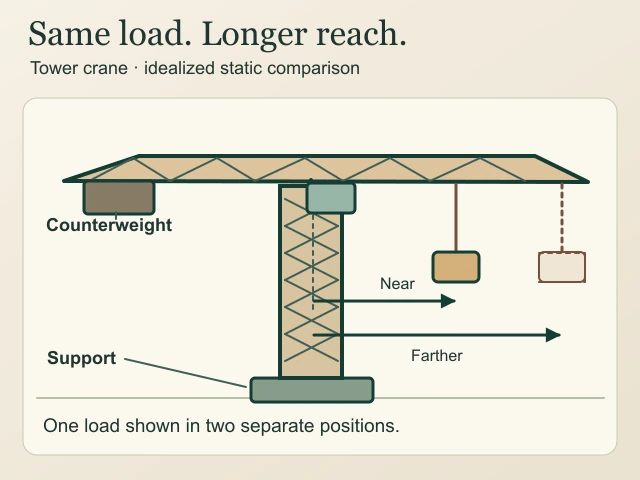
Original static comparison, not the Wittenberge installation or a lift plan. A solid load and a dashed alternative show different positions of the same load, not simultaneous lifting.
Original Manthoryn educational illustration · CC BY 4.0. CC BY 4.0 ↗ · Image source ↗
A few details change the picture.
A farther load is not a heavier load
Hold the same bag close to your shoulder in imagination, then farther away. Your shoulder has to resist more turning even though the bag has not changed. The crane problem has the same distinction. In the simplest static comparison, the weight acts vertically and the useful distance is the horizontal distance to its line of action. The effect experts call a moment increases as the distance increases. [3]
The counterweight has a turning effect too
The short arm behind the tower carries mass that acts on the other side. Gravity on that mass can oppose some of the load-side turning. But the match is not automatically exact for every load position. The jib and machinery also have weight. A tower crane is not a perfectly balanced playground seesaw floating freely at its pivot. Forces and moments go into the mast and its supporting structure. [2][3]
Read all the way down to the support
The Wittenberge case makes the support visible as a decision. The project used a platform attached to the new bridge, and Liebherr describes a working arrangement different from the model’s headline reach. In the schematic, the dark foundation stands for a support reaction, not the machinery at Wittenberge. Comparing them is useful precisely because a real support is a site-specific design choice. [1][3]
Why one number cannot describe the crane
The model brochure separates maximum capacity, maximum radius and capacity at the jib head. A reader cannot combine the biggest value from each column and expect a valid operating point. The force-times-distance model explains why position matters. It says nothing sufficient about wind, rapid movement, configuration, allowable loads or support checks. This article is about reading the problem, not making a lift decision. [2][3]
Keep a little curiosity.
Enjoying a discovery is enough. These optional questions may become a deeper investigation.
Which other effects would have to be included before a static balance model could describe a changing load?
This is a conceptual follow-up. Actual lifting and support decisions require approved equipment information and qualified engineering.
A complete CEL answer is not published yet.
Plant a Seed for this question →Sources & image notes.
Facts are tied to the references below. This is a source-checked editorial discovery, rather than an assessment or a claim of independent expert review.
- Germany first: Liebherr tower crane mounted on railway bridge ↗
Liebherr press release, December 14, 2023. Actual Liebherr 125 EC-B 6 on a platform attached to the new Wittenberge bridge; documents why this job used a different arrangement from the product’s headline configuration.
Checked 2026-11-17. - The EC-B series ↗
Liebherr product brochure. The specific 125 EC-B 6 row lists different kinds of limits, including maximum capacity and tip load, not interchangeable values. No load rating is offered in the manuscript.
Checked 2026-11-17. - Torque ↗
OpenStax, Rice University. Turning effect of force and perpendicular lever-arm distance. General mechanics only.
Checked 2026-11-17.
Image provenance and modifications
Some collection cards show a labelled detail crop. The full image above retains its source framing.
Illustration
Original static comparison, not the Wittenberge installation or a lift plan. A solid load and a dashed alternative show different positions of the same load, not simultaneous lifting.
Original Manthoryn educational illustration · CC BY 4.0.
Creator/publisher: Original Manthoryn educational illustration / Manthoryn.
Source record · Original image · Original Manthoryn educational illustration, CC BY 4.0 International. No third-party photo or illustration was reproduced.
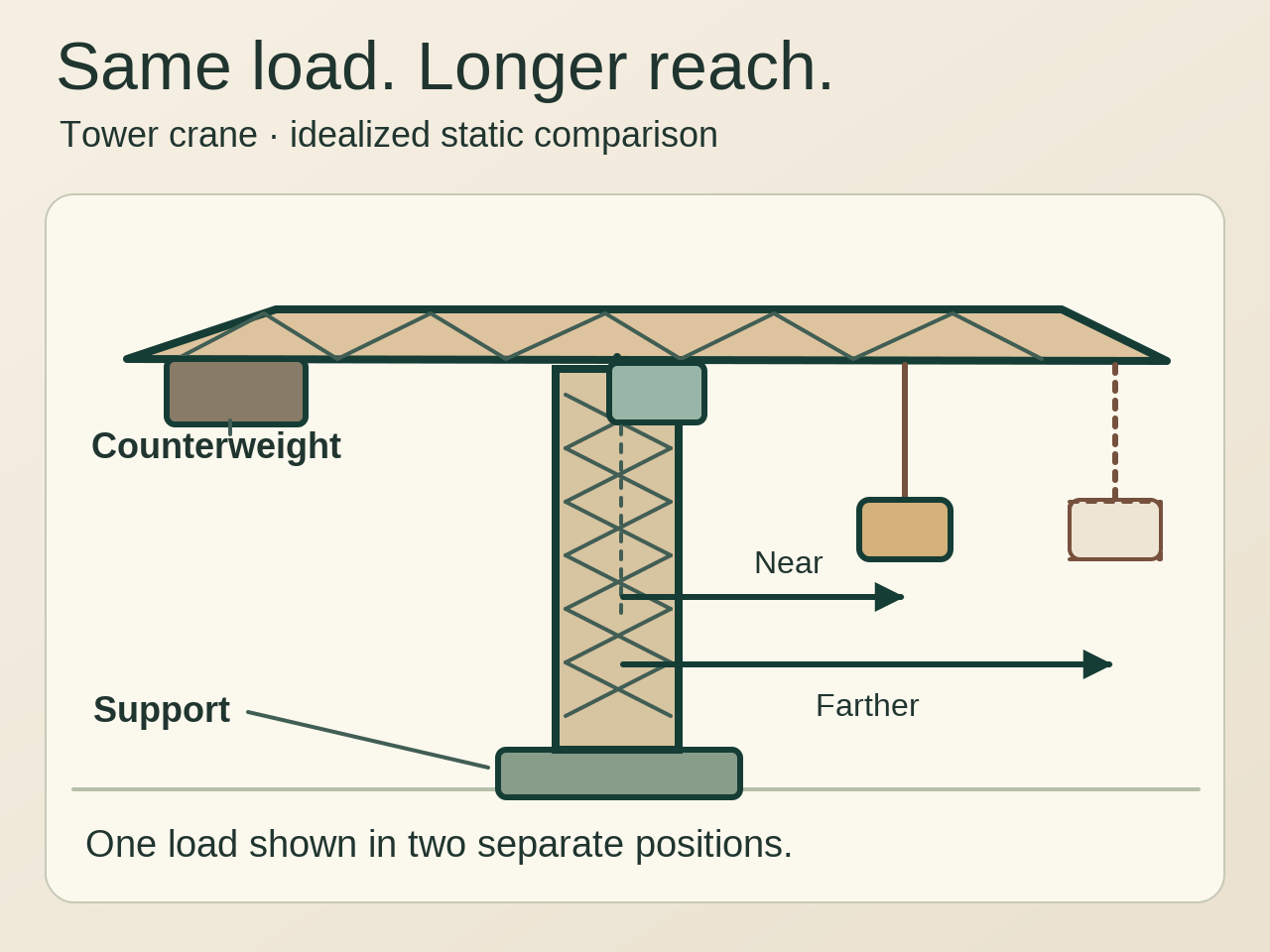
Changes: Created as an original SVG, then proportionally rasterized to WebP at two widths without cropping.
Rights/source metadata checked 2026-11-17. Images identify the object or work; factual claims rely on the editorial references.
Discovery entry.ce3-machines-tower-crane · revision 1.0.0. Raise a content or image concern →. This prepares a local note; no report is delivered.