Ingenuity: finding enough air to fly
A rotorcraft for Mars had less air to push and less weight to support.
Ingenuity reached Mars tucked under the Perseverance rover. On April 19, 2021, it lifted itself above the surface at Jezero Crater. Its challenge was familiar in one sense: an aircraft has to exert force on air to support its weight. But NASA describes the local flight atmosphere as less than one percent as dense as Earth’s at the surface. There is much less air in any given volume. [1]
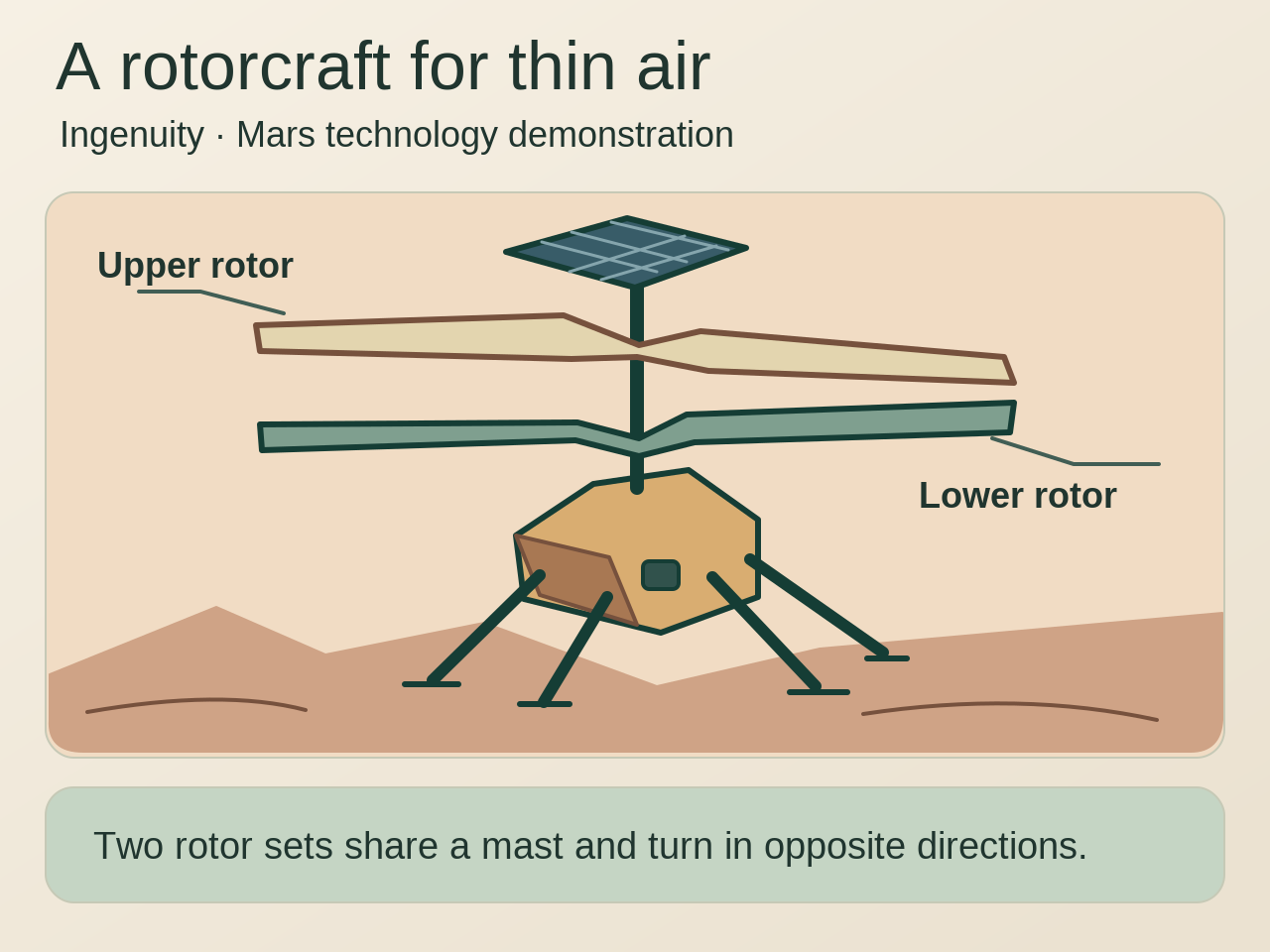
Look at the tall stack above the little body. Two rotor sets share an axis and turn in opposite directions. Spread those blades out against the size of the craft and you can see the shape of the problem. Under Mars conditions, a light payload and a comparatively broad spinning system belonged together. [2][1]
← Explore Helicopters & Drones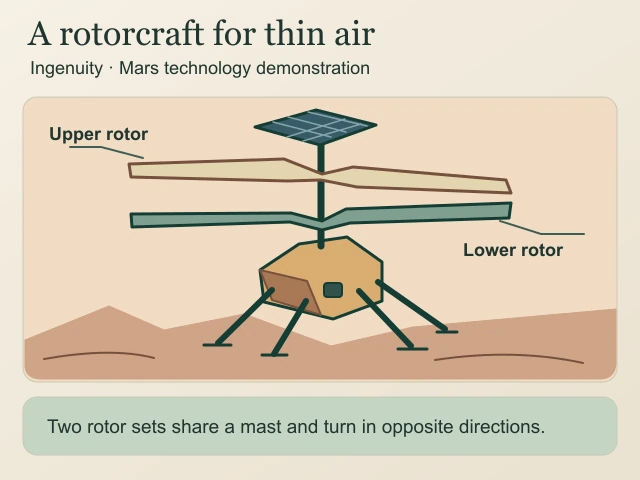
Original mechanism illustration based on NASA’s description. The rotor sets are offset in the view so both can be seen. It is not a telemetry image or technical drawing.
Original Manthoryn educational illustration · CC BY 4.0. CC BY 4.0 ↗ · Image source ↗
A few details change the picture.
Move enough air to support the craft
Rotating blades are wings in motion. They generate force as they travel through the air. A lower density makes that task harder at comparable blade size and speed. Larger blades sweep a wider disc, and faster rotation increases their relative speed through the surrounding gas. The operational result also depends on the blade shape, the flow and the limits of the motor and structure. Changing just one part is not the whole answer. [4][1]
Less weight helps, but the air still matters
Mars pulls less strongly on the vehicle than Earth does, so the same mass weighs less there. That helps on the side of the equation that asks how much upward force the aircraft needs. Thin air works against it on the supply side. The engineering job was to meet both constraints, not pick whichever planet sounds easier to fly on. [1][4]
Two rotors share a turning problem
A motor twisting a rotor also exerts a reaction on the rest of the aircraft. Oppositely turning rotors can offset much of this effect. Ingenuity still needed navigation and control; an opposite-spin geometry does not by itself hold a heading or choose a landing spot. The engineering assessment discusses sensors and onboard state estimation, an equally important part of turning lift into a controlled flight. [2]
From a short trial to an extended test
NASA initially planned up to five test flights. The mission later used the aircraft as a scout and to gather further engineering experience. Seventy-two flights demonstrate much more than a concept drawing, but they do not make these dimensions a universal Mars helicopter recipe. Other missions have different payloads, terrain, power budgets and atmospheric conditions. [1][3]
Keep a little curiosity.
Enjoying a discovery is enough. These optional questions may become a deeper investigation.
What would changing the payload force engineers to reconsider about a rotorcraft’s energy use?
The actual design must satisfy multiple flight and mission constraints. The reader’s schematic gives no design settings.
A complete CEL answer is not published yet.
Plant a Seed for this question →Sources & image notes.
Facts are tied to the references below. This is a source-checked editorial discovery, rather than an assessment or a claim of independent expert review.
- Ingenuity Mars Helicopter ↗
NASA Science. Mission role, Jezero Crater, dates, 72 completed flights, mass, approximate tip-to-tip rotor span, thin atmosphere and onboard operation.
Checked 2026-11-17. - Guidance, Navigation, and Control Technology Assessment, Part IV ↗
NASA Jet Propulsion Laboratory. Ingenuity’s two coaxial counter-rotating rotor sets, solar recharge and flight navigation; the report’s then-current flight count is not reused.
Checked 2026-11-17. - The Most Extreme Flights of NASA’s Ingenuity Mars Helicopter ↗
NASA Science / JPL. Post-mission total and end announcement, evolution from planned test flights.
Checked 2026-11-17. - Factors That Affect Lift ↗
NASA Glenn Research Center. Qualitative roles of density, area, shape and relative flow speed in aerodynamic lift. No quantitative generalization across all rotor flows.
Checked 2026-11-17.
Image provenance and modifications
Some collection cards show a labelled detail crop. The full image above retains its source framing.
Illustration
Original mechanism illustration based on NASA’s description. The rotor sets are offset in the view so both can be seen. It is not a telemetry image or technical drawing.
Original Manthoryn educational illustration · CC BY 4.0.
Creator/publisher: Original Manthoryn educational illustration / Manthoryn.
Source record · Original image · Original Manthoryn educational illustration, CC BY 4.0 International. No third-party photo or illustration was reproduced.
Changes: Created as an original SVG, then proportionally rasterized to WebP at two widths without cropping.
Rights/source metadata checked 2026-11-17. Images identify the object or work; factual claims rely on the editorial references.
Discovery entry.ce3-machines-ingenuity · revision 1.0.0. Raise a content or image concern →. This prepares a local note; no report is delivered.