Bathyscaphe Trieste: a cabin beneath a float
The space for people, the lifting volume and the ballast were three parts of one dive.
Look at the layout of Trieste and the crew cabin is surprisingly small. A round chamber hangs under a much longer body. On 23 January 1960, Don Walsh and Jacques Piccard descended to Challenger Deep in that chamber. The shape of the whole craft becomes understandable when you separate what kept water pressure out from what made the vehicle want to rise. [1][2]
A bathyscaphe is a deep-diving research vessel. This one was not a large pressure cabin with a little fuel tank. Its large upper float provided buoyancy. The people rode below in a much smaller pressure-resistant sphere. [1]
← Explore Submarines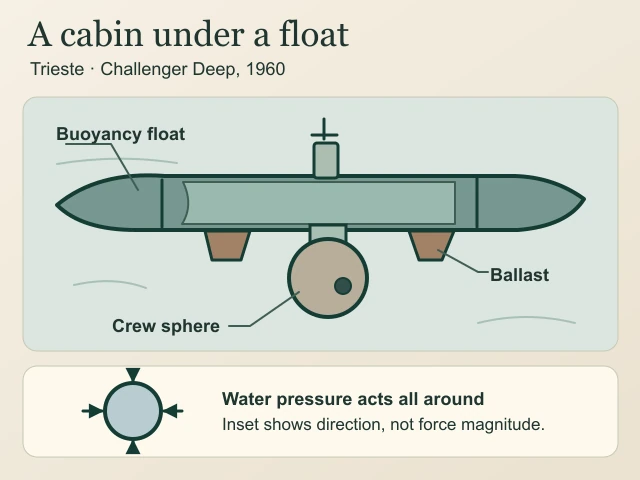
Original schematic of the functional separation shown in the January 1960 arrangement. Dimensions, seals and operating details are deliberately omitted.
Original Manthoryn educational illustration · CC BY 4.0. CC BY 4.0 ↗ · Image source ↗
A few details change the picture.
Keep the living space separate
The farther down the craft went, the more water lay above it. Pressure acts all around a submerged chamber. A sphere offers a symmetric shape without broad flat faces that would have to span the pressure difference in a different way. That geometric idea does not make any particular sphere safe at depth. The glass, seals, penetrations, material and exact design still mattered. The drawing leaves them outside the model. [1][3]
Make a separate volume want to rise
Gasoline is lighter than the seawater it displaces in the float. That volume can therefore contribute an upward margin to support the heavier equipment and pressure chamber. The fluid-filled float does not provide a dry space for people. In a simple mental model, the large volume helps carry a compact and heavy payload while the payload’s own shell deals with the pressure difference. [1][3]
Change the balance for the return
The craft can descend if total weight exceeds buoyant force. At depth, the historical design could release iron ballast, making the remaining craft lighter without giving up the float’s main displacement. Then the balance favors ascent. The roles are distinct: ballast changes the balance, the float supplies most of the buoyancy, and the sphere protects the crew. This explanation is not a submersible construction or operation guide. [1][3]
A vehicle changes what can be observed
A dive can put observers beside a previously inaccessible place without making every brief sighting interpretable. In his interview, Walsh allowed for uncertainty about what the crew saw at the bottom. That distinction between reaching a place and knowing what was there belongs with the technology. The craft made observations possible, but confidence still depended on the evidence they could actually collect. [1]
Keep a little curiosity.
Enjoying a discovery is enough. These optional questions may become a deeper investigation.
How could a later expedition turn a brief sighting at depth into better evidence?
This asks what a research craft can measure and record. The historical illustration makes no safety or operating claim.
A complete CEL answer is not published yet.
Plant a Seed for this question →Sources & image notes.
Facts are tied to the references below. This is a source-checked editorial discovery, rather than an assessment or a claim of independent expert review.
- Fifty-six Years After the Deepest Dive ↗
Office of Naval Research, Future Force, Summer 2016, Don Walsh interview. Walsh and Piccard’s 23 January 1960 dive, Project Nekton goals, general arrangement of the crew sphere, gasoline float and releasable iron ballast. Walsh also discusses observation uncertainty.
Checked 2026-11-17. - Trieste ↗
Naval History and Heritage Command. Post-acquisition Krupp sphere and approximately seven-mile Challenger Deep descent. This is the 1960 Trieste, not the successor Trieste II.
Checked 2026-11-17. - Archimedes’ Principle ↗
OpenStax, Rice University. Depth and pressure difference, displaced fluid, and net upward force. No deep-sea vessel design standards are inferred.
Checked 2026-11-17.
Image provenance and modifications
Some collection cards show a labelled detail crop. The full image above retains its source framing.
Illustration
Original schematic of the functional separation shown in the January 1960 arrangement. Dimensions, seals and operating details are deliberately omitted.
Original Manthoryn educational illustration · CC BY 4.0.
Creator/publisher: Original Manthoryn educational illustration / Manthoryn.
Source record · Original image · Original Manthoryn educational illustration, CC BY 4.0 International. No third-party photo or illustration was reproduced.
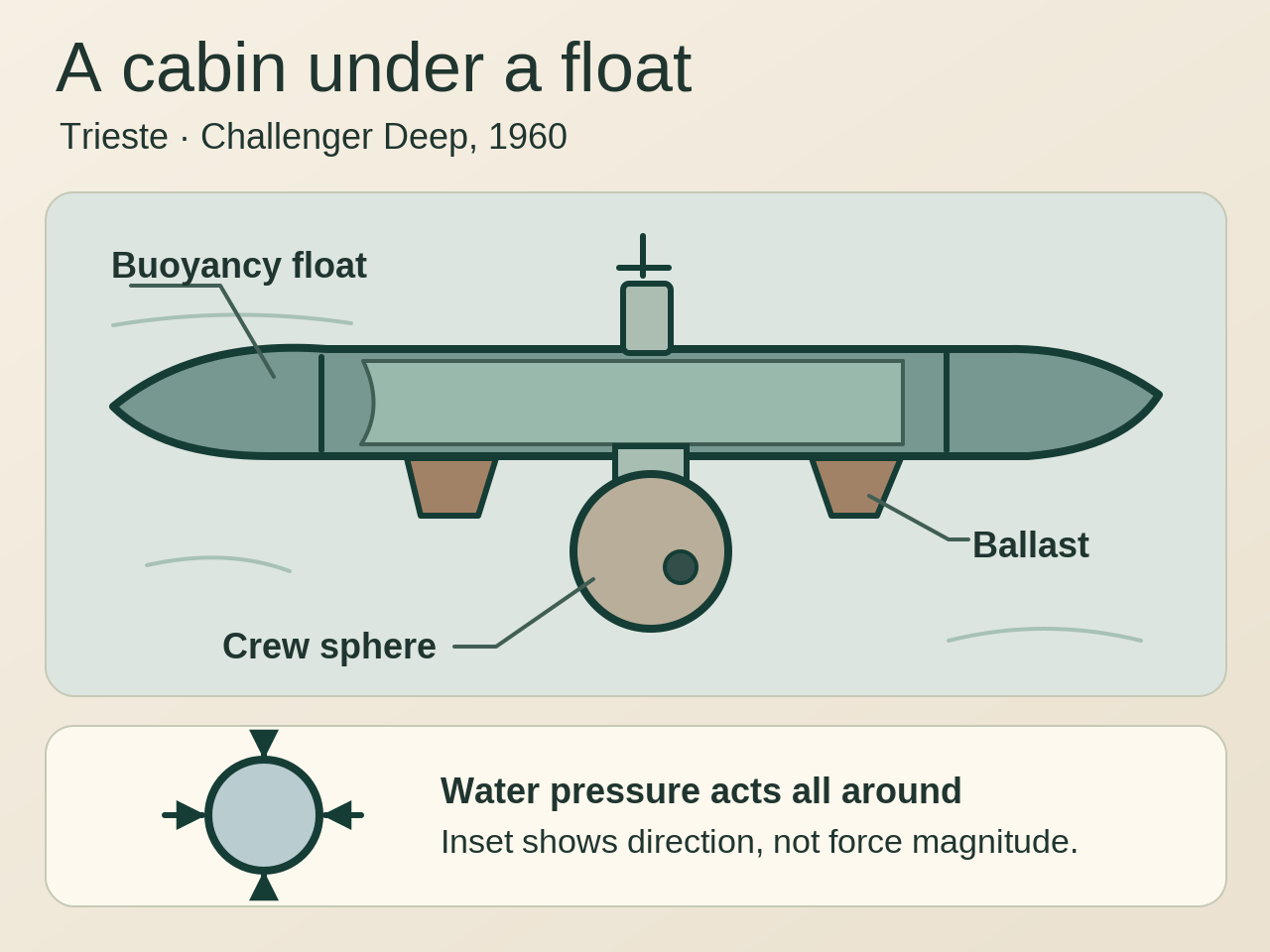
Changes: Created as an original SVG, then proportionally rasterized to WebP at two widths without cropping.
Rights/source metadata checked 2026-11-17. Images identify the object or work; factual claims rely on the editorial references.
Discovery entry.ce3-machines-trieste · revision 1.0.0. Raise a content or image concern →. This prepares a local note; no report is delivered.