Stephenson's Rocket
A locomotive needed a working system, not simply an engine.
An engine can move a piston without moving a train. Rocket is fascinating because its celebrated steam engine had to work with a boiler, wheels and a railway. Built in 1829 by Robert Stephenson and Company, it won the Rainhill locomotive trials. Its importance lies in how several useful ideas were brought together, rather than in a claim that one person invented every part of steam railways. [1]
← Explore Trains & Railways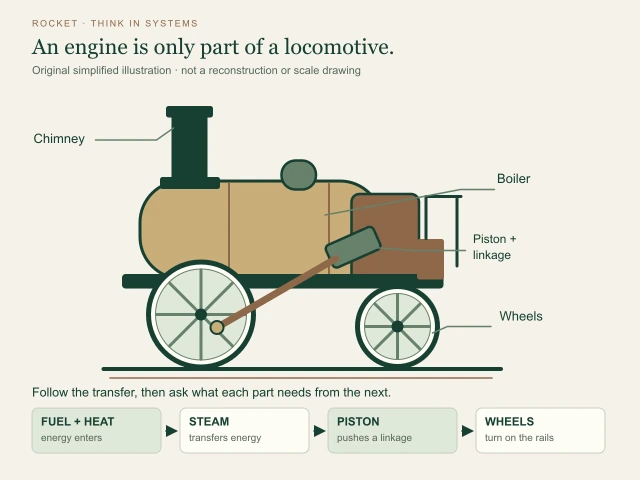
Original explanatory illustration of a steam-locomotive system. Component positions, colours and dimensions are schematic; this is not a documentary view, restoration or exact 1829 reconstruction.
Original Manthoryn educational illustration, CC BY 4.0. Proportionally rasterized from its public SVG master. CC BY 4.0 ↗ · Image source ↗
A few details change the picture.
The boiler has to keep up
A locomotive consumes steam as its engine works. Rocket’s boiler passed hot combustion gases through 25 small tubes surrounded by water, increasing the heating surface compared with one large passage. This made heat transfer part of the machine’s design: a powerful cylinder is of limited use if the boiler cannot supply it. The museum’s engineering account describes a separate firebox and the arrangement of those tubes. [2]
One part changes the conditions for another
The blastpipe directed exhaust steam into the chimney, encouraging the flow of combustion gases through the fire and boiler. That connects two processes often imagined separately: the engine’s used steam helped the boiler continue raising fresh steam. This is a system relationship, not free energy. Fuel still supplied the heat, and the arrangement had to work under the conditions of the actual locomotive. [2]
A useful way to inspect any machine is to follow a complete path. Here the question is not just “does the piston move?” but “what supplies it, what does it drive, and what limits the result?” That is an explanatory reading of the documented combination of boiler, engine and running gear, not a new measured performance claim about Rocket. [1]
A train needs a railway
Rainhill tested competing locomotives for the Liverpool and Manchester Railway. That purpose matters: a successful railway locomotive needed to perform as transport, not merely demonstrate a mechanism on a bench. A working route, vehicles, fuel, water and people belong to the wider transport system. The trials were one historically specific comparison, not proof that Rocket was the best possible machine for every route or load. [1]
The object continued changing
The museum records later rebuilding: the cylinders were lowered and a larger smokebox fitted; wheels were replaced. Looking at the preserved object therefore raises two questions: what does this surviving component show, and which period does it belong to? The surviving object is not an unchanged record of every feature of the original 1829 locomotive. Our illustration is a simplified teaching schematic, not a reconstruction of a particular restoration. Museum documentation and the object need to be read together. [2]
Look for relationships, not a magic part
Start with the long boiler, the tall chimney, the driving wheels and the cylinders. Try explaining why each would be ineffective without another part. A boiler alone is not a train; wheels alone do not supply power. Rocket becomes more understandable when its parts form a chain of functions. This is a way to look at a documented engineering object, not an instruction to build or operate a pressure vessel. [1]
Keep a little curiosity.
Enjoying a discovery is enough. These optional questions may become a deeper investigation.
Why can improving one part of a machine fail to improve the whole system?
A deeper CEL explanation of coupled engineering constraints is not yet available in this collection.
A complete CEL answer is not published yet.
Plant a Seed for this question →Sources & image notes.
Facts are tied to the references below. This is a source-checked editorial discovery, rather than an assessment or a claim of independent expert review.
- Rocket locomotive, 1829 ↗
Science Museum Group. Object identity, builder/date, Rainhill purpose and the combination of multi-tube boiler and blastpipe. The official catalogue search extract was readable; direct fetch timed out.
Checked 2026-11-17. - Rocket’s engineering excellence — Michael Bailey,25 October 2018 ↗
Science and Industry Museum. Boiler tubes, blastpipe, construction, later rebuilding and the difference between surviving and 1829 states. Current display-location statements in this2018 account are not used.
Checked 2026-11-17.
Image provenance and modifications
Some collection cards show a labelled detail crop. The full image above retains its source framing.
Illustration
Original explanatory illustration of a steam-locomotive system. Component positions, colours and dimensions are schematic; this is not a documentary view, restoration or exact 1829 reconstruction.
Original Manthoryn educational illustration, CC BY 4.0. Proportionally rasterized from its public SVG master.
Creator/publisher: Original Manthoryn educational illustration / Manthoryn.
Source record · Original image · Original code-native educational illustration released under Creative Commons Attribution 4.0 International; no museum photograph, logo, illustration or historic drawing was copied.
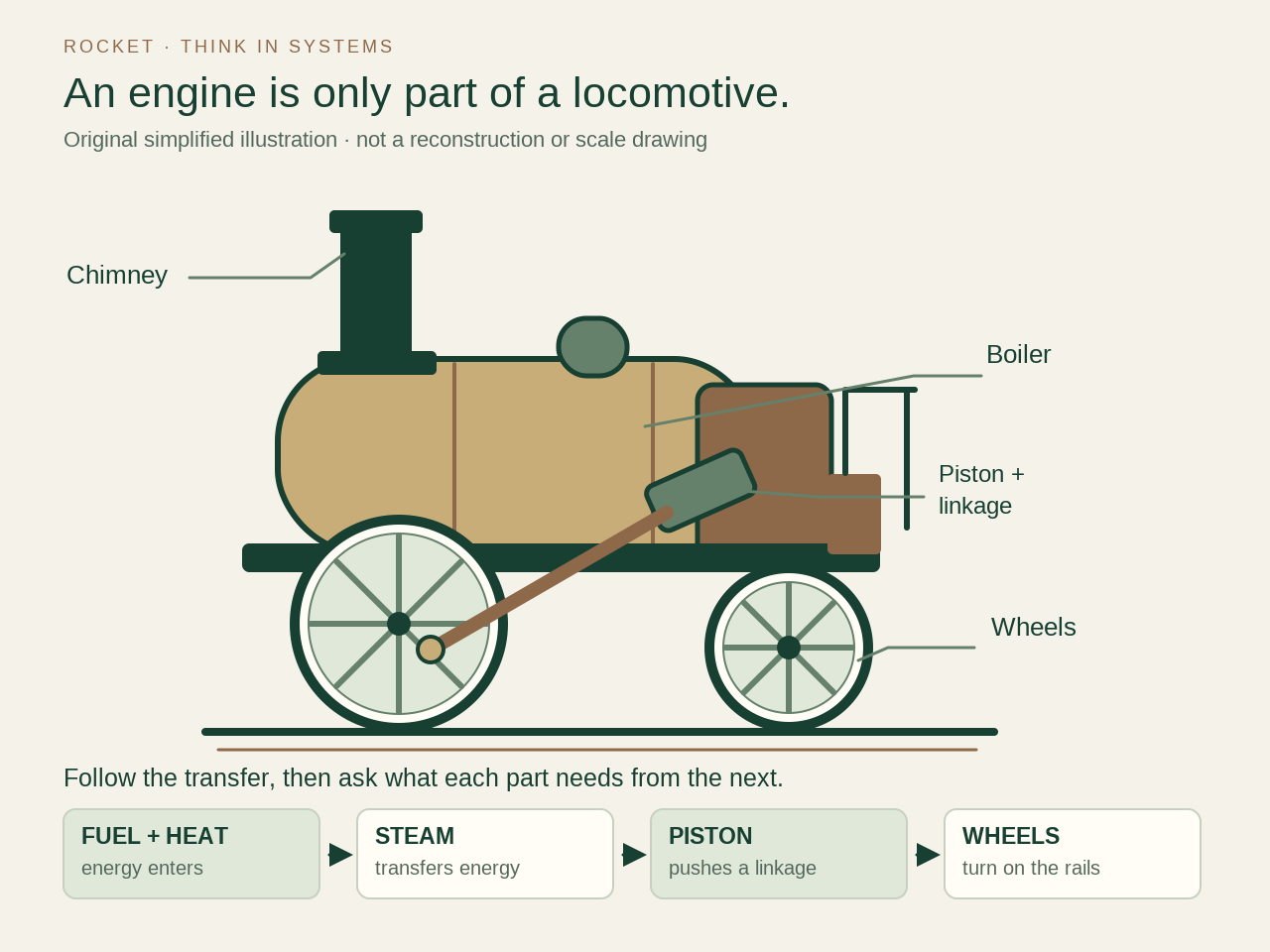
Changes: Original schematic composed in SVG for this explanation; proportionally rasterized to WebP without cropping. Not a documentary image or dimensionally exact reconstruction.
Rights/source metadata checked 2026-11-17. Images identify the object or work; factual claims rely on the editorial references.
Discovery entry.ce1-rocket · revision 1.0.0. Raise a content or image concern →. This prepares a local note; no report is delivered.