Jacquard loom punched cards
A pattern becomes repeatable when the machine can read a prepared choice.
A patterned textile contains many small choices about which threads pass over others. A Jacquard mechanism made selected choices repeatable by reading holes in a chain of cards. The cards did not supply the loom’s power or imagine its design. They carried a prepared pattern that a particular mechanism could turn into controlled thread selection. [1][2]
← Explore Computers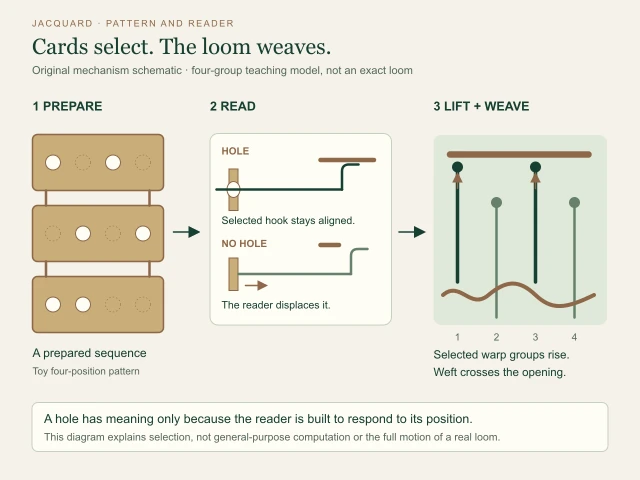
Original four-group teaching schematic of card-controlled selection. Actual Jacquard mechanisms have many more selectors and vary in construction; this is not a photograph or exact museum-loom drawing.
Original Manthoryn educational illustration, CC BY 4.0. Proportionally rasterized from its public SVG master. CC BY 4.0 ↗ · Image source ↗
A few details change the picture.
The cloth is built one crossing at a time
The warp is the set of lengthwise threads held on a loom. Raising selected warp threads opens a path for the weft, carried across by a shuttle. Which threads rise changes which colour or thread appears at the surface. A complex-looking pattern can therefore depend on an ordered sequence of relatively small mechanical selections. [2]
A hole matters because of the reader
A hole in a card has no weaving instruction on its own. Its position matters because it meets a corresponding part of the reading mechanism. The same piece of card, presented to a different arrangement, need not produce the same result. Information here is a relationship between a prepared physical pattern and a machine designed to respond to it. [1]
Consider a deliberately simplified teaching model with four possible thread groups. A card marked “raise groups 1 and 3” would be useful only if positions 1 and 3 actually controlled those groups. This is an illustrative explanation, not a transcription of the museum loom’s real card layout. The distinction helps separate the principle from the historical object’s much richer construction. [2]
A chain stores an order
Lacing the cards together keeps successive selections in sequence. The Science Museum Group records a set of 59 cards, dated 1890–1910, joined in concertina fashion. Such an object is more than a pile of holes: it preserves an order that the mechanism can revisit. Our four-group teaching schematic explains the selection principle; it does not reproduce that particular 59-card accession or an exact museum loom. [3]
A useful historical bridge, with limits
The Computer History Museum describes how Charles Babbage planned to use punched cards for programs and data in his Analytical Engine. That gives a specific historical connection to computing. It does not mean that every mechanism reading a pattern can calculate anything, learn its own design or execute modern software. Ask what choices the reader supports before calling a device programmable in a broader sense. [2]
The cards do not remove the work of making
National Museums Scotland identifies its displayed handloom as a 19th-century loom used by the Hamilton brothers at Stonehouse in Lanarkshire. Its Jacquard attachment belongs within a working textile practice: designing the pattern, preparing cards, setting the loom and making cloth. Looking closely at both the chain and the surrounding equipment keeps the story about human making as well as automatic control. [1]
Keep a little curiosity.
Enjoying a discovery is enough. These optional questions may become a deeper investigation.
What makes a stored pattern an instruction for a particular machine?
A deeper CEL explanation of representation, control and general-purpose computation is not published in this collection.
A complete CEL answer is not published yet.
Plant a Seed for this question →Another story to explore.
Editorial suggestions for browsing, with the reason shown. These are not canonical knowledge-graph relationships.
Sources & image notes.
Facts are tied to the references below. This is a source-checked editorial discovery, rather than an assessment or a claim of independent expert review.
- The Jacquard loom: Innovation in textiles and computing ↗
National Museums Scotland. The museum handloom, attachment, pattern control, Scottish use and named workers; no assumption of rights to the museum website photographs.
Checked 2026-11-17. - 1801: Punched cards control Jacquard loom ↗
Computer History Museum. Warp selection for shuttle passes, prepared card sequences and Babbage’s planned use of punched cards. The four-group teaching example is original and simplified.
Checked 2026-11-17. - Jacquard Punched Cards, 1890–1910 ↗
Science Museum Group. A separate documented59-card concertina set; used as an example of retained sequence, not as the identity of the pictured display.
Checked 2026-11-17.
Image provenance and modifications
Some collection cards show a labelled detail crop. The full image above retains its source framing.
Illustration
Original four-group teaching schematic of card-controlled selection. Actual Jacquard mechanisms have many more selectors and vary in construction; this is not a photograph or exact museum-loom drawing.
Original Manthoryn educational illustration, CC BY 4.0. Proportionally rasterized from its public SVG master.
Creator/publisher: Original Manthoryn educational illustration / Manthoryn.
Source record · Original image · Original code-native educational illustration released under Creative Commons Attribution 4.0 International; no museum photograph, logo, illustration or historic drawing was copied.
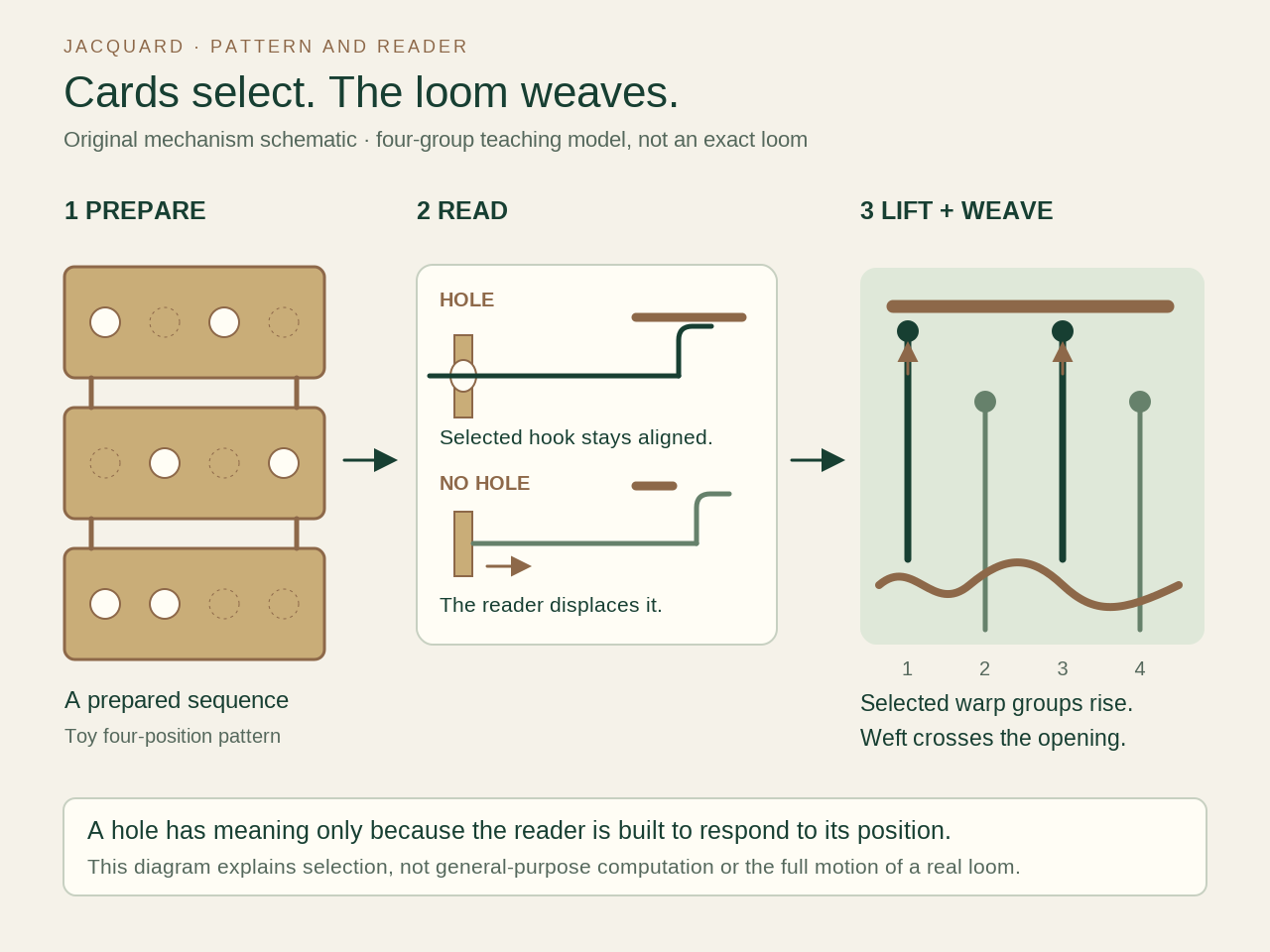
Changes: Original schematic composed in SVG for this explanation; proportionally rasterized to WebP without cropping. Not a documentary image or dimensionally exact reconstruction.
Rights/source metadata checked 2026-11-17. Images identify the object or work; factual claims rely on the editorial references.
Discovery entry.ce1-jacquard · revision 1.0.0. Raise a content or image concern →. This prepares a local note; no report is delivered.