Shakey
An early robot that connected seeing, planning and moving.
Shakey was a mobile robot built to reason about actions in a small, controlled world. From 1966 to 1972, SRI researchers combined limited perception, an environment model and planning so it could find routes and rearrange simple objects. The achievement was the combination: a plan had to become movement in a physical room. [1]
← Explore Artificial Intelligence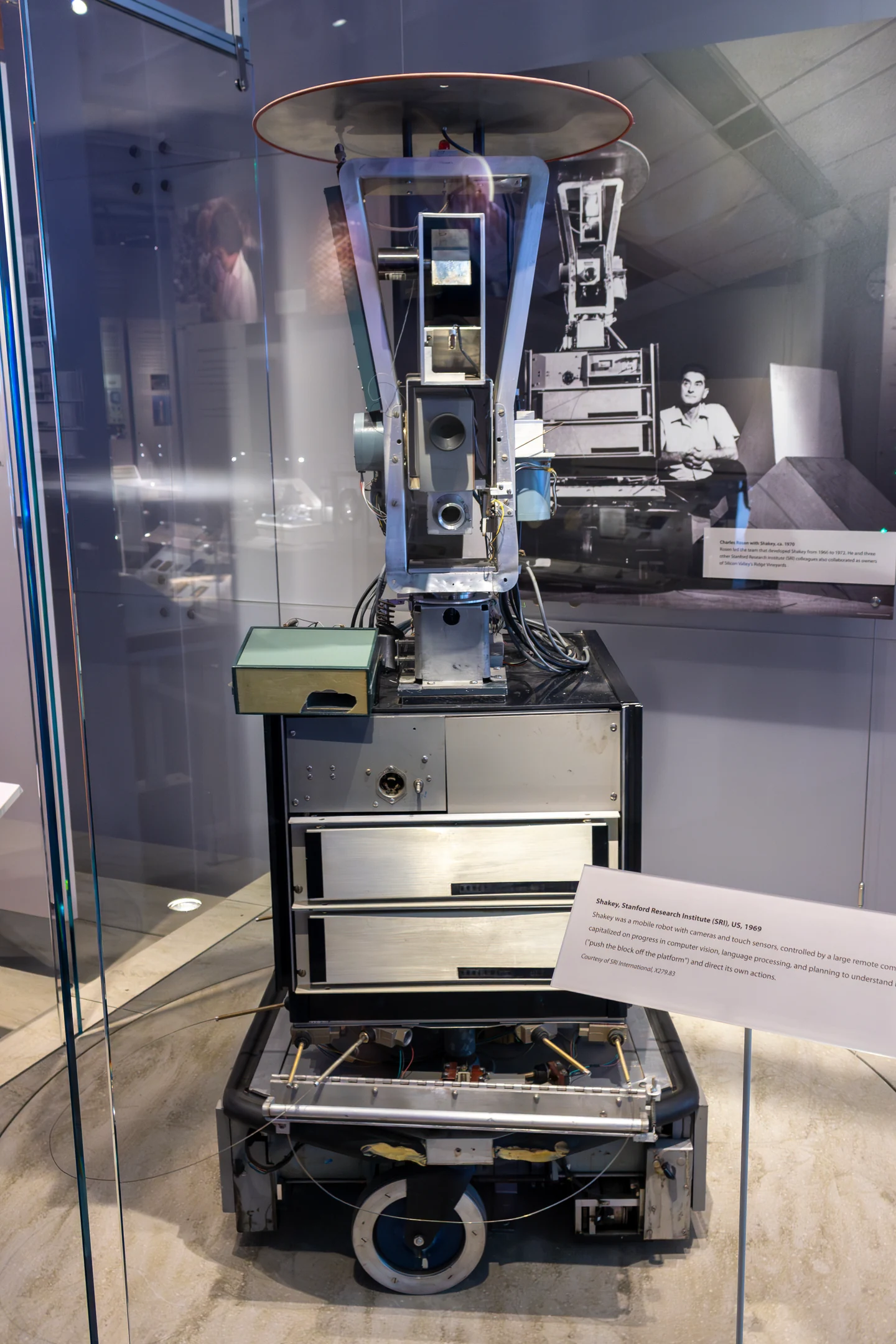
Shakey on display at the Computer History Museum, photographed by The wub in 2023. This modern documentary photograph shows the preserved research robot.
The wub / Wikimedia Commons — CC BY-SA 4.0 CC BY-SA 4.0 ↗ · Image source ↗
A few details change the picture.
A television camera and optical range finder helped it observe; bump detectors, a push bar and drive wheels let it interact with its surroundings. [2][3]
The robot communicated by radio with a controlling computer. The intelligence of the complete system was not all packed inside the wheeled body. [2]
Its experiments included finding locations, avoiding obstacles and pushing boxes into groups within a seven-room environment. These were deliberately bounded tasks. [2]
A model that could be used
SRI’s retrospective describes STRIPS, a planning system that represented a situation through objects, possible actions, preconditions and effects. A proposed action belonged in a plan only when its requirements were satisfied. Moving between rooms or gathering boxes therefore involved a description of the world as well as motors and sensors. [2]
A small world, a large question
DARPA traces the project to a 1964 proposal by Charles Rosen and agency support beginning in 1966. The eventual robot earned its name from the shaking of its motion. Its unusual appearance hides a practical research question: how can observations, a plan and physical actions remain connected as the situation changes? [3]
The limits matter as much as the milestone. SRI’s technical report explicitly describes restricted perception and simple objects. Shakey was not a robot that could understand any home or handle any everyday request. It made an important set of problems concrete in a manageable environment, where route-finding, planning and action could be studied together. [1]
Keep a little curiosity.
Enjoying a discovery is enough. These optional questions may become a deeper investigation.
How does a robot turn a symbolic plan into actions when its view of the world is incomplete?
A dedicated explanation connecting robotic perception, planning and execution is not published here. This is an editable Plant a Seed curiosity, not a claim of a supported lesson.
A complete CEL answer is not published yet.
Plant a Seed for this question →Another story to explore.
Editorial suggestions for browsing, with the reason shown. These are not canonical knowledge-graph relationships.
Sources & image notes.
Facts are tied to the references below. This is a source-checked editorial discovery, rather than an assessment or a claim of independent expert review.
- Shakey The Robot — N. J. Nilsson (ed.), 1984 ↗
SRI International. Primary technical-report abstract establishes the 1966–1972 SRI program and explicitly limited perception/environment modeling, planning, route-finding and rearrangement of simple objects.
Checked 2026-11-14. - 75 Years of Innovation: Shakey the Robot ↗
SRI International. Camera, optical range finder, radio link to controlling computer, bump detectors and push bar; seven-room location/box/obstacle tasks; STRIPS world model, actions, preconditions and effects.
Checked 2026-11-14. - Shakey the Robot ↗
Defense Advanced Research Projects Agency. Charles Rosen’s 1964 proposal, ARPA support in 1966, origin of the name, room navigation and camera/range-finder/radio/stepper-wheel components. Broad intelligence claims are narrowed to the demonstrated research environment.
Checked 2026-11-14.
Image provenance and modifications
Some collection cards show a labelled detail crop. The full image above retains its source framing.
Photograph
Shakey on display at the Computer History Museum, photographed by The wub in 2023. This modern documentary photograph shows the preserved research robot.
The wub / Wikimedia Commons — CC BY-SA 4.0
Creator/publisher: The wub / Wikimedia Commons.
Source record · Original image · Creative Commons Attribution-ShareAlike 4.0 International (CC BY-SA 4.0)


Changes: EXIF orientation normalized and proportionally resized to WebP at 480, 960 and 1440 pixels wide; no crop, generative modification, object removal or color alteration. Adapted CC BY-SA images remain available under CC BY-SA 4.0.
Rights/source metadata checked 2026-11-14. Images identify the object or work; factual claims rely on the editorial references.
Discovery entry.shakey · revision 1.0.0. Raise a content or image concern →. This prepares a local note; no report is delivered.