Sojourner
Six wheels, a small solar panel and a new way to explore Mars.
Sojourner was the small rover carried by Mars Pathfinder in 1997. After the lander reached Ares Vallis on July 4, the rover rolled onto the surface and made Mars a place a mobile robot could investigate at close range. [1][2]
← Explore Inventions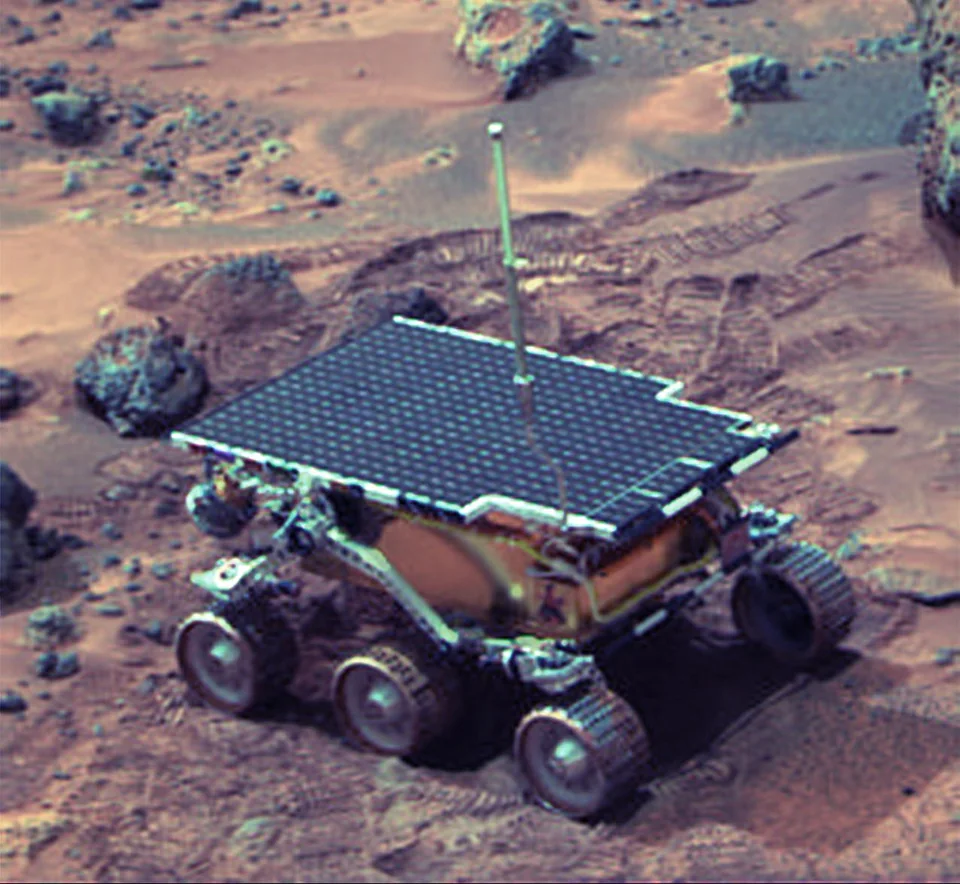
Sojourner on the 22nd Martian day of the Pathfinder mission, near The Dice and Yogi. Authentic mission photograph; NASA/JPL-Caltech.
Courtesy NASA/JPL-Caltech. Resized and encoded as WebP; no retouching. NASA/JPL image-use policy ↗ · Image source ↗
A few details change the picture.
Its body was just 65 centimetres long, but its six wheels carried a scientific instrument to rocks rather than waiting for rocks to arrive at a fixed lander. [1]
The name honoured Sojourner Truth, the American abolitionist and women’s rights activist. The rover began as a technology demonstration, not a miniature version of today’s larger missions. [3]
A little vehicle with a real job
Look beneath the solar panel: a rocker-bogie suspension distributed the chassis load across six wheels. Motors drove and steered the rover and deployed its Alpha Proton X-Ray Spectrometer. This instrument let Sojourner examine nearby rocks and soil at close range. [1][2]
The rover did not work alone
Pathfinder’s lander was both a communications relay and a lookout. Its images let operators on Earth see Sojourner and the surrounding terrain, while the rover’s own observations added another viewpoint. The mission was a partnership between a moving vehicle, a stationary lander and people working a planet away. [1]
A first step that changed the scale
The mission demonstrated that a rover could operate on Mars, helping establish the path followed by the larger Spirit, Opportunity, Curiosity and Perseverance rovers. Sojourner’s importance is not that it did everything a later rover could do. It showed that taking those first small drives was possible. [3]
The photograph shows Sojourner on the mission’s 22nd Martian day near rocks nicknamed The Dice and Yogi. It is a real mission image; its colour and resolution belong to the camera system and processing of that time. [3]
Keep a little curiosity.
Enjoying a discovery is enough. These optional questions may become a deeper investigation.
How can a six-wheeled rover keep moving over uneven ground?
This deeper explanatory question is not answered by a published CEL explanation yet. The discovery remains open to enjoy; suggesting the question does not promise publication.
A complete CEL answer is not published yet.
Plant a Seed for this question →How do people guide a rover when they cannot stand beside it?
This deeper explanatory question is not answered by a published CEL explanation yet. The discovery remains open to enjoy; suggesting the question does not promise publication.
A complete CEL answer is not published yet.
Plant a Seed for this question →Another story to explore.
Editorial suggestions for browsing, with the reason shown. These are not canonical knowledge-graph relationships.
Sources & image notes.
Facts are tied to the references below. This is a source-checked editorial discovery, rather than an assessment or a claim of independent expert review.
- Mars Pathfinder Rover: Sojourner ↗
NASA Jet Propulsion Laboratory Robotics. Vehicle dimensions, mass, power, six-wheel suspension, motors, instrument and lander relay/terrain imaging.
Checked 2026-11-13. - Mars Pathfinder ↗
NASA Science. Mission identity, July 4, 1997 landing and rover science context.
Checked 2026-11-13. - NASA Marks 25 Years Since Pathfinder Touched Down on Mars ↗
NASA / Jet Propulsion Laboratory. Sojourner Truth namesake, technology demonstration, later rover legacy and exact sol-22 image identity/credit.
Checked 2026-11-13.
Image provenance and modifications
Some collection cards show a labelled detail crop. The full image above retains its source framing.
Photograph
Sojourner on the 22nd Martian day of the Pathfinder mission, near The Dice and Yogi. Authentic mission photograph; NASA/JPL-Caltech.
Courtesy NASA/JPL-Caltech. Resized and encoded as WebP; no retouching.
Creator/publisher: NASA/JPL-Caltech / NASA / Jet Propulsion Laboratory.
Source record · Original image · NASA editorial/informational media permission; NASA/JPL-Caltech credited
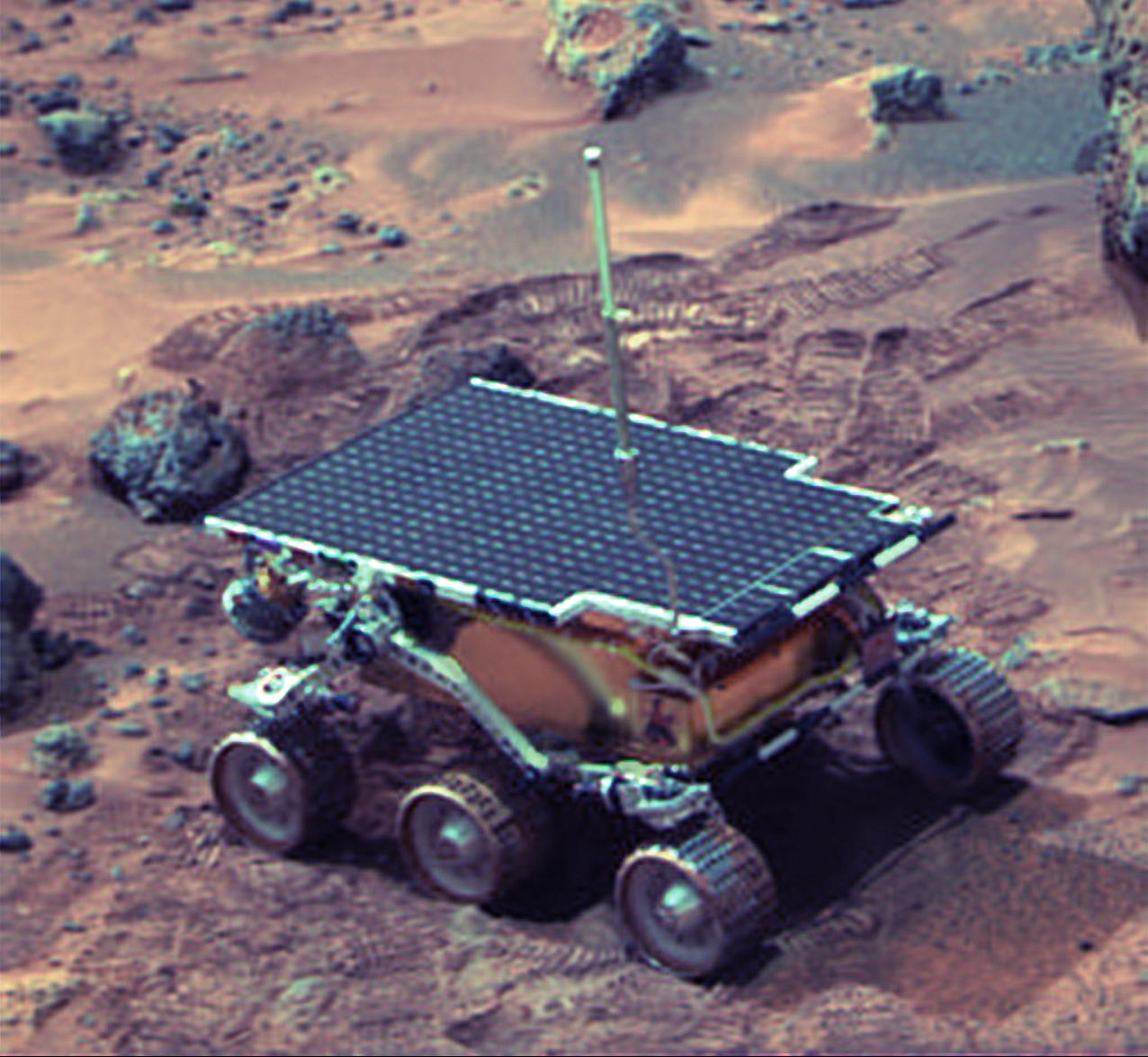
Changes: Auto-oriented as required by source metadata; resized to responsive widths without enlargement, encoded as WebP. No crop, compositing, retouching or content alteration.
Rights/source metadata checked 2026-11-13. Images identify the object or work; factual claims rely on the editorial references.
Discovery entry.sojourner · revision 1.0.0. Raise a content or image concern →. This prepares a local note; no report is delivered.