Antikythera mechanism
A corroded fragment with a sky of cycles hidden in its gears.
Recovered from a shipwreck near the Greek island of Antikythera, this ancient Greek device used gears and dials for astronomical and calendar calculations. What survives is fragmented bronze, not a complete working machine; the fragments are the starting point for understanding it. [1][3][2]
← Explore Archaeological Discoveries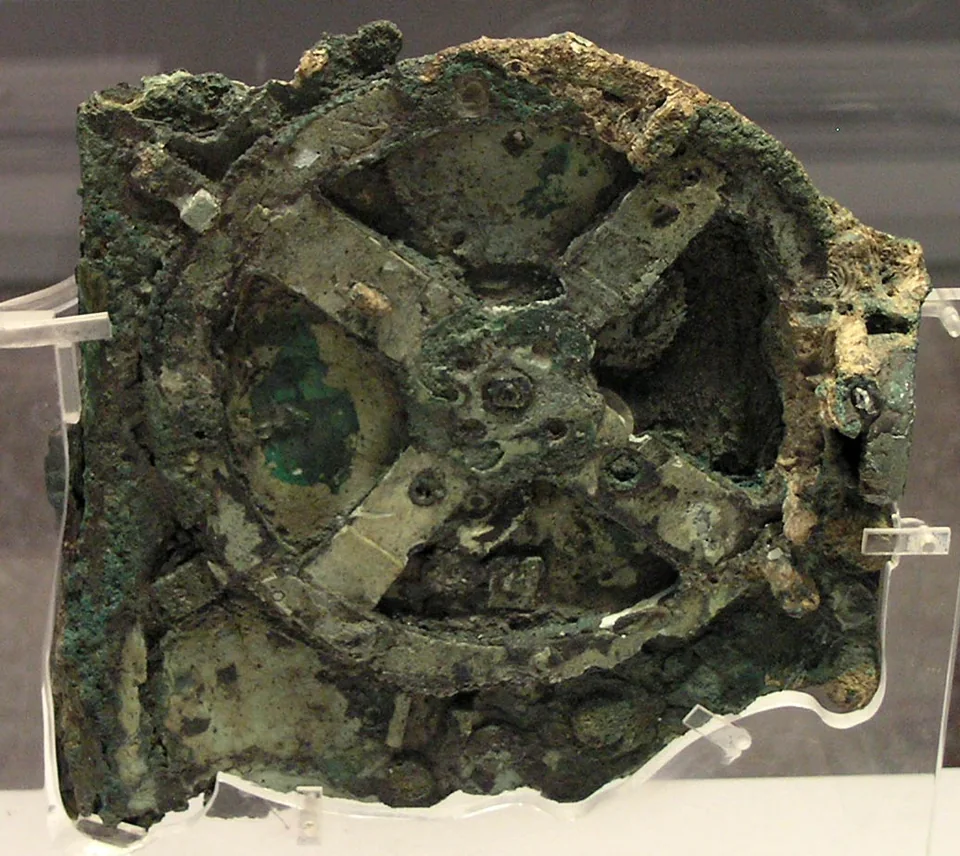
Fragment A of the original Antikythera mechanism, National Archaeological Museum, Athens. Surviving ancient fragment, not a modern reconstruction.
Marsyas, “NAMA Machine d’Anticythère 1”, via Wikimedia Commons, CC BY 2.5. Resized without enlargement and encoded as WebP. CC BY 2.5 ↗ · Image source ↗
A few details change the picture.
Researchers catalogue 82 surviving fragments. The seven largest are labelled A to G, while smaller pieces have numbers; the large piece shown here is Fragment A. [3]
Surviving toothed gears, inscriptions and dial scales support its identity as a calculating device. They also make it an archaeological puzzle about what the missing whole looked like. [1]
Out of a shipwreck
Sponge divers from Symi discovered the wreck in 1900. Recovery work under Greek government supervision followed, and the mechanism came out of the sea in 1901. Its importance was not immediately obvious: recognising the machine within damaged material was a separate stage from bringing objects to the surface. [2]
Cycles in bronze
The Greek Ministry of Culture describes calculations involving the Sun, Moon, calendars and eclipse prediction. Gears convert a turn into linked movements, so the device could represent recurring cycles on dials. Astronomical inscriptions and instructions on protective plates give researchers evidence beyond the shape of the surviving mechanism. [1]
Evidence, not a finished answer
Researchers have recorded the fragments with photography, surface imaging and X-rays, including three-dimensional scans. These methods expose details that are difficult to see on corroded surfaces. Even the orientation of every fragment is not settled. A modern reconstruction should therefore be read as an interpretation supported by evidence, not mistaken for the intact ancient object. [4][3]
The photograph here shows an original surviving fragment. Its irregular edges and partly visible gears matter: the gaps are part of what archaeologists and historians have to explain, rather than something a polished model can quietly remove. [3]
Keep a little curiosity.
Enjoying a discovery is enough. These optional questions may become a deeper investigation.
How can meshing gears represent cycles of different lengths?
This deeper explanatory question is not answered by a published CEL explanation yet. The discovery remains open to enjoy; suggesting the question does not promise publication.
A complete CEL answer is not published yet.
Plant a Seed for this question →How do researchers test a reconstruction when much of an object is missing?
This deeper explanatory question is not answered by a published CEL explanation yet. The discovery remains open to enjoy; suggesting the question does not promise publication.
A complete CEL answer is not published yet.
Plant a Seed for this question →Another story to explore.
Editorial suggestions for browsing, with the reason shown. These are not canonical knowledge-graph relationships.

The Great Wave
A towering wave, a distant mountain and the craft hidden in a printed blue.
Look at a different kind of historical making: a woodblock print whose materials and production choices still reward investigation.
Discover the story Photograph detail
Sojourner
Six wheels, a small solar panel and a new way to explore Mars.
Compare this geared calculating device with a modern robot built to carry instruments and follow carefully planned operations.
Discover the storySources & image notes.
Facts are tied to the references below. This is a source-checked editorial discovery, rather than an assessment or a claim of independent expert review.
- The Antikythera Mechanism ↗
Hellenic Ministry of Culture. Ancient Greek astronomical calculator, surviving gears, inscriptions, calendar/eclipses and the Hellenistic cultural context. No precise disputed manufacture year is asserted.
Checked 2026-11-13. - History ↗
Antikythera Mechanism Research Project. Sponge-diver wreck discovery in 1900, government-supervised salvage and recovery/recognition chronology.
Checked 2026-11-13. - The Fragments ↗
Antikythera Mechanism Research Project. 82 catalogued fragments, A–G/numbered naming, museum location and uncertainty about fragment orientations.
Checked 2026-11-13. - The Data ↗
Antikythera Mechanism Research Project. Photography, surface-imaging, X-ray and CT research evidence and distinction between measured fragments and constructed models.
Checked 2026-11-13.
Image provenance and modifications
Some collection cards show a labelled detail crop. The full image above retains its source framing.
Photograph
Fragment A of the original Antikythera mechanism, National Archaeological Museum, Athens. Surviving ancient fragment, not a modern reconstruction.
Marsyas, “NAMA Machine d’Anticythère 1”, via Wikimedia Commons, CC BY 2.5. Resized without enlargement and encoded as WebP.
Creator/publisher: Marsyas / Marsyas / Wikimedia Commons.
Source record · Original image · CC BY 2.5 (selected from the file’s offered license alternatives)


Changes: Resized without enlargement and encoded as WebP. No crop, retouching, compositing or content changes.
Rights/source metadata checked 2026-11-13. Images identify the object or work; factual claims rely on the editorial references.
Discovery entry.antikythera-mechanism · revision 1.0.0. Raise a content or image concern →. This prepares a local note; no report is delivered.