Chess: forced or promising?
One move can be necessary without proving that it is a good long-term plan.
“I have to play this” can mean two different things in chess. It may mean that the rules leave only one legal move, or that a player believes one move offers the best chance. The first claim can sometimes be proved by eliminating every alternative. The second usually asks for an evaluation of positions that remain possible. An original small position makes the difference visible. [1]
← Explore Puzzles & Strategy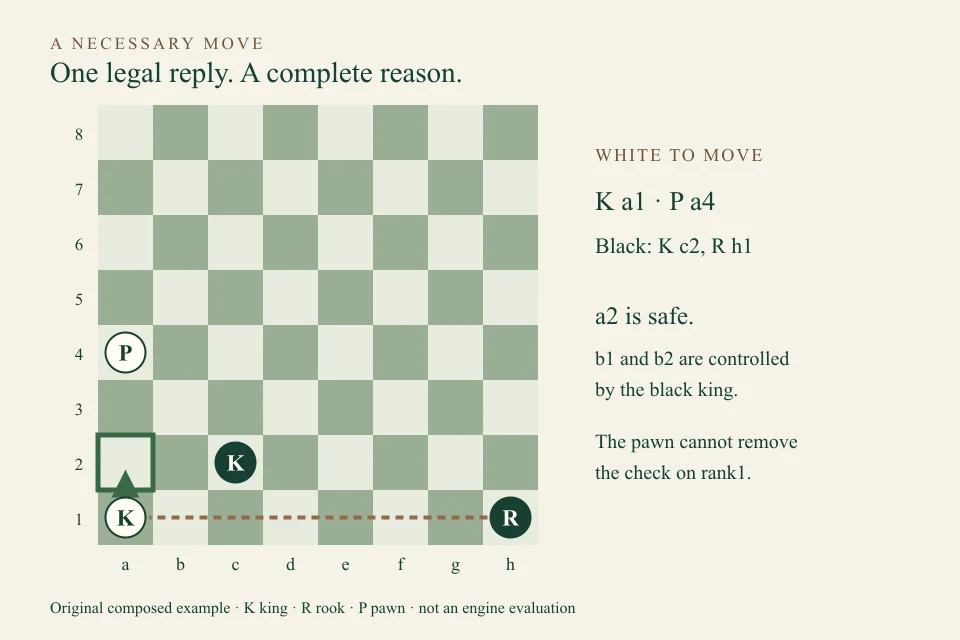
An original composed position. K means king, R rook and P pawn. This is a schematic teaching diagram, not an historical game, engine output or measured learning result.
Manthoryn original illustration, CC BY 4.0. SVG master and proportionally rasterized WebP renditions. CC BY 4.0 ↗ · Image source ↗
A few details change the picture.
First identify the constraint
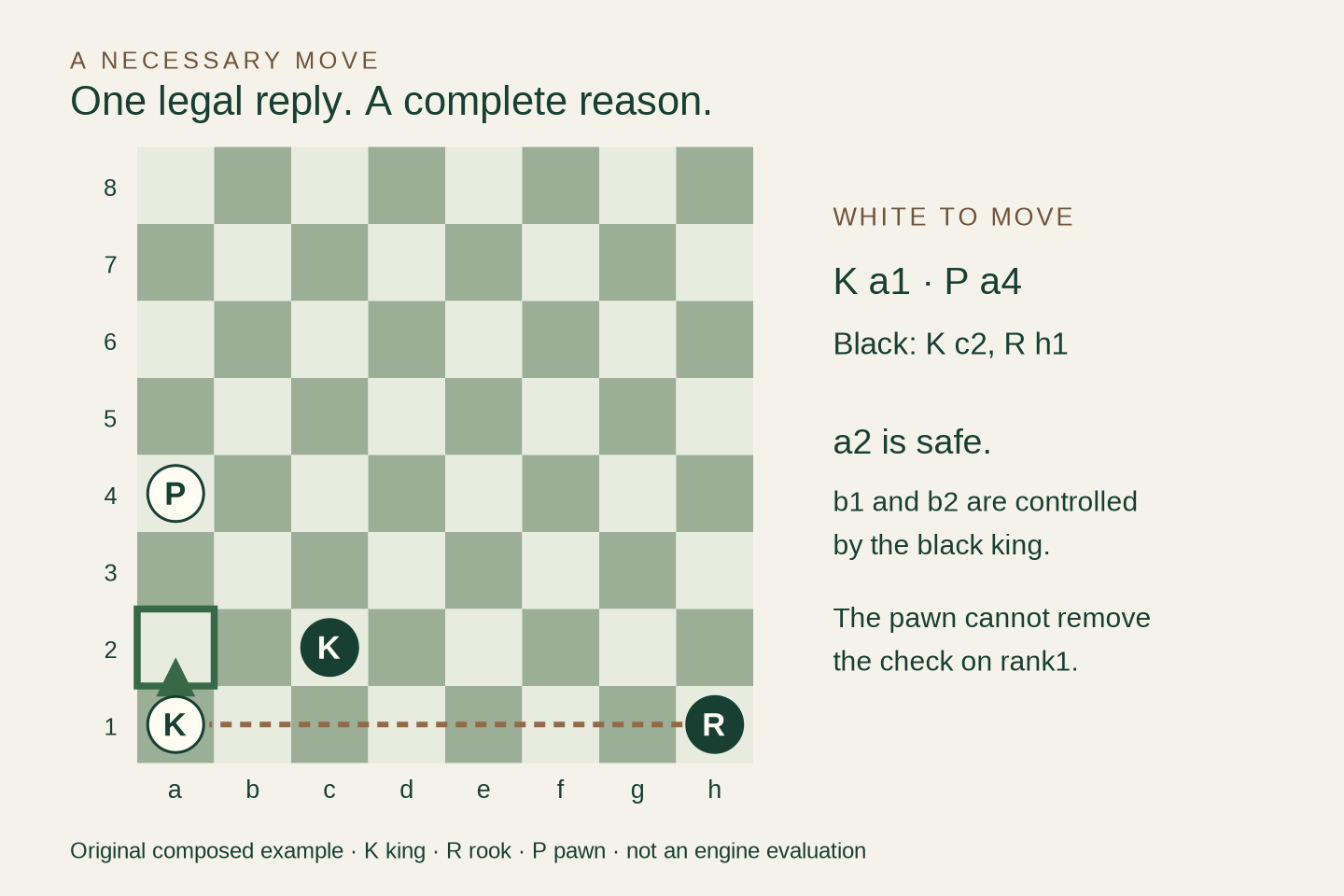
The black rook on h1 attacks along the first rank, with no piece between it and the white king on a1. White is in check. A legal move must remove that check; it cannot leave the king attacked. The pawn may look tempting because advancing it would make progress towards promotion, but a4–a5 does nothing to remove this rook attack. [1]
A short proof can be complete
From the corner a1, the king has only three neighbouring squares: a2, b1 and b2. The black king on c2 controls b1 and b2. Neither is a safe destination. Square a2 is not attacked by the black king or the rook on h1. White therefore has one legal king move: Ka2. There is no white piece that can capture the rook or interpose on the first rank. [1]
What the proof did not establish
The conclusion is deliberately narrow. We have not shown that White is winning, drawing or losing with best play. We have shown that one move satisfies the present rules while the alternatives do not. That is a complete answer to a legality question and an incomplete answer to a game-outcome question. More analysis would be needed for the latter. [1]
Now make the choice genuinely different
Imagine a second composed position with the same kings and pawn, but put the black rook on h8 instead of h1. This is a different board, not a continuation of the first example. The immediate check disappears. At least Ka2 and a4–a5 are now legal. Choosing between them calls for reasons about future play, rather than the earlier proof that there was only one legal response. [1]
Ask what “forced” is claiming
When someone calls a move forced, ask what alternatives were excluded and why. Were they illegal, or merely judged unattractive? In a tactical line, “forced” can also be shorthand for an opponent having no satisfactory defence under stated analysis; that is not automatically the same as having exactly one legal move. State the claim precisely enough to test it. [1]
You can inspect this example without an account, a chess engine or a promise of improvement. List the pieces, mark the attacked squares and explain each rejected alternative. The point is to enjoy a compact reasoning puzzle while keeping proof, prediction and preference separate. [1]
Keep a little curiosity.
Enjoying a discovery is enough. These optional questions may become a deeper investigation.
How can a complete check of alternatives turn a plausible move into a proof?
A formal CEL explanation of proof by cases and strategic evaluation is not yet published for this question.
A complete CEL answer is not published yet.
Plant a Seed for this question →Sources & image notes.
Facts are tied to the references below. This is a source-checked editorial discovery, rather than an assessment or a claim of independent expert review.
- FIDE Laws of Chess taking effect from 1 January 2023 ↗
International Chess Federation. Articles 3.3,3.7,3.8,3.9 and 3.10 define rook/pawn/king moves, check and legality. Both board positions, their piece lists and the case analysis are original Manthoryn teaching examples, not material taken from FIDE or a reported game.
Checked 2026-11-17.
Image provenance and modifications
Some collection cards show a labelled detail crop. The full image above retains its source framing.
Illustration
An original composed position. K means king, R rook and P pawn. This is a schematic teaching diagram, not an historical game, engine output or measured learning result.
Manthoryn original illustration, CC BY 4.0. SVG master and proportionally rasterized WebP renditions.
Creator/publisher: Original Manthoryn educational illustration / Manthoryn.
Source record · Original image · Original code-native educational illustration released under Creative Commons Attribution4.0 International. No third-party piece artwork was used.
Changes: Complete original frame proportionally resized and converted to WebP. No crop, stretching, retouching or generated documentary additions.
Rights/source metadata checked 2026-11-17. Images identify the object or work; factual claims rely on the editorial references.
Discovery entry.ce1-chess-decisions · revision 1.0.0. Raise a content or image concern →. This prepares a local note; no report is delivered.