One event, two viewpoints
The events can stay fixed while the telling changes what we know when.
A missing object can become a mystery before anything mysterious has happened. In the original fictional scene below, a paper boat is moved into a box. Tell the scene from the returning owner’s limited view and its whereabouts are unknown. Show the move first and the same return becomes a moment in which we know more than the character. The event sequence need not change for the reading experience to change. [1]
← Explore Storytelling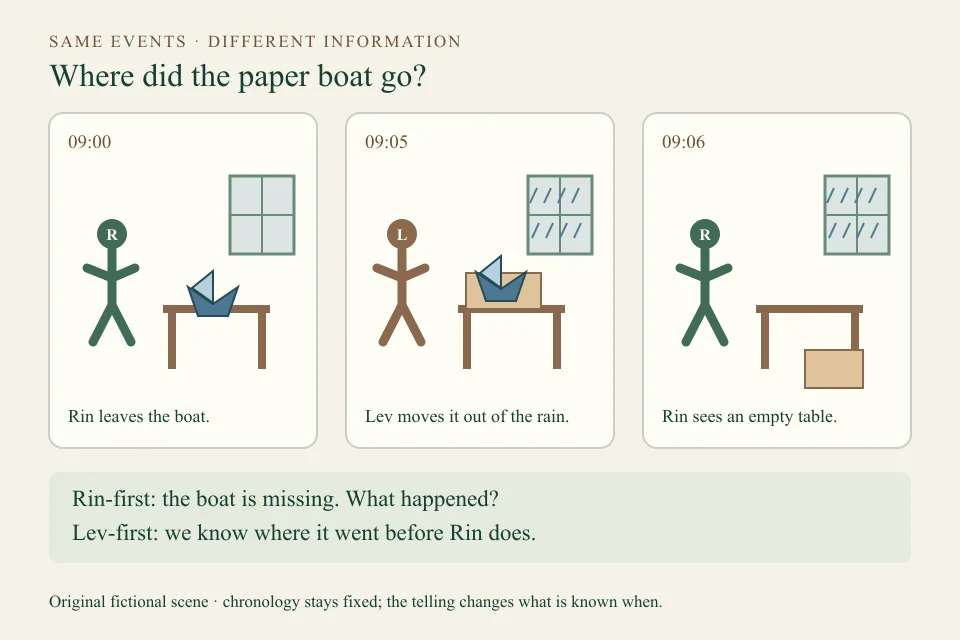
Original fictional scene. The timeline is fixed; beginning with Rin’s return or Lev’s action changes what information arrives first. This is not an archival image or a measured audience experiment.
Manthoryn original fictional scene and illustration, CC BY 4.0. SVG master and proportionally rasterized WebP renditions. CC BY 4.0 ↗ · Image source ↗
A few details change the picture.
Give the scene a fixed spine
Here are the invented events in order. At 09:00 Rin leaves a blue paper boat on a table by a window. At 09:05 rain begins and Lev puts the boat in a box away from the window. At 09:06 Rin returns and sees the empty tabletop. The box is nearby but closed. These details are the agreed basis for the comparison, not facts borrowed from a source. [1]
Begin where Rin can see
“Rin returned to the table. The blue boat was gone. Beside the wall stood a closed box. What had happened?” This is original fiction told with Rin’s limited information. It does not say Lev destroyed or stole the boat. The gap invites a question, while any accusation would go beyond what this passage establishes. [1]
The Living Handbook of Narratology calls attention to the selection or restriction of narrative information. That is useful here: we are not changing the boat’s location between versions. We are changing whether the account supplies the event that explains its absence. A reader can recognize the gap without having the same emotional reaction as every other reader. [1]
Supply the action before the return
Now begin earlier: “Rain ticked against the window. Lev lifted the blue boat into a dry box and lowered the lid. A moment later, Rin came back to the empty table.” The movement is no longer concealed from the reader. Rin can still be puzzled, but the reader has already been given a reason why the boat is missing. These sentences are another original version of the same fictional spine. [2]
Who speaks is not the whole question
Both passages use third-person narration, yet they give different access to information. A first-person narrator can also tell a story with hindsight, while a third-person narrator can remain close to one person’s experience. Ask separately who is speaking, whose experience shapes the description and what the account permits us to know. Those distinctions are more informative than treating a pronoun as a complete theory of perspective. [2]
Change the telling without pretending to prove a universal effect
A film editor makes related choices about which material arrives first and what a viewer can connect. BFI’s discussion of documentary editing emphasizes that selecting and ordering material is interpretive work, not simply shortening footage. Our scene is fiction rather than documentary; it offers a small comparison, not evidence that real historical footage can be rearranged without changing a factual claim. [3]
Try a third version that begins with the closed box being opened. Which question disappears, and which new question becomes interesting? There is no required reaction or scored answer. The useful skill is to name what the telling supplies, what it leaves unknown and what an interpretation adds. The paper boat provides a shared example so those choices stay visible. [3]
Keep a little curiosity.
Enjoying a discovery is enough. These optional questions may become a deeper investigation.
How does a narrator’s choice of information differ from what actually happened in a story?
A deeper CEL explanation connecting narrative form, inference and source evaluation is not yet published for this question.
A complete CEL answer is not published yet.
Plant a Seed for this question →Sources & image notes.
Facts are tied to the references below. This is a source-checked editorial discovery, rather than an assessment or a claim of independent expert review.
- Focalization — Burkhard Niederhoff ↗
The Living Handbook of Narratology, University of Hamburg. Framework for selecting/restricting narrative information. All Rin/Lev/boat events, times and quoted passages are original fictional Manthoryn examples, not quotations from the handbook.
Checked 2026-11-17. - Perspective – Point of View — Burkhard Niederhoff ↗
The Living Handbook of Narratology, University of Hamburg. Perspective as more than optical position or grammatical person; framework for the original comparison, not a source for its fictional events.
Checked 2026-11-17. - In praise of the undersung art of documentary editing ↗
British Film Institute. Editorial practice as interpretation; distinguishes the original fictional exercise from claims about documentary evidence or universal audience responses.
Checked 2026-11-17.
Image provenance and modifications
Some collection cards show a labelled detail crop. The full image above retains its source framing.
Illustration
Original fictional scene. The timeline is fixed; beginning with Rin’s return or Lev’s action changes what information arrives first. This is not an archival image or a measured audience experiment.
Manthoryn original fictional scene and illustration, CC BY 4.0. SVG master and proportionally rasterized WebP renditions.
Creator/publisher: Original Manthoryn educational illustration / Manthoryn.
Source record · Original image · Original code-native illustration released under Creative Commons Attribution4.0 International. Characters, scene and panels were created for this explanation.
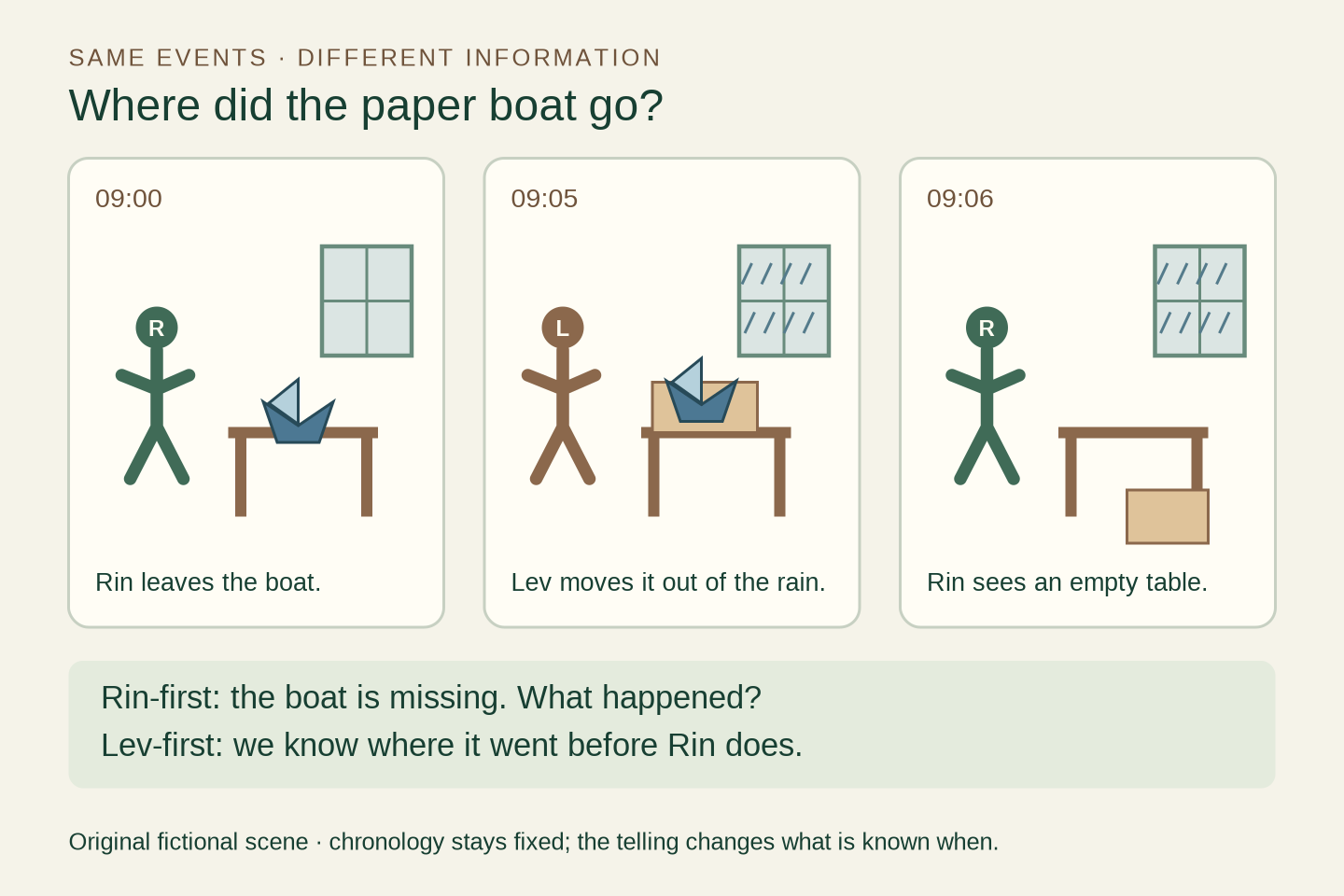
Changes: Complete original frame proportionally resized and converted to WebP. No crop, stretching, retouching or generated documentary additions.
Rights/source metadata checked 2026-11-17. Images identify the object or work; factual claims rely on the editorial references.
Discovery entry.ce1-two-viewpoints · revision 1.0.0. Raise a content or image concern →. This prepares a local note; no report is delivered.