Lotte Reiniger’s silhouette animation
A sequence of small changes lets a flat shape appear to act.
Lotte Reiniger made expressive films from paper and light. In her 1936 account of the method, she describes making figures from separate movable pieces and changing their positions between exposures. The cut-out supplies a pose. Only when the exposures are shown in sequence does that pose become part of an action. [1]
The BFI National Archive’s pieces for Reiniger’s Cinderella show that a production can require several shapes for one character, including versions with more details for close views. This helps explain why the animator has to think about both what moves and what can be seen at a particular distance. [2]
← Explore Animation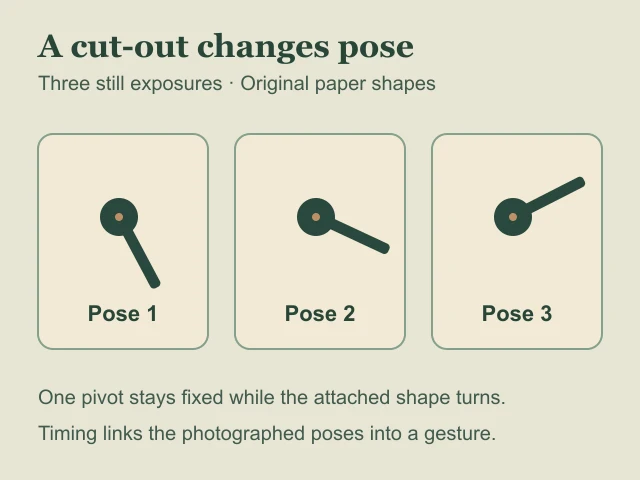
Original paper geometry, illustrating successive positions. None of Reiniger’s cut-outs or frames is reproduced.
Original Manthoryn educational illustration · CC BY 4.0. CC BY 4.0 ↗ · Image source ↗
A few details change the picture.
Start with one silhouette
One opaque shape against a lit or light surface can show the direction of an arm and the bend of a body. Join a few parts and change their positions between photographed moments. A drawing of successive positions lets you see which pieces turn. It still takes sequence and timing for a viewer to see those positions as one action. [1]
Compare two kinds of step between photographs
Imagine a new cut-out made from a circle and a hinged rectangle. If the rectangle turns a small amount each time, the recorded positions are close together. A large change carries it farther between frames. Holding one position for several frames produces a pause. These alterations can suggest a slow gesture, a sudden reaction or a moment of hesitation, depending on context. [1]
Choose a shape that reads clearly in its shot
The BFI’s Cinderella record shows different cut-outs of the prince and identifies a close view that includes more detail. The object for a distant shot can emphasize the complete outline. A close view can let the audience read finer changes. The same character need not always be represented by exactly the same physical piece. [2]
Use contrast to show which part moved
A steady background can make a changing figure easier to follow. Another choice moves several layers, potentially affecting the feeling of depth or movement. Read a short strip by naming the stable pieces, the pieces that change, and when an audience receives a new clue. That order can communicate action even with a restricted range of marks. [1][2]
Keep a little curiosity.
Enjoying a discovery is enough. These optional questions may become a deeper investigation.
How could the same cut-out look uncertain in one sequence and eager in another?
Compare changes of posture and the timing of a pause in your own invented example.
A complete CEL answer is not published yet.
Plant a Seed for this question →Sources & image notes.
Facts are tied to the references below. This is a source-checked editorial discovery, rather than an assessment or a claim of independent expert review.
- Scissors make films ↗
Lotte Reiniger, Sight and Sound; BFI archive. Creator’s 1936 first-person description of making and animating silhouettes.
Checked 2026-11-17. - Lotte Reiniger’s cut-out figures and backgrounds for Cinderella ↗
BFI National Archive. Surviving items and original object catalogue, multiple silhouettes for one character and increased detail for closer shots.
Checked 2026-11-17.
Image provenance and modifications
Some collection cards show a labelled detail crop. The full image above retains its source framing.
Illustration
Original paper geometry, illustrating successive positions. None of Reiniger’s cut-outs or frames is reproduced.
Original Manthoryn educational illustration · CC BY 4.0.
Creator/publisher: Original Manthoryn educational illustration / Manthoryn.
Source record · Original image · Original Manthoryn illustration, CC BY 4.0. No third-party art or recorded media reproduced.
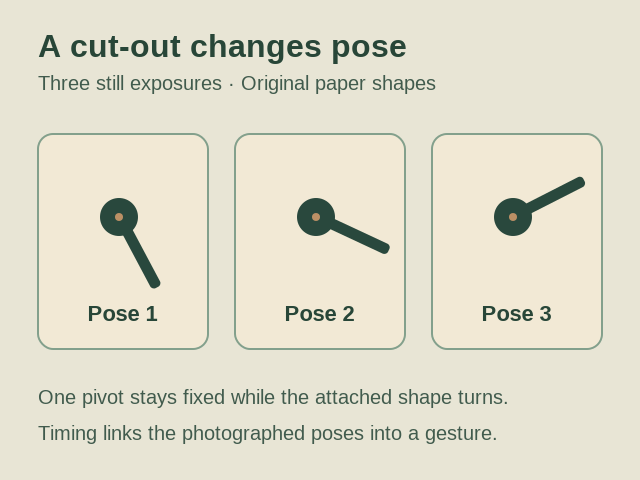
Changes: Rasterized to two full-frame WebP widths.
Rights/source metadata checked 2026-11-17. Images identify the object or work; factual claims rely on the editorial references.
Discovery entry.ce3-movies-reiniger-silhouette · revision 1.0.0. Raise a content or image concern →. This prepares a local note; no report is delivered.