Lumière Cinématographe
A small wooden box that could photograph, print and project moving images.
The portable Lumière Cinématographe could record a film, print a positive copy and project it for an audience. Inside was a mechanism built around a crucial action: stopping the film. [1]
← Explore Cinematography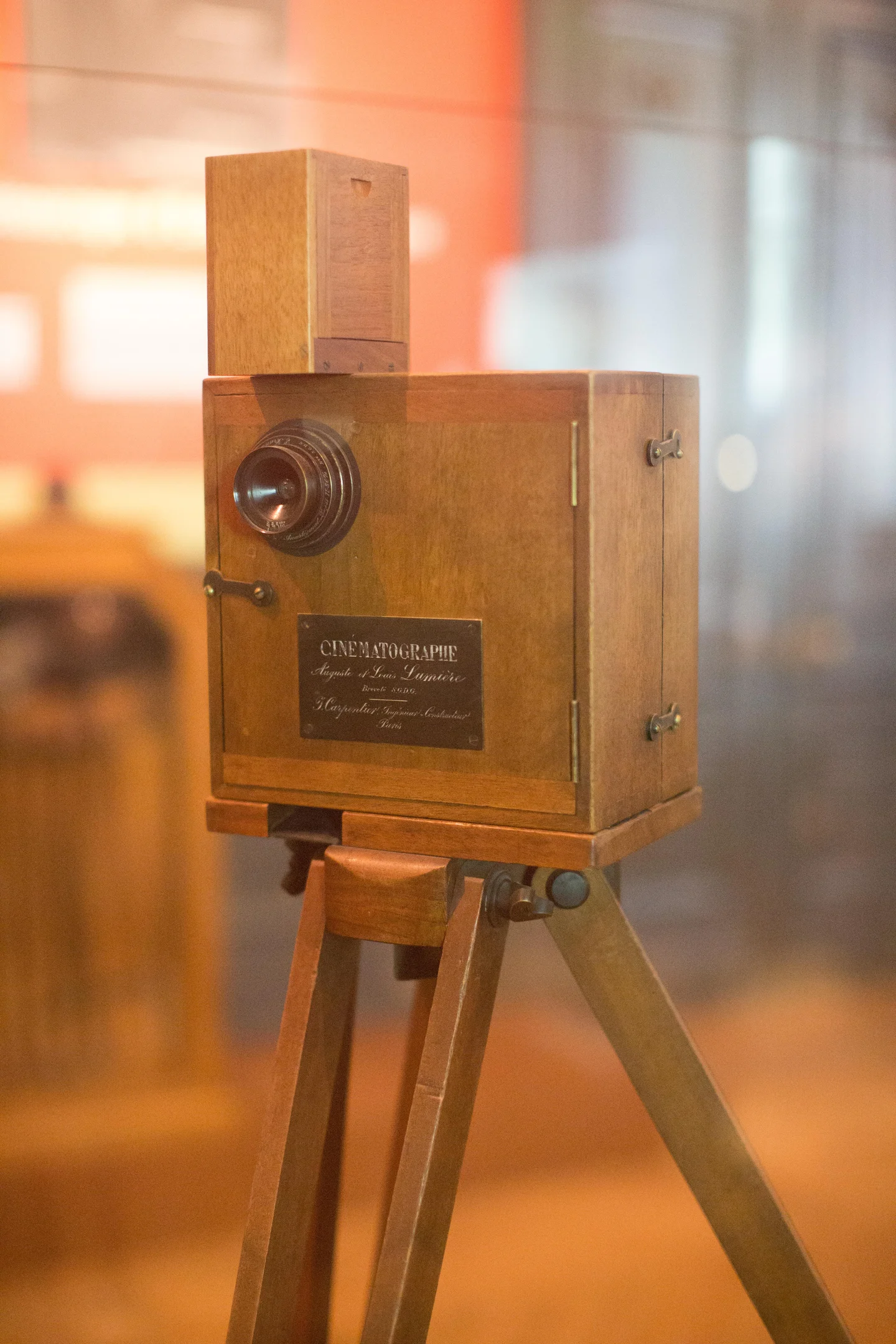
A Cinématographe at the Institut Lumière, photographed by Victor Grigas on 3 July 2014.
Institut Lumière — CINEMATOGRAPHE Camera — Victor Grigas, Wikimedia Commons, CC BY-SA 4.0. CC BY-SA 4.0 ↗ · Image source ↗
A few details change the picture.
Motion made from pauses
An eccentric cam converts the handle’s rotation into an up-and-down movement. Small claws engage the perforations and advance the film in steps. Each movement is followed by a pause for exposure or projection. The Institut Lumière compares this alternating action to a sewing machine’s movement of fabric. [1]
The same apparatus could also make a positive print. A developed negative and unexposed film travelled together, with the lens facing an evenly lit surface such as a sunlit white wall. Combining these functions helped operators travel without carrying three entirely separate machines. [1]
From apparatus to shared experience
On 28 December 1895, a paying audience at the Grand Café in Paris watched a programme of ten Lumière films. Operators subsequently travelled to film other countries and lives. The Musée Lumière highlights their framing and aesthetic choices: the story involves people deciding what to show, as well as a machine capable of showing it. [3]
The Lumières were not working in isolation. Dickson and Edison’s recording and viewing systems, Léon Bouly’s earlier patents and other parallel inventions belong to this history too. The Cinématographe’s achievement is easier to appreciate as a practical combination of improvements than as a claim that one box invented cinema alone. [2]
Keep a little curiosity.
Enjoying a discovery is enough. These optional questions may become a deeper investigation.
Why must a film frame pause in the gate while the mechanism keeps turning?
A focused explanation of intermittent film transport and exposure is not yet published. You can suggest this question through Plant a Seed.
A complete CEL answer is not published yet.
Plant a Seed for this question →Another story to explore.
Editorial suggestions for browsing, with the reason shown. These are not canonical knowledge-graph relationships.
Sources & image notes.
Facts are tied to the references below. This is a source-checked editorial discovery, rather than an assessment or a claim of independent expert review.
- Le Cinématographe Lumière ↗
Institut Lumière. Three functions, portable apparatus, hand-cranked cam/claw intermittent movement, exposure/projection during pauses and negative-to-positive contact-printing procedure. Original English synthesis of the French institutional account.
Checked 2026-11-14. - When the pictures started moving: patent for the Lumière brothers’ cinematograph ↗
German Patent and Trade Mark Office (DPMA). French patent FR 245032 and application date, Lumière applicants, camera/projector context, Dickson/Edison, Bouly and parallel pioneers. The page’s unverified train-panic anecdote and absolute invention-priority language are not repeated.
Checked 2026-11-14. - Musée Lumière: the invention in its historical and artistic setting ↗
Institut Lumière / Musée Lumière. Ten-film paid Grand Café programme on 28 December 1895; travelling Lumière operators, their framing and aesthetic choices, and broader experimental context. No claim that the photographed apparatus is the original screening instrument.
Checked 2026-11-14. - Institut Lumière — CINEMATOGRAPHE Camera: photograph and file-specific licence ↗
Victor Grigas / Wikimedia Commons. Authentic camera-apparatus photograph, Institut Lumière setting, Victor Grigas authorship, 3 July 2014 capture and CC BY-SA 4.0 release. The 2014 original upload is used, rather than the 2020 brightness/color/crop revision.
Checked 2026-11-14.
Image provenance and modifications
Some collection cards show a labelled detail crop. The full image above retains its source framing.
Photograph
A Cinématographe at the Institut Lumière, photographed by Victor Grigas on 3 July 2014.
Institut Lumière — CINEMATOGRAPHE Camera — Victor Grigas, Wikimedia Commons, CC BY-SA 4.0.
Creator/publisher: Victor Grigas / Victor Grigas / Wikimedia Commons.
Source record · Original image · Creative Commons Attribution-ShareAlike 4.0 International (CC BY-SA 4.0). The photograph and resized derivatives remain under this licence.


Changes: Resized and converted to WebP from the original 2014 upload; original composition preserved. No generative editing. Derivatives licensed CC BY-SA 4.0.
Rights/source metadata checked 2026-11-14. Images identify the object or work; factual claims rely on the editorial references.
Discovery entry.lumiere-cinematographe · revision 1.0.0. Raise a content or image concern →. This prepares a local note; no report is delivered.