A zoetrope and the timing of motion
Brief views of different poses can be experienced as one movement.
A zoetrope holds a sequence of drawings in a rotating drum. Near the rim are slits through which a viewer can glimpse the drawings. The Science Museum Group preserves a named zoetrope with strips and discs, documenting how successive brief views make drawings appear to move. [1]
The pictures in a strip are static. Their spaced presentation offers clues for seeing a moving shape. The intervals between views and changes in position matter. The device helps separate getting a clear glimpse and interpreting several glimpses as one action. [1][2]
← Explore Cinematography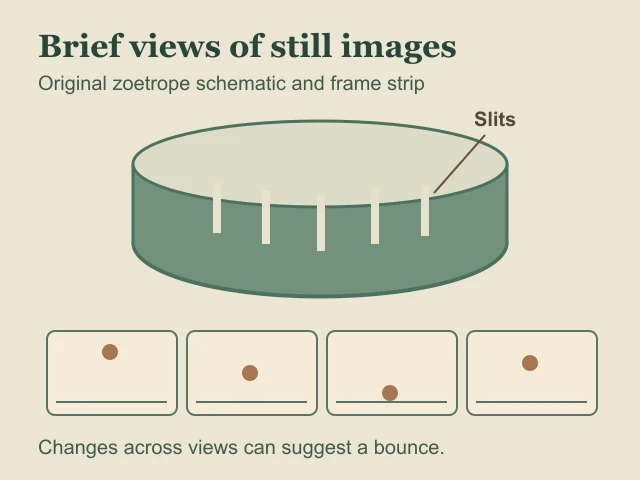
Static, original presentation of a zoetrope and frame strip. The mechanism gives intermittent views of drawings.
Original Manthoryn educational illustration · CC BY 4.0. CC BY 4.0 ↗ · Image source ↗
A few details change the picture.
Notice what the slit changes
As the drum turns, looking through a slit limits which drawing is visible and for how long. Looking at the same drawings continuously as the drum spins would tend to smear detail across the view. Interruption helps give the viewer brief, separable glimpses. The slits control the presentation while the drawings supply the changed positions. [1]
Choose what changes from one drawing to the next
Imagine an invented strip with a dot above a line. Draw it nearer the line, on the line, and rising again. A viewer might connect those positions as a bounce. Keep the positions and vary the delay. A long enough delay can make the events feel separate. The relation between distance and timing matters along with the order of poses. [2][1]
Ask what a vision experiment can measure
Experiments on apparent motion ask what people perceive when they receive separate visual patterns. The original Braddick study used patterned displays and tested how their relation affected motion judgments. Results from a particular laboratory setup do not give one threshold for every zoetrope. They distinguish perceiving a sequence as motion from simply remembering the preceding frame. [2]
Check what happens where the strip starts again
If the first and last poses fit as neighbors, the viewer can connect one turn of the drum to the next. A mismatch can make a jump visible. This is also a useful timing question when watching a film scene. Notice which changes the sequence invites you to group together and which transition deliberately interrupts that grouping. [1][2]
Keep a little curiosity.
Enjoying a discovery is enough. These optional questions may become a deeper investigation.
What difference would you expect between changing the spacing of the drawings and changing how often a viewer sees them?
Use an original static strip. A perception study would need to state both the timing and what the viewer perceived.
A complete CEL answer is not published yet.
Plant a Seed for this question →Sources & image notes.
Facts are tied to the references below. This is a source-checked editorial discovery, rather than an assessment or a claim of independent expert review.
- Zoetrope, with 38 strips and 6 discs ↗
Science Museum Group. Catalogue of the apparatus, strips and viewing through slits. No object image reproduced.
Checked 2026-11-17. - A short-range process in apparent motion ↗
Oliver Braddick, Vision Research. Primary study’s restricted contrast on apparent motion in sequential patterned displays, not a universal account of film perception.
Checked 2026-11-17.
Image provenance and modifications
Some collection cards show a labelled detail crop. The full image above retains its source framing.
Illustration
Static, original presentation of a zoetrope and frame strip. The mechanism gives intermittent views of drawings.
Original Manthoryn educational illustration · CC BY 4.0.
Creator/publisher: Original Manthoryn educational illustration / Manthoryn.
Source record · Original image · Original Manthoryn illustration, CC BY 4.0. No third-party art or recorded media reproduced.
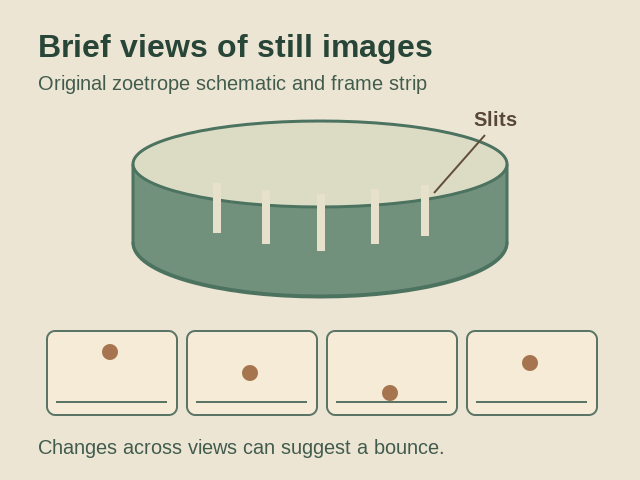
Changes: Rasterized to two full-frame WebP widths.
Rights/source metadata checked 2026-11-17. Images identify the object or work; factual claims rely on the editorial references.
Discovery entry.ce3-movies-zoetrope · revision 1.0.0. Raise a content or image concern →. This prepares a local note; no report is delivered.