A Trip to the Moon and staged illusion
A cut can make separately staged places belong to one journey.
In Georges Méliès’s 1902 film Le Voyage dans la Lune, a group travels from an imagined launch to a personified Moon. The journey works because each scene sends attention forward to the next. The viewer sees a staged departure and a separately staged arrival, then links them as the progress of one expedition. [1][2]
The BFI catalogues the film as A Trip to the Moon. Its guide identifies several recognizable images, including the launch and the arrival in the Moon’s eye. The expressive face turns the destination into a participant in the story. Here the question is what makes a sequence intelligible, regardless of whether the viewer takes the journey as physically realistic. [1][2]
← Explore Movies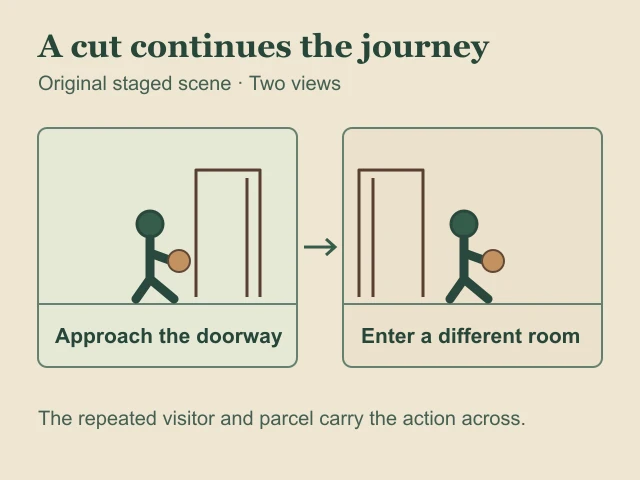
Invented doorway example showing the continuity of an action across a cut. It does not reproduce a film image.
Original Manthoryn educational illustration · CC BY 4.0. CC BY 4.0 ↗ · Image source ↗
A few details change the picture.
Give the sequence a departure and a destination
A launch scene gives the audience an intention and an object to follow. A scene placed after it gives a destination, where the travelers or effects of their arrival can be recognized. The order makes the cut meaningful. If a long interval is omitted, the audience can still connect the events from what the scenes have set up. [1][2]
Follow the action when the viewpoint changes
The film’s close view of the Moon is not the same scale or viewpoint as the preparations. The audience has to let one view give way to another while keeping its understanding of the goal. An invented scene of an empty room, a door opening and a new room can illustrate the same principle without reproducing Méliès’s characters or settings. [1][2]
Ask whose journey the story is built around
The expedition is the center of the film’s account. Encounters with the Moon’s inhabitants are part of an early twentieth-century fantasy of encountering and occupying another place. Film scholarship has argued that the spectacle can also be read as satire of imperial conquest. That is an interpretation about choices and historical context, not a claim that every viewer reads it identically. [2][3]
Keep the edition separate from the staged method
An archive can point you to one preserved or presented version. A reproduction may contain separate contributions in color treatment, music or restoration. To discuss a frame in a specific edition, identify the edition. The original explanatory drawing here uses a new scene with the same broad idea of sequence. [1][2]
Keep a little curiosity.
Enjoying a discovery is enough. These optional questions may become a deeper investigation.
What would make an audience connect two separately staged rooms as parts of the same journey?
Compare repeated actions, shared objects and the order of views without copying a film’s actual scenes.
A complete CEL answer is not published yet.
Plant a Seed for this question →Sources & image notes.
Facts are tied to the references below. This is a source-checked editorial discovery, rather than an assessment or a claim of independent expert review.
- Le Voyage dans la Lune (1902) ↗
British Film Institute. Film identity, date and catalogue reference.
Checked 2026-11-17. - A Trip to the Moon ↗
BFI Player, archive presentation. Archive description of departure, moon arrival and staged fantasy. This reference does not authorize reproduction.
Checked 2026-11-17. - The Spectacle of the Moon Conquest ↗
University of Birmingham research record. Original scholarly argument about visual culture and anti-imperialist satire. Cited as a reading, not a confirmed universal intent.
Checked 2026-11-17.
Image provenance and modifications
Some collection cards show a labelled detail crop. The full image above retains its source framing.
Illustration
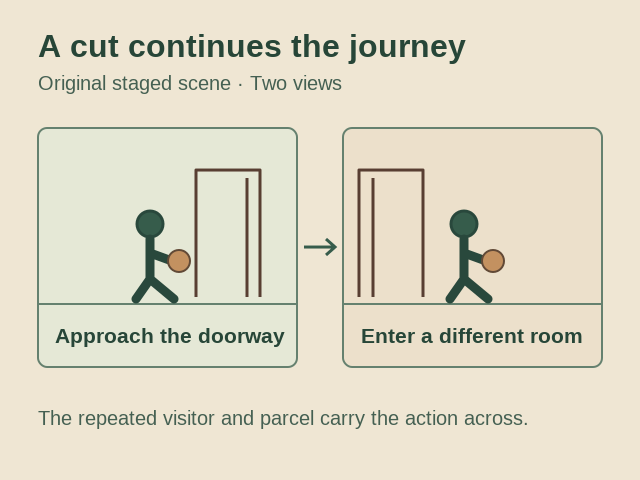
Invented doorway example showing the continuity of an action across a cut. It does not reproduce a film image.
Original Manthoryn educational illustration · CC BY 4.0.
Creator/publisher: Original Manthoryn educational illustration / Manthoryn.
Source record · Original image · Original Manthoryn illustration, CC BY 4.0. No third-party art or recorded media reproduced.
Changes: Rasterized to two full-frame WebP widths.
Rights/source metadata checked 2026-11-17. Images identify the object or work; factual claims rely on the editorial references.
Discovery entry.ce3-movies-melies-staged-journey · revision 1.0.0. Raise a content or image concern →. This prepares a local note; no report is delivered.