A fictional space habitat versus a real design constraint
Let an imaginary ring expose one question about rotating motion.
Picture two fictional habitats with circular floors rotating around an axle. Residents stand against the inner face of the outer rim. The story gives everyone an ordinary sense of down, even far from a planet. That choice opens a physical question: which way would the floor have to accelerate a person to keep them going around the ring? [1][2]
In the simple model, the floor pushes toward the center and continually changes the direction of the person’s velocity. The idea motivates a comparison between circle size and turning rate. NASA’s historic Space Settlements design study also considered rotation, but the setting described here is original fiction. [1][2]
← Explore Science Fiction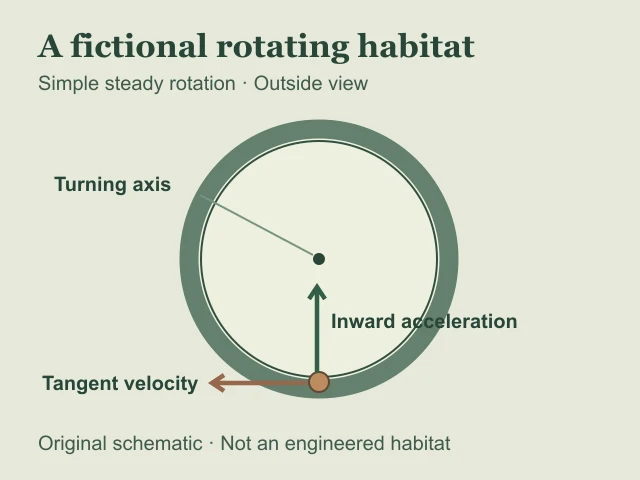
Invented habitat exterior view. The arrows show a simple motion model. No real or licensed fiction habitat is depicted.
Original Manthoryn educational illustration · CC BY 4.0. CC BY 4.0 ↗ · Image source ↗
A few details change the picture.
Follow the path from outside the habitat
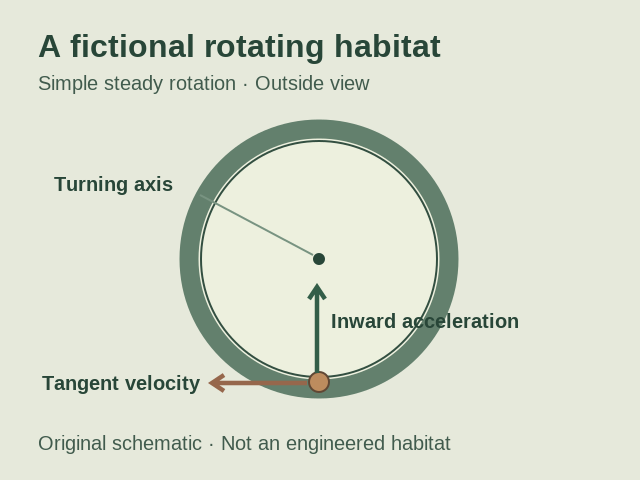
Someone attached to the outer rim traces a circle. At any instant their velocity points along the tangent. A moment later that direction has changed, which requires an inward acceleration. In this model the floor supplies an inward contact force. That felt pressure motivates the story’s idea of a floor even without Earth’s gravity. [1]
Say what stays fixed when you compare two circles
Compare a wider and a narrower ring turning at the same angular rate. A point on the larger circle travels farther during the same revolution time. The model predicts a larger inward acceleration there. If you compared points with the same tangential speed instead, a larger radius would produce a smaller inward acceleration. The choice of fixed quantity changes the question. [1]
Identify the conditions the story leaves out
The historical NASA study considered rotating designs when discussing gravity-like conditions. A design study can expose trade-offs without supplying verified human comfort, structural safety or proof of construction. The simple ring illustration omits where a person is within the habitat, what happens when they walk and how other systems would be supported. [2][1]
Ask what a new scene should test
A story might show a person walking from the rim toward the center. If both parts share one turning rate, ask how their distance from the axle changes and what the motion model predicts for standing still relative to the floor. Walking introduces other effects. A precise comparison gives the writer a question to explore without turning fiction into engineering evidence. [1][2]
Keep a little curiosity.
Enjoying a discovery is enough. These optional questions may become a deeper investigation.
What would change if two habitat floors had the same rim speed but different radii?
Use circular motion in a labelled fictional model. A comfort or engineering judgment needs additional measurements.
A complete CEL answer is not published yet.
Plant a Seed for this question →Sources & image notes.
Facts are tied to the references below. This is a source-checked editorial discovery, rather than an assessment or a claim of independent expert review.
- University Physics Volume 1 §4.4 Uniform and Nonuniform Circular Motion ↗
OpenStax. Centripetal acceleration and the distinction between angular rate, radius and tangential speed.
Checked 2026-11-17. - Space Settlements: A Design Study ↗
NASA Technical Reports Server, NASA SP-413. Historical conceptual design study and role of rotation in proposed settlements. The discussed ring is original fiction.
Checked 2026-11-17.
Image provenance and modifications
Some collection cards show a labelled detail crop. The full image above retains its source framing.
Illustration
Invented habitat exterior view. The arrows show a simple motion model. No real or licensed fiction habitat is depicted.
Original Manthoryn educational illustration · CC BY 4.0.
Creator/publisher: Original Manthoryn educational illustration / Manthoryn.
Source record · Original image · Original Manthoryn illustration, CC BY 4.0. No third-party art or recorded media reproduced.
Changes: Rasterized to two full-frame WebP widths.
Rights/source metadata checked 2026-11-17. Images identify the object or work; factual claims rely on the editorial references.
Discovery entry.ce3-movies-fictional-habitat · revision 1.0.0. Raise a content or image concern →. This prepares a local note; no report is delivered.