Between pictures: how a silent page carries time
A pot, a hand and a small change let you infer something the page never draws.
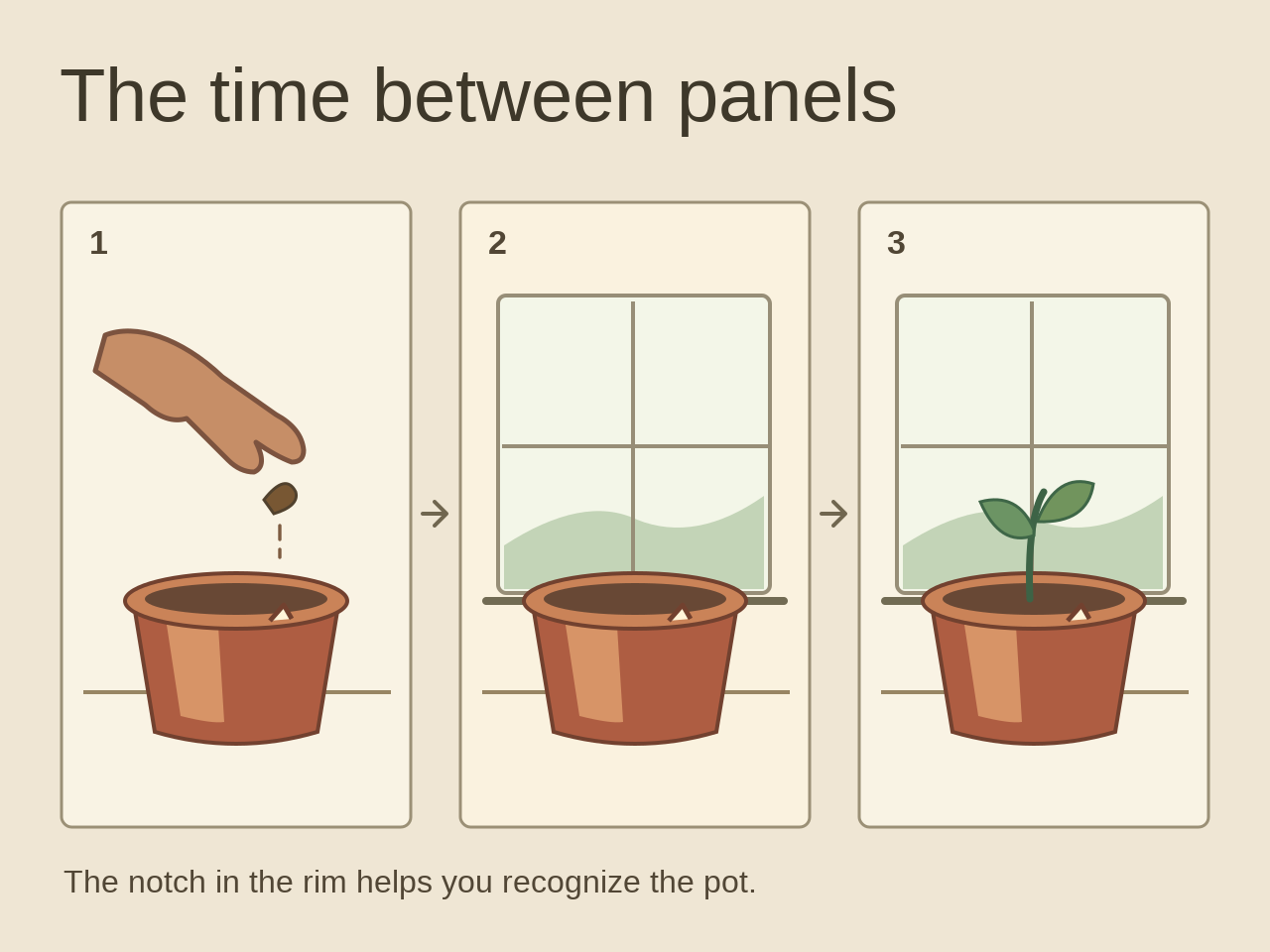
In the first frame, someone places a seed in a small pot. In the second, the pot waits beside a window. In the third there is a green shoot. The page contains three still pictures and no footage of a seed germinating. You supply that change yourself, which is precisely how the pictures can make time felt. [2]
This example is an original page, separate from Lynd Ward’s Gods’ Man. The Library of Congress preserves a first edition of the 1929 novel, which tells a much darker story through uncaptioned woodblock images. That work is a real historical example of how sequences can do work that a single illustration cannot do alone. [1][2]
← Explore Comics
Original teaching sequence, not a depiction of any Lynd Ward page or character. The story invites a time inference without specifying the duration.
Original Manthoryn educational illustration · CC BY 4.0. CC BY 4.0 ↗ · Image source ↗
A few details change the picture.
Recognize what stays the same
Look for the dark notch on the pot lip. It repeats in every panel. One might still imagine three different pots, but the repeated feature makes the simpler connection plausible. A visual sequence can ask readers to carry an identity between gaps without telling them in captions that they have done so. [2]
Look at the difference
The seed, empty-looking soil and green shoot are deliberately distinct. The second picture does not show the hidden changes below the soil. You infer them because pictures on either side offer compatible evidence. Replace the final frame with a dry, cracked pot and you would expect quite a different intervening story from almost the same layout. [2]
A gap has no fixed duration
The first two frames could be close together. The third invites a larger jump, but it gives no date. Nothing fixes whether the frame boundary stands for seconds or days. Our reading relies on prior experience and conventions that the maker can support, disrupt or clarify with a cue such as a clock, a new season or an explicit label. [2][1]
Order can be part of the art
A bound book like Gods’ Man offers an intended sequence through page turns. Other works can arrange frames in a different order or make their sequence uncertain. The arrows in our three-panel illustration mark this one intended order. They do not decide how every visual narrative or writing tradition should be read. [1][2]
Keep a little curiosity.
Enjoying a discovery is enough. These optional questions may become a deeper investigation.
How can a comic show the same moment from two positions without suggesting that time has passed?
A visual maker can vary what repeats and what changes. This example shows only one temporal sequence.
A complete CEL answer is not published yet.
Plant a Seed for this question →Sources & image notes.
Facts are tied to the references below. This is a source-checked editorial discovery, rather than an assessment or a claim of independent expert review.
- Lynd Ward’s Eerie, Early Graphic Novel, ‘Gods’ Man’ ↗
Library of Congress, Rare Book and Special Collections. Identifies the book in the LOC’s holdings as a 1929 wordless narrative made of uncaptioned woodblock illustrations. No specific plate described beyond source scope.
Checked 2026-11-17. - Wisdom from the Old Master ↗
Library of Congress account of Will Eisner’s 2003 lecture. Practitioner interpretation of how images in short wordless print sequences connect. Supports historical context, not a universal reading rule.
Checked 2026-11-17.
Image provenance and modifications
Some collection cards show a labelled detail crop. The full image above retains its source framing.
Illustration
Original teaching sequence, not a depiction of any Lynd Ward page or character. The story invites a time inference without specifying the duration.
Original Manthoryn educational illustration · CC BY 4.0.
Creator/publisher: Original Manthoryn educational illustration / Manthoryn.
Source record · Original image · Original Manthoryn illustration, CC BY 4.0. No museum image, historic figure or third-party illustration was reproduced.
Changes: Original subject-specific SVG rasterized to two WebP widths without cropping.
Rights/source metadata checked 2026-11-17. Images identify the object or work; factual claims rely on the editorial references.
Discovery entry.ce3-music-arts-wordless-sequence · revision 1.0.0. Raise a content or image concern →. This prepares a local note; no report is delivered.