Mbira
Metal keys, resonant sound and patterns carried by people.
At first glance, the keys of a mbira can resemble a compact keyboard. Yet the arrangement is an invitation to a different musical practice. Metal tongues are fixed to a support and plucked; their vibration produces sound. Some instruments are placed in a larger resonator, such as a deze. Our schematic shows that pairing without claiming an exact specimen or tuning. [2]
How can a set of metal keys create a musical world? The physical mechanism supplies tones, while tuning, repeated patterns and the knowledge of players make those tones meaningful. Mbira is not a single universal instrument design or one scale shared by every African community. [1]
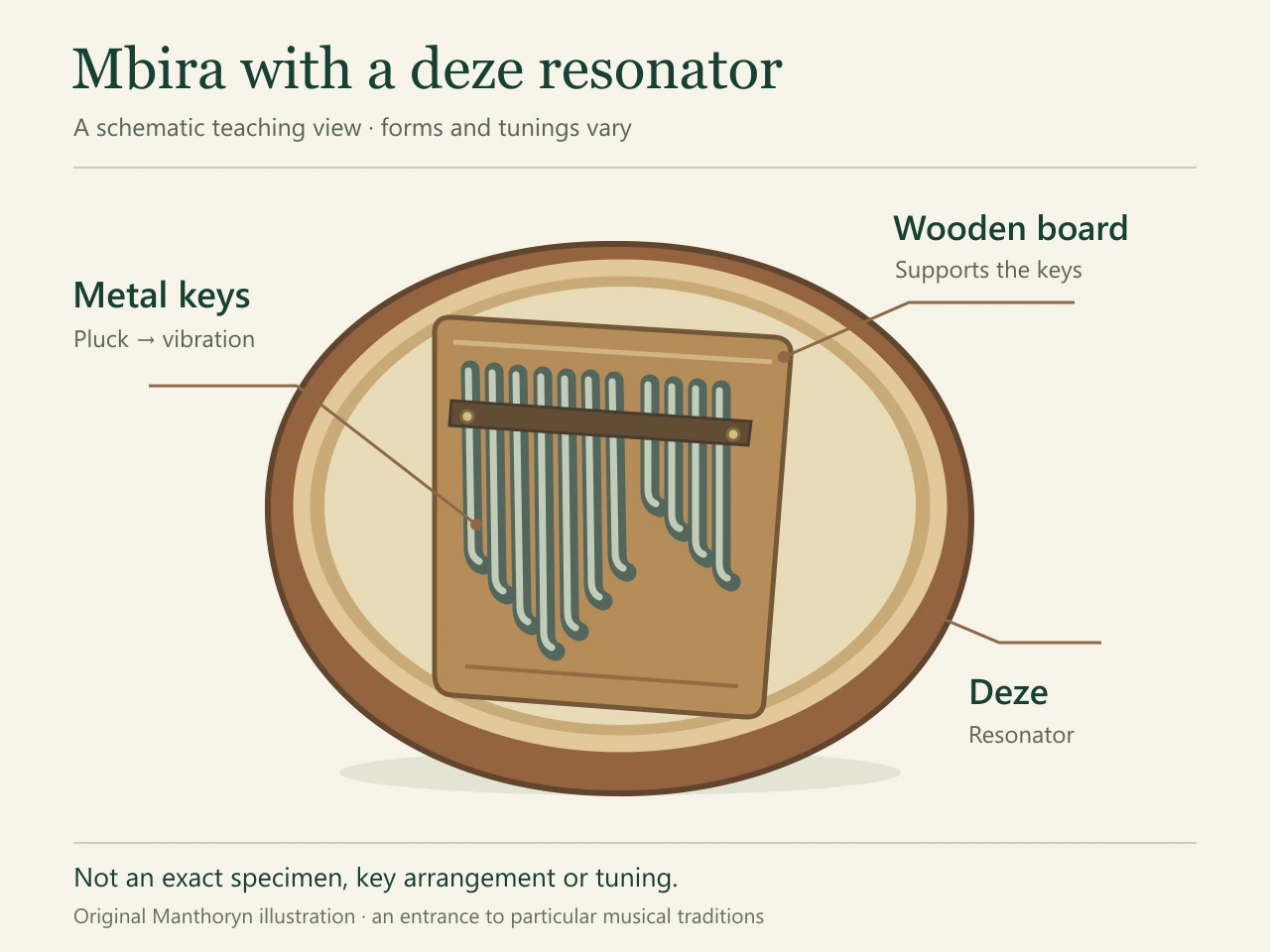
Original educational schematic of an mbira with a deze resonator. This is not a documentary photograph, an exact specimen, a tuning chart or a universal design for all mbira and related instruments. Forms, key arrangements and musical traditions vary.
Manthoryn original educational illustration, CC BY 4.0. SVG master and proportionally rasterized WebP renditions. CC BY 4.0 ↗ · Image source ↗
A few details change the picture.
A key moves, then vibrates
The Australian Museum describes metal strips secured to an instrument body and plucked by the player. Releasing a displaced key lets it vibrate. In a comparable set of keys, different lengths help produce different pitches; length is not a complete tuning rule independent of material and construction. [1]
This gives a useful first distinction: the key is both something a finger acts on and a part that produces a sound. Its visible shape is connected to a physical action rather than being a decorative label for a note. [4]
The instrument has a setting
UNESCO describes a wooden board with metal keys, sometimes mounted with a calabash or wooden resonator. Our labelled schematic pairs metal keys and a surrounding deze; it is not a photograph of a particular mbira dzavadzimu. That surrounding body belongs in the image because the instrument should not be reduced to an isolated row of keys. [2]
A catalogue example can help us look carefully at a particular object, but it cannot stand for every form. Instruments differ in key arrangement, material, resonating body and local name. “Thumb piano” is an accessible label, not proof that it uses the layout or musical conventions of a piano. [1]
A pattern is not just a list of fixed frequencies
The practitioner organisation MBIRA describes tuning differences among mbira dzavadzimu instruments. It notes that a piece can be recognised through its pattern of key strokes even when instruments use different intervals. Musical identity cannot always be reduced to one standard set of equal-tempered pitches. [3]
That observation changes what a beginner might listen for: a recurring relationship among gestures and sounds, rather than a hunt for a single correct translation onto a familiar keyboard. It does not imply that tuning is arbitrary or unimportant to players. [3]
Repetition can make room for relationships
UNESCO’s account describes the music as cyclical and links the practice with community communication and social meaning. A repeated pattern can offer a returning frame within which musical relationships are heard. A short written description cannot replace listening to practitioners explain those relationships. [2]
The University of Washington collection situates mbira dzavadzimu within a wider Southern African family of lamellaphones. That family resemblance is useful for studying an acoustic principle, while specific names and traditions keep cultural differences visible. [4]
Keep the players in the explanation
The mechanism of a vibrating key is only one part of the answer. People craft, tune, teach, perform and recognise pieces within particular practices. An explanation that stops at metal and wood would miss what makes this an instrument rather than simply an object that rings. [3]
Enjoy the complete instrument in its resonator, then ask which patterns a player hears and how another player learns them. No recording, performance, ceremonial claim or tuning chart is invented here; this is an entrance into further listening and cultural understanding. [4]
Questions this story opens
What determines the pitch of a plucked metal tongue?
A deeper acoustic explanation is not yet supplied by a current published CEL gateway. Specific tuning traditions require their own sources and practitioner context.
Plant a Seed for this question →Sources & image notes.
Facts are tied to the references below. This is a source-checked editorial discovery, rather than an assessment or a claim of independent expert review.
- Mbira — Thumb Piano of Africa ↗
Australian Museum. Plucked metal keys, varied forms, length/pitch relationship under comparable construction and diverse uses; no universal age/tuning claim.
Checked 2026-11-17. - Art of crafting and playing Mbira/Sansi in Malawi and Zimbabwe ↗
UNESCO Intangible Cultural Heritage. Wooden board/metal keys, optional resonator, cyclical music and community meaning; official indexed record/video description inspected, direct page challenged.
Checked 2026-11-17. - The Mbira Instrument ↗
MBIRA. Practitioner explanation of mbira dzavadzimu tuning variation and musical identity; official indexed passage inspected, direct endpoint unavailable.
Checked 2026-11-17. - Mbira Dzavadzimu357 ↗
University of Washington Ethnomusicology Musical Instrument Collection. Lamellaphone classification, supported keys and particular instrument identity; official indexed catalogue description inspected, interactive view requires JavaScript.
Checked 2026-11-17.
Image provenance and modifications
Some collection cards show a labelled detail crop. The full image above retains its source framing.
Illustration
Original educational schematic of an mbira with a deze resonator. This is not a documentary photograph, an exact specimen, a tuning chart or a universal design for all mbira and related instruments. Forms, key arrangements and musical traditions vary.
Manthoryn original educational illustration, CC BY 4.0. SVG master and proportionally rasterized WebP renditions.
Creator/publisher: Original Manthoryn educational illustration / Manthoryn.
Source record · Original image · Original code-native educational illustration released under Creative Commons Attribution 4.0 International. No third-party photograph, ancient inscription or instrument artwork was copied.
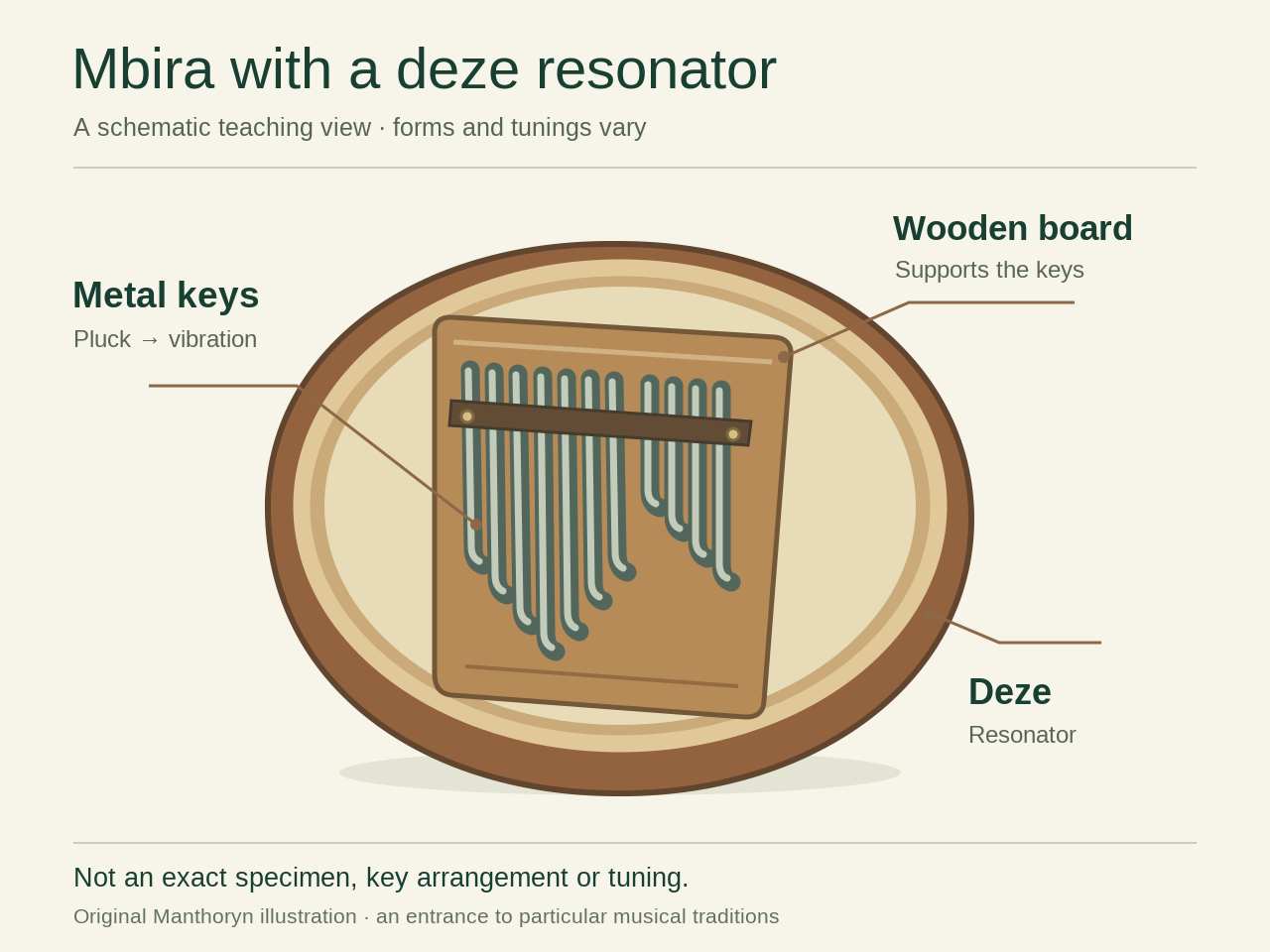
Changes: Original vector artwork, proportionally rasterized to 640px and 1280px WebP. Complete frame retained, no crop or stretching. This is a labelled illustration, not alteration or reconstruction of a documentary photograph.
Rights/source metadata checked 2026-11-17. Images identify the object or work; factual claims rely on the editorial references.
Discovery entry.ce1-mbira · revision 1.0.0. Raise a content or image concern →. This prepares a local note; no report is delivered.