Vermeer: a room arranged around light
Let your eye move from the window to the cloth, the pitcher and back again.
Set your eyes first on the pitcher. A small note of light on its metal makes the object visible against a busy cloth. Now look toward the window. The picture is not a picture of two unrelated bright things. Johannes Vermeer places the woman between them, with one hand by the sash and the other at the pitcher. Light and arrangement give your eye reasons to travel. [1][2]
The complete painting is Young Woman with a Water Pitcher, made around 1662. The reading below is one way to look at its balance of shapes and brightness. A different viewer might enter the picture through the red cloth or the map on the wall first. [1][2]
← Explore Painting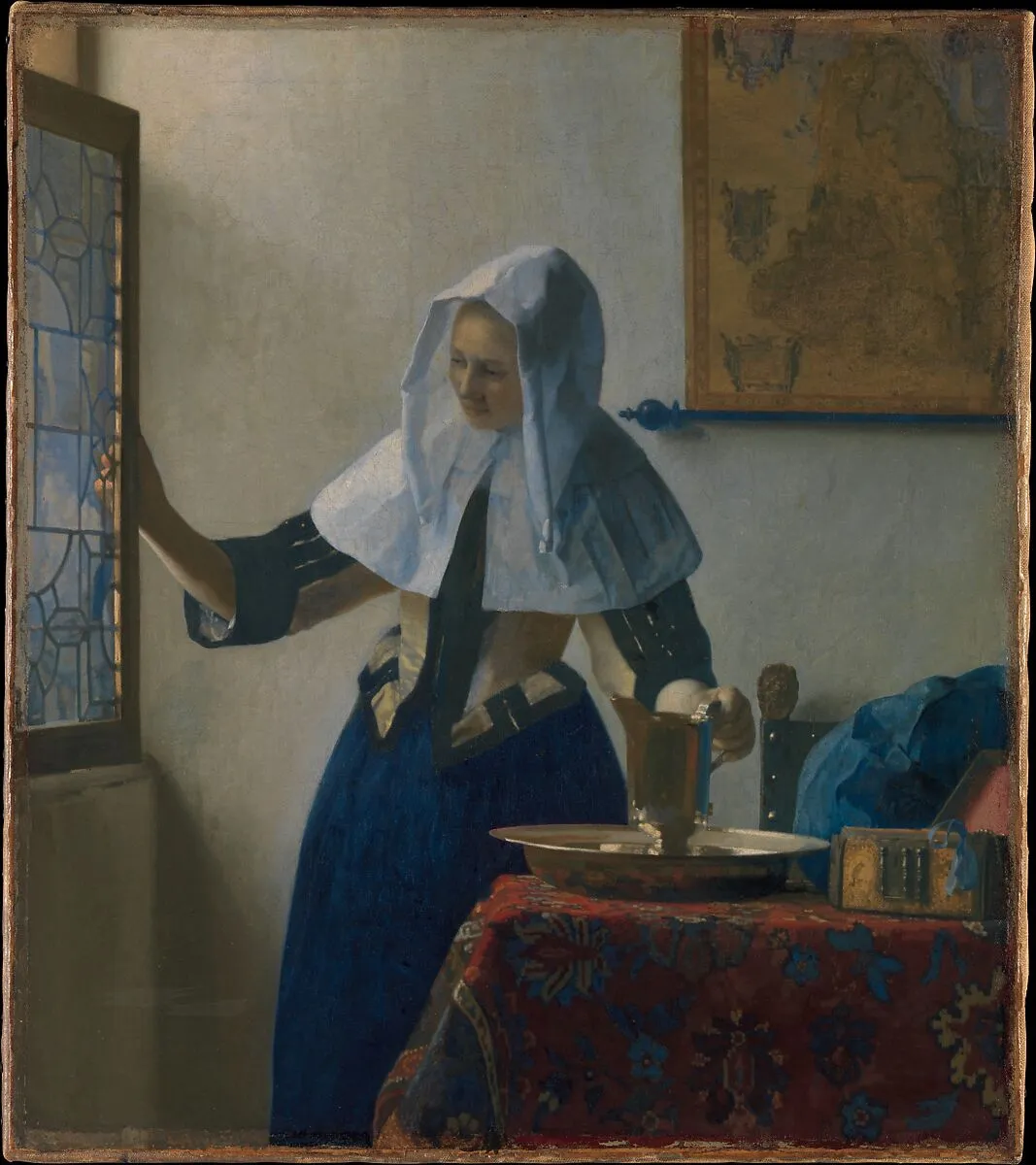
Johannes Vermeer, Young Woman with a Water Pitcher, ca. 1662. Oil on canvas. The Metropolitan Museum of Art, 89.15.21. Public Domain, Met Open Access.
Johannes Vermeer. The Metropolitan Museum of Art, Marquand Collection, Gift of Henry G. Marquand, 1889. 89.15.21. Public Domain (CC0). Public domain / CC0 ↗ · Image source ↗
A few details change the picture.
Notice where the light seems to come from
The light near the window and the faint shadows on the white covering are not a single flat color. The Met’s teaching guide draws attention to changes in warm and cool tones. Look how the folds show form even where the cloth remains relatively pale. A modest color difference can do more than a heavy outline. [2]
Let the gesture bridge two shapes
The tall window makes a strong boundary on one side. The extended arm leads into the figure, and the second hand brings the pitcher into the same scene. This is one possible path around the composition. It describes relations within the painting rather than proving that Vermeer wanted every eye to move in one direction. [1][2]
Compare the quiet wall and the busy cloth
There is much to inspect in the rug, basin and small box, but the broad wall lets those objects occupy the foreground without covering the whole view in equal detail. The dark rectangle of the map also changes the value of the pale wall around it. A shape can contribute to the room’s balance without becoming the center of the pictured action. [1][2]
Try a second first look
Start again at the cloth and see if you reach the pitcher as quickly. Then compare what happens near the light face and the edges of the map. A useful interpretation lets you point to something another person can inspect, even if their reading differs. Painted choices give us evidence to discuss, without giving us direct access to the sitter’s thoughts or the painter’s intentions. [1][2]
Keep a little curiosity.
Enjoying a discovery is enough. These optional questions may become a deeper investigation.
How would the scene feel different if the room were shown in even light?
This asks about visible relationships and interpretation, not a known alternate painting or a claim about the artist’s intent.
A complete CEL answer is not published yet.
Plant a Seed for this question →Sources & image notes.
Facts are tied to the references below. This is a source-checked editorial discovery, rather than an assessment or a claim of independent expert review.
- Young Woman with a Water Pitcher ↗
The Metropolitan Museum of Art. Exact Vermeer painting ca. 1662. Accession 89.15.21. Catalogue account of the figure, window, objects and domestic scene. Public Domain image.
Checked 2026-11-17. - Looking to Connect with European Paintings: Visual Approaches for Teaching in the Galleries ↗
The Metropolitan Museum of Art. Vermeer illumination chapter, 83–85: hue and tonal shifts on cloth, metal, wall and head covering; painted details and curatorial interpretation distinguished.
Checked 2026-11-17.
Image provenance and modifications
Some collection cards show a labelled detail crop. The full image above retains its source framing.
Artwork reproduction
Johannes Vermeer, Young Woman with a Water Pitcher, ca. 1662. Oil on canvas. The Metropolitan Museum of Art, 89.15.21. Public Domain, Met Open Access.
Johannes Vermeer. The Metropolitan Museum of Art, Marquand Collection, Gift of Henry G. Marquand, 1889. 89.15.21. Public Domain (CC0).
Creator/publisher: Johannes Vermeer / The Metropolitan Museum of Art.
Source record · Original image · The linked exact artwork record marks this museum image Public Domain. The Metropolitan Museum of Art makes its designated public-domain artwork images available under CC0.
Changes: Institutional JPEG retained in the source archive. Full image converted to WebP at two widths without cropping, rotation or recoloring.
Rights/source metadata checked 2026-11-17. Images identify the object or work; factual claims rely on the editorial references.
Discovery entry.ce3-music-arts-vermeer-water-pitcher · revision 1.0.0. Raise a content or image concern →. This prepares a local note; no report is delivered.